
Hanoi to launch portal to ease hurdles for tech businesses

Hanoi is plans an online portal and inter-agency task force to streamline case handling and address impediments facing science and technology enterprises, innovative startups and digital technology businesses.
On the afternoon of September 30, Hanoi People’s Committee assigned Hanoi Department of Science and Technology to lead, in coordination with the Hanoi Association of Small and Medium Enterprises, a conference on addressing bottlenecks faced by sci-tech enterprises, innovative startups and digital technology businesses.
The conference focused on difficulties in investment, production and business activities, market development and access to resources, with the aim of expanding production capacity, increasing revenues and opening up export markets within the fourth quarter of this year.
According to information shared by Hanoi Department of Science and Technology at the event, the capital currently has 226 sci-tech enterprises, more than 1,000 innovative startups and 10,996 digital technology enterprises.
In the first six months of the year, the digital economy was estimated to account for 16.7 per cent of the city’s regional GDP. The Hanoi Technology Exchange has attracted 221 technologies and 233 businesses to participate in technology matching and networking activities.
Access to capital for technological innovation remains a major hindrance, as research and development costs are incurred before revenue is generated. Of the 21 recommendations in this area, nine have been resolved.
Hanoi has announced 30 major challenges for 2026-2030, inviting businesses to propose solutions and providing mechanisms for the city to become an early customer for products developed by local enterprises. The city also has a mechanism to support up to 50 per cent of the costs of exporting digital technology products and services.
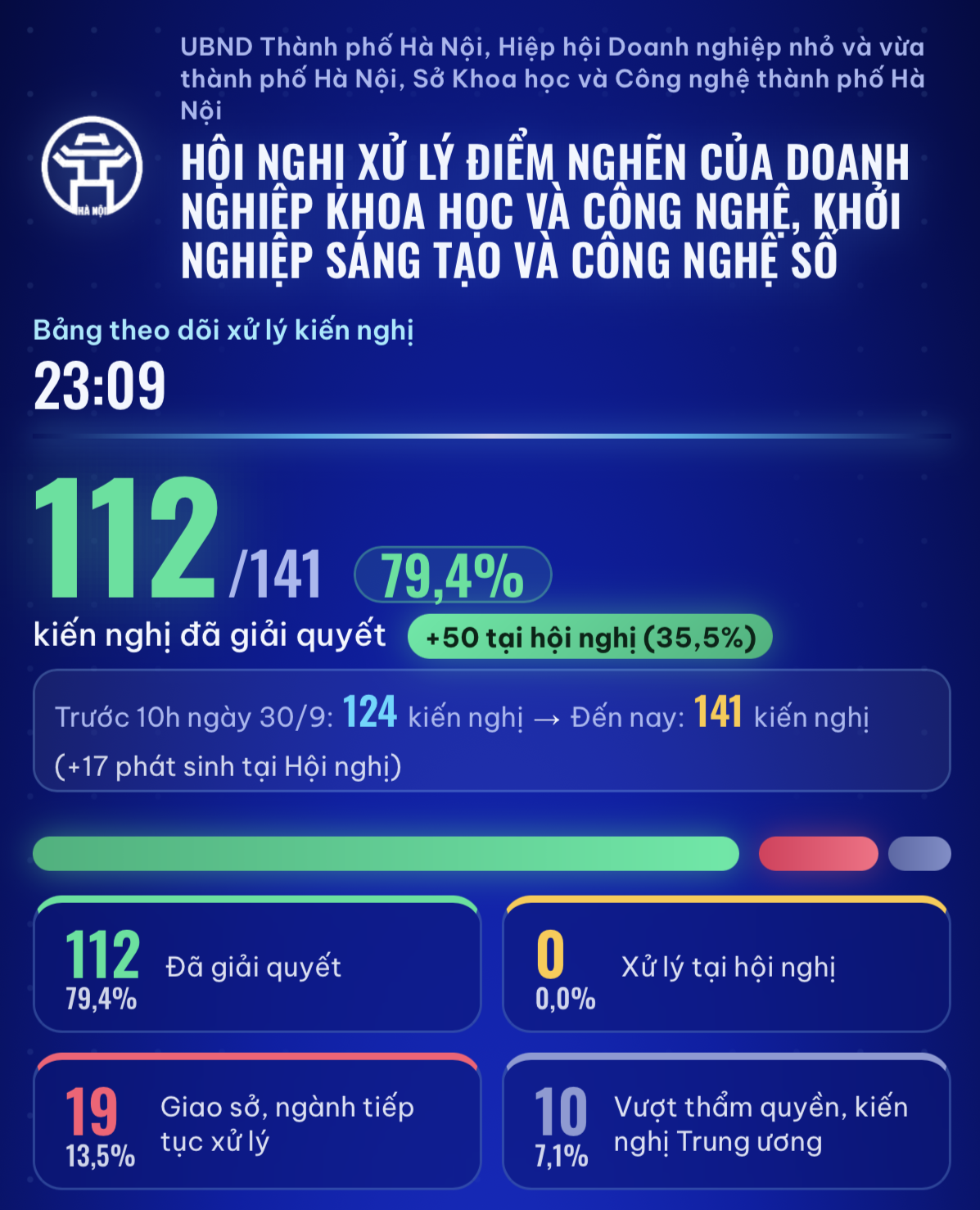 |
| 112 of the 141 recommendations have been resolved. Photo: Ha Vy |
Testing capabilities and research infrastructure are being addressed in parallel with market expansion. This group comprises 14 recommendations, of which eight have been resolved. Hanoi has issued a list of priority sectors for controlled testing under Decision No.3994/QD-UBND, together with streamlined procedures and support mechanisms under Resolution 26. Under Resolution No.25/2026/NQ-HDND, private-sector laboratories are eligible for support of up to 30 per cent of the cost of new investment or upgrading, as well as 30 per cent of operating costs during their first three years.
In the areas of data and digital transformation, 15 of the 24 recommendations have been resolved. Resolution No.59/2026/NQ-HDND provides support for small and medium-sized enterprises and household businesses to cover the costs of using digital transformation solutions included in the list approved by the city. Technology enterprises can register their products for inclusion in the list, thereby opening up additional market opportunities. Hanoi also has a mechanism for sharing public and private data on a contractual basis.
The group covering human resources and linkages with research institutes and universities has seven recommendations, of which four have been resolved. The city is implementing cooperation among the government, educational institutions and businesses to train semiconductor talent under Plan No.212/KH-UBND, together with technology transfer support mechanisms under Resolution No.24/2026/NQ-HDND.
Of the remaining 62 recommendations, 25 require direction from city leaders at the conference; 31 require further study and proposals from departments and agencies; while six fall beyond the city’s authority and will be consolidated for submission to central ministries and agencies.
Drawing on the 124 recommendations received ahead of the conference, Truong Viet Dung, Vice Chairman of Hanoi People’s Committee, identified a broader issue beyond individual obstructions.
“The city’s policy tools have not yet been connected into a seamless pathway from policy to businesses, from technology to markets, and from public resources to outcomes,” he said. “Hanoi has introduced many policies, but their implementation, communication and support for businesses in accessing them remain limited. Simply publishing documents on the information portal and waiting for businesses to find and study them on their own is not enough for policies to achieve their intended impact.”
 |
| Truong Viet Dung, Vice Chairman of Hanoi People’s Committee. Photo: Ha Vy |
“Policies must proactively reach the right target groups,” Dung said, assigning Hanoi Department of Science and Technology to lead the work and complete, by November 30, the design of policy pathways aligned with the life cycles of businesses and technologies.
“Each pathway must enable businesses to identify where they are, which tools they should use, who can provide guidance, what documents are required, how long it will take to obtain a result, and what value the outcome is expected to create,” he said. “The pathways need to clearly map out the support journey for science and technology tasks; technological innovation, research and development and shared infrastructure; innovative startups; controlled testing; technology commercialisation and transactions; and access to capital and investment.”
“The requirement is to identify groups of businesses with specific needs, provide information, invite and guide them, and monitor their access process. Given limited human resources, government agencies can initially focus on specific groups, deliver tangible results and thereby strengthen the confidence of businesses and investors,” he added.
At the conference, Cu Ngoc Trang, director of Hanoi Department of Science and Technology, proposed establishing a grievance portal for sci-tech enterprises, innovative startups and digital technology businesses as an online channel for dialogue.
“Businesses could submit dossiers and supporting documents online for issues involving taxation, land or preferential policies, reducing the need to provide the same documents multiple times,” Trang said. “The department will seek to connect the portal with tax, social insurance and customs authorities, as well as the city’s departments and agencies, to gradually enable more transparent online processing. This would also make it clearer what the specific issue is and which agency is responsible for addressing it.”
 | Vietnam infrastructure push drives demand for advanced technologies Vietnam's accelerating infrastructure push is driving demand for advanced machinery, digital solutions, and greener technologies across construction, transport, mining, and energy. |
 | Vietnam pushes digital finance into tangible gains On September 24 in Hanoi, the Ministry of Finance, together with other agencies, organised Vietnam Digital Finance 2026 under the theme “Powering an intelligent, secure, connected, and sustainable digital financial ecosystem." |
What the stars mean:
★ Poor ★ ★ Promising ★★★ Good ★★★★ Very good ★★★★★ Exceptional
 Tag:
Tag:
Related Contents




Latest News






More News
- EFTA–Vietnam Free Trade Agreement opens up opportunities to enhance supply chain (October 20, 2026 | 15:56)
- Dong Thap province steps up industrial expansion and infrastructure connectivity (October 19, 2026 | 08:56)
- Vung Ang LNG Terminal looks for candidates for $1 billion EPC contract (October 16, 2026 | 17:53)
- Work on digital technology building begins in Hanoi (October 16, 2026 | 17:46)
- Vietnam CFA showcase highlights $120m funding need for climate ventures (October 16, 2026 | 17:14)
- Long-delayed LNG power projects may be replaced in revised PDP VIII (October 14, 2026 | 11:59)
- Foreign investors seeking a synchronised manufacturing ecosystem (October 14, 2026 | 11:51)
- Localities report breakthrough results in FDI in first nine months (October 14, 2026 | 11:45)
- Why Asian FDI is flowing into northern Vietnam’s industrial parks (October 14, 2026 | 09:03)
- Hung Yen unveils adjusted master plan with three economic zones (October 13, 2026 | 11:30)










 Mobile Version