
Global supply chain restructuring presents new opportunities for logistics sector

According to Phan Thi Thang, Deputy Minister of Industry and Trade, geopolitical uncertainties, coupled with shifts in investment flows, digital transformation, and the green transition, are fundamentally reshaping the global trade landscape.
"Global supply chains are no longer operating under the traditional centralised model. Instead, they are becoming increasingly diversified to enhance resilience against market disruptions. This presents both challenges and opportunities for countries with strategic locations, stable investment environments, and strong manufacturing capabilities," Thang said at a logistics forum on global supply chain restructuring in Ho Chi Minh City on July 24.
"For Vietnam, this is a critical opportunity to leverage its geostrategic location, extensive network of free trade agreements, and an increasingly attractive investment environment to attract shifting investment flows, expand manufacturing, and diversify export markets," Thang said.
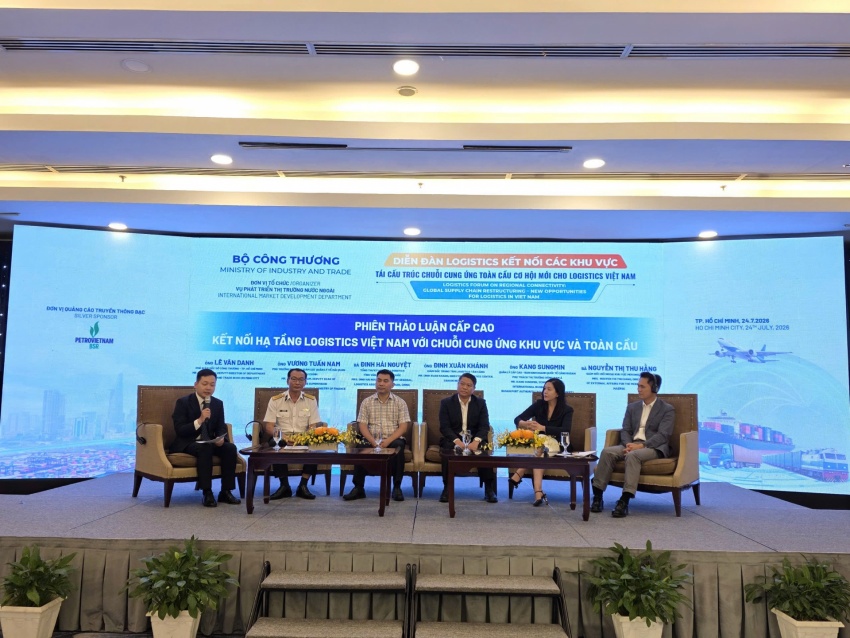 |
| Experts discuss matters at the logistics forum on global supply chain restructuring in Ho Chi Minh City on July 24 |
According to the Ministry of Industry and Trade, the country's economic growth targets for the coming period will place significant demands on import and export activities. The government is aiming for annual economic growth of at least 10 per cent, with trade identified as one of the key growth drivers and export growth targeted at 15–16 per cent.
Despite ongoing global economic uncertainties, Vietnam's trade performance remained resilient in the first half of 2026, reflecting the adaptability of the country's manufacturing and export sectors within regional and global supply chains. However, the continued expansion of trade volumes also requires the logistics sector to scale up accordingly to meet growing demand for the efficient movement of goods.
"Logistics capabilities determine not only the speed of goods movement but also a country's ability to attract investment, expand markets, and strengthen its position in global supply chains," Thang said. "This is why the Vietnam Logistics Services Development Strategy sets targets of increasing the sector's value-added contribution to 5–7 per cent of GDP, achieving annual growth of 12–15 per cent, and reducing logistics costs to 12–15 per cent of GDP from the current level of around 17 per cent."
Nguyen Loc Ha, Standing Vice Chairman of Ho Chi Minh City People's Committee, said the ongoing restructuring of global supply chains is creating significant growth opportunities for the city.
“Ho Chi Minh City is well positioned to develop into an international logistics services centre, serving as a key gateway for coordinating and connecting regional and global supply chains. The city's expanded development space also provides stronger conditions for building a highly integrated logistics ecosystem, spanning transport infrastructure, logistics hubs, and value-added services,” Ha said.
He added that to capitalise on these advantages, the city has identified four strategic priorities: developing a modern, integrated logistics infrastructure with strong regional connectivity; accelerating digital transformation to improve supply chain transparency; promoting green logistics in line with evolving international standards; and strengthening the logistics workforce while developing a high value-added logistics services ecosystem.
"Logistics is inherently a highly regional industry, and no locality can develop it in isolation. Ho Chi Minh City is therefore seeking to strengthen cooperation with ministries, sectors, and neighbouring localities in planning and investing in transport corridors and logistics hubs, sharing data, and encouraging businesses to shift from competing individually to collaborating in order to enhance the competitiveness of the entire supply chain," Ha said.
While Ho Chi Minh City is expected to emerge as the supply chain coordination hub for southern Vietnam, Quang Tri and Haiphong are well positioned, thanks to their strategic locations and transport infrastructure, to develop large-scale logistics hubs and strengthen their integration into regional and global supply chains.
Le Duc Tien, Vice Chairman of Quang Tri People's Committee, said the province sits at the intersection of the East-West Economic Corridor and Vietnam's North-South transport corridor, while also serving as the closest gateway linking the Greater Mekong Subregion to the East Sea and international shipping routes. This strategic location provides Quang Tri with a significant advantage in integrating more deeply into regional logistics networks.
"Quang Tri's development strategy is to create a new growth space where transport infrastructure is closely integrated with logistics, industry, trade, and services, enabling goods to be transshipped and stored, processed, and upgraded through value-added activities," Tien said.
Meanwhile, Haiphong continues to strengthen its position as northern Vietnam's logistics gateway, supported by an increasingly advanced seaport system and integrated transport infrastructure.
Pham Tuan Hai, deputy director of Haiphong Department of Industry and Trade, said the growing emphasis on green logistics, green ports, and digital transformation is creating both opportunities and challenges for major maritime hubs.
"As northern Vietnam's largest maritime gateway, with all five modes of transport and a strategic location along two international economic corridors, Haiphong has a strong foundation to develop into an international logistics and seaport hub," Hai said.
In recent years, the city's logistics infrastructure has expanded rapidly. Its port system, comprising the Lach Huyen deepwater port and 50 port terminals, has a combined handling capacity of around 170–180 million tonnes annually. Container throughput capacity has reached 7.5–8 million TEUs per year, accounting for nearly 40 per cent of Vietnam's total container volume.
At the same time, Cat Bi International Airport is undergoing further upgrades, while an expanding expressway network and major transport infrastructure projects are helping to reduce transit times and strengthen regional connectivity.
According to Hai, one of Haiphong's key priorities is to accelerate both digital and green transformation. The city plans to develop digital ports and digital logistics systems by applying AI, big data, and automation to logistics management, while establishing a shared data platform linking ports, businesses, and government agencies.
In parallel, Haiphong is promoting the development of green ports, green logistics, and clean energy infrastructure. The city is also investing in internationally qualified human resources and strengthening regional cooperation to build a modern, integrated, and globally competitive logistics network.
What the stars mean:
★ Poor ★ ★ Promising ★★★ Good ★★★★ Very good ★★★★★ Exceptional
 Tag:
Tag:Related Contents

Latest News


More News
- Work on digital technology building begins in Hanoi (October 16, 2026 | 17:46)
- Vietnam CFA showcase highlights $120m funding need for climate ventures (October 16, 2026 | 17:14)
- Long-delayed LNG power projects may be replaced in revised PDP VIII (October 14, 2026 | 11:59)
- Foreign investors seeking a synchronised manufacturing ecosystem (October 14, 2026 | 11:51)
- Localities report breakthrough results in FDI in first nine months (October 14, 2026 | 11:45)
- Why Asian FDI is flowing into northern Vietnam’s industrial parks (October 14, 2026 | 09:03)
- Hung Yen unveils adjusted master plan with three economic zones (October 13, 2026 | 11:30)
- Ho Chi Minh City climbs 17 places in Global Financial Centres Index (October 13, 2026 | 11:27)
- Quang Tri province to tighten delayed power projects (October 13, 2026 | 10:34)
- $600 million Ho Chi Minh City - Long Thanh expressway expansion under pressure (October 09, 2026 | 16:00)









 Mobile Version