
FDI drives nearly half of formal jobs for women in Vietnam, OECD says

 |
| Photo: baodautu.vn |
The report, released on June 25, noted that Vietnam's economic transformation and rapid industrialisation have attracted significant foreign direct investment since the late 1980s. An abundant and low-cost labour force has positioned the country as an attractive destination for foreign investors.
In addition, targeted policy initiatives to ensure equal access to education has helped supply a high-quality labour force of both men and women. Vietnam now boasts one of the highest rates in the world for women’s labour force participation.
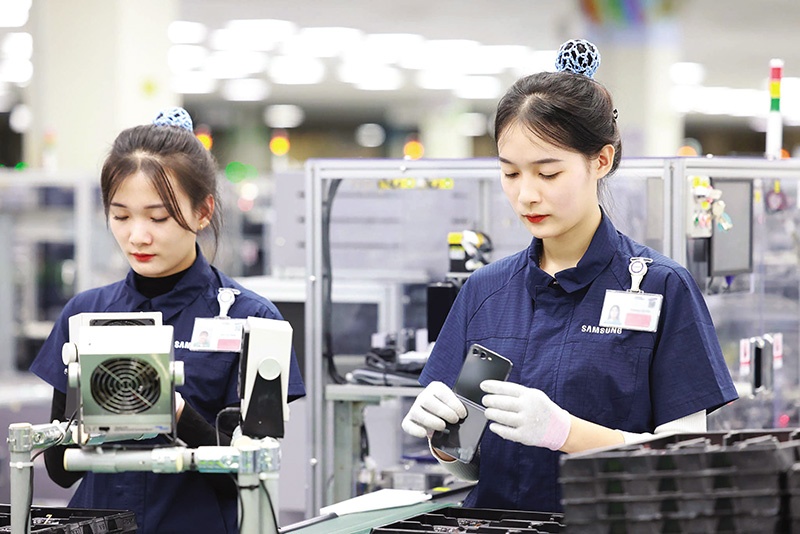
Against this background, foreign multinational enterprises (MNEs) played an increasingly significant role in generating female employment, with nearly one in two women in formal employment working for an MNE.
Growing foreign direct investment (FDI) in the manufacturing sector has been a key driver of female employment, particularly in leather- and garment-making, and in the fast-growing electronics sector. Around 90 per cent of female workers at foreign firms are engaged in manufacturing.
Although services sectors represent a smaller share of female employment at foreign firms, their contribution is steadily growing. On average, foreign firms have higher shares of female employees than domestic peers in all sectors of the economy except mining and quarrying, electricity generation, and water and waste management.
While foreign firms serve as key employers of women, the quality of job opportunities they provide remains low, with limited career progression, particularly in male-dominated sectors. While women have a significant presence at foreign firms, and particularly in the manufacturing sector, they remain significantly underrepresented in management and ownership roles in comparison to domestic firms. Foreign firms are half as likely to have a female top manager or owner as domestic firms.
On average, foreign firms pay higher wages than their domestic peers across all sectors, but such foreign wage premiums are highest in male-dominated sectors and tend to be lower in sectors with higher representation of women. In the manufacturing sector, foreign firms pay on average 20 per cent higher wages than domestic firms, in comparison to around 155 per cent higher in the male-dominated construction sector and 194 per cent in mining and quarrying.
The uneven geographical distribution of FDI may also aggravate gender disparities, as foreign-invested enterprises tend to locate themselves in urban centres, leaving women in rural areas with fewer opportunities to benefit from FDI, while at the same time creating social costs to those choosing to migrate and seize those opportunities.
According to OECD, there is room to channel FDI to sectors with untapped potential for increasing women’s employment and job quality. This includes certain service sectors such as education and health and social work, financial, banking and insurance activities, information and communication, and accommodation and food services. Strengthening women’s skills will enable them to meet industry needs in key FDI sectors, such as digital and high-tech technologies or green sectors.
Vietnam is progressively integrating gender considerations into its policy and institutional framework, but challenges remain. Enhancing the impact of FDI on gender equality requires a conducive policy and institutional framework, particularly as Vietnam seeks to attract investment in knowledge-intensive and higher value-added sectors, where women’s potential remains untapped.
Encouragingly, Vietnam has shown commitment in incorporating women’s economic empowerment in national strategies and plans, but the role of FDI in advancing gender equality could be more clearly defined. Similarly, gender considerations remain absent from certain horizontal strategies and plans, such as strategies documents addressing the digital transformation.
In addition, co-ordination between bodies responsible for investment and gender equality, namely the Ministry of Finance and the Ministry of Home Affairs, could be strengthened to ensure that investment promotion and facilitation efforts seek to address, rather than exacerbate, gender disparities. Tax incentives aimed at increasing women’s participation in certain sectors may disqualify many firms due to complex conditions, within a broader incentive framework that is already intricate for foreign investors to navigate.
Vietnam has demonstrated strong commitment in creating a conducive legal framework for women’s economic participation. For instance, the Law on Gender Equality of 2006 establishes the principle of gender equality across various domains, such as education, employment and family life. Women’s economic participation is reflected in other key laws and regulations, including the Labour Code of 2019 and its subsequent revisions.
While Vietnam has a conducive legal framework for women’s employment, compliance with domestic laws could be strengthened, including among foreign firms. In addition, social institutions (i.e. informal laws, social norms and practices) perpetuate traditional gender roles and continue to shape women’s education and career decisions.
Vietnam is a signatory to two international investment and trade agreements that include provisions encouraging a positive contribution of FDI to gender equality. The Comprehensive and Progressive Agreement for Trans-Pacific Partnership free trade agreement includes provisions to encourage parties to co-operate on the skills development programmes of women and adopt domestic regulations and practices towards the elimination of gender discrimination in employment.
The EU-Vietnam Free Trade Agreement includes provisions that call on parties to fulfil their obligations under the International Labour Organisation Declaration, including on the elimination of gender discrimination in employment. While positive, the provisions have little to no binding force.
“Moving forward, Vietnam is encouraged to favour provisions that envisage, more clearly, the contribution of FDI in the advancement of gender equality, and allow for some degree of enforceability,” OECD noted.
 | Hanoi symposium highlights gender equality research and policy An international scientific conference on gender equality and female empowerment was held in Hanoi, bringing together Vietnamese and international experts. |
 | Experts highlight unpaid care work as key barrier to gender equality Vietnam’s push for gender equality is hindered by a persistent blind spot: unpaid care work, which limits women’s participation in the workforce. |
 | Canada pledges $81 million for initiatives in Vietnam Canada has committed $81.43 million in development funding to support initiatives in Vietnam, focusing on climate action, inclusive institutions and economic empowerment for vulnerable groups. |
What the stars mean:
★ Poor ★ ★ Promising ★★★ Good ★★★★ Very good ★★★★★ Exceptional
 Tag:
Tag:
Related Contents





Latest News

More News
- Vietnam’s registered FDI surpasses $50 billion in nine months (October 07, 2026 | 10:30)
- Samsung Electro-Mechanics to add $1.85 billion semiconductor investment in Thai Nguyen (October 06, 2026 | 18:23)
- Electronics funding will be won via a capable ecosystem: SGS (October 06, 2026 | 09:00)
- LNG power plant projects risk falling behind schedule (October 03, 2026 | 09:00)
- Pandora opens world’s largest fine jewellery crafting facility (October 02, 2026 | 22:21)
- An Phat 5 Industrial Park positions for new wave of investment in northern Vietnam (October 02, 2026 | 09:00)
- Hanoi to launch portal to ease hurdles for tech businesses (October 01, 2026 | 09:00)
- Foreign investors to be widened for market access (September 30, 2026 | 17:54)
- Phu Quoc Airport planning adjusted to serve APEC 2027 (September 30, 2026 | 17:35)
- Nearly 200 foreign-invested enterprises in Vietnam to pay global minimum tax (September 30, 2026 | 17:26)


Latest News





 Mobile Version