
MoF outlines strategy to attract high-quality foreign resources

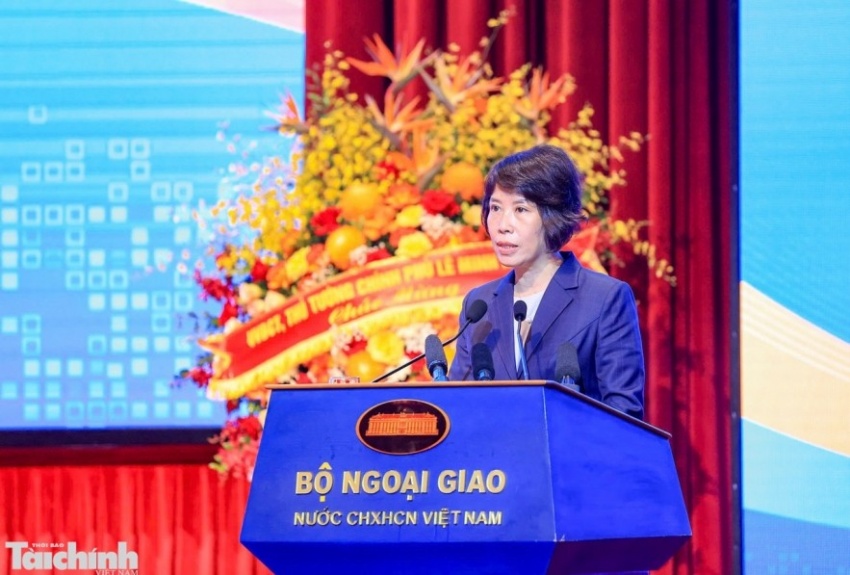 |
| Deputy Minister of Finance Nguyen Thi Bich Ngoc. Photo: Duc Thanh |
Addressing a plenary session titled on diplomacy, the deputy minister presented a keynote speech on priorities for mobilising external resources to support economic growth and the roles of the Ministry of Foreign Affairs (MoFA) and Vietnam's overseas representative missions.
Investors prioritise institutional quality
Deputy Minister Ngoc said the rapidly changing and increasingly complex global landscape has reshaped international capital flows, with investors placing greater emphasis on institutional quality, policy stability, and regulatory predictability, rather than relying solely on production costs or market size.
"International investors are now asking practical questions before committing capital: whether projects are ready for immediate investment, where financing will come from, how risks are allocated, whether mechanisms exist to hedge foreign exchange risks and facilitate exit, whether investor rights are adequately protected, and, importantly, whether authorities have the capacity to resolve implementation issues efficiently," she said.
In the view of the Ministry of Finance (MoF), Vietnam's challenge in the next development phase is not simply to attract more capital, but to answer three strategic questions: what types of external resources are needed to support the country's new growth model, which partners can enhance Vietnam's position in global value chains, and how external resources can be transformed into productivity, technological capability, competitiveness, and stronger domestic capacity.
She stated that Vietnam continues to demonstrate strong appeal to international investors. The country's stock market capitalisation rose to $414 billion, equivalent to approximately 82.3 per cent of 2025 GDP.
She also noted that FTSE Russell has announced a roadmap to upgrade Vietnam's stock market from frontier to secondary emerging market status, with the reclassification expected to take effect in September 2026. "The upgrade would provide an important foundation for expanding access to international capital through both direct and indirect investment channels," the deputy minister said.
However, she stressed that higher capital inflows did not automatically translate into better quality, stronger economic spillovers, or greater efficiency. Linkages between domestic and foreign-invested enterprises remain limited, while technology transfer and research and development activities have yet to meet expectations. The participation of Vietnamese businesses in global supply chains also remains modest, with investors continuing to pay close attention to workforce quality, supporting industries, and policy consistency.
Five strategic shifts in foreign investment
Deputy Minister Ngoc said the Politburo's Resolution No.10-NQ/TW on developing FDI sets out a new strategic direction, requiring several major shifts in attracting resources.
The first is moving from attracting capital alone to mobilising a broader combination of resources. Investment projects should be assessed not only by the size of committed capital, but also by their technology, value added, job quality, research and development capability, budget contribution, and linkages with domestic enterprises.
Second, Vietnam should move away from broad-based investment promotion towards a more selective approach by prioritising leading corporations and investors capable of developing industrial ecosystems, creating new markets, bringing core technologies, introducing advanced governance standards, and integrating Vietnam into global networks.
Third, investment incentives should gradually shift towards performance-based support. Government support policies should be tied to measurable commitments on technology transfer, research and development, workforce training, business linkages, environmental protection, and tangible contributions to the economy.
Fourth, Vietnam should transition from attracting individual projects to developing complete investment ecosystems. Strategic projects can only realise their full potential when supported by supplier networks, research centres, educational institutions, logistics infrastructure, and strong domestic enterprises.
Fifth, investment promotion should evolve into results-based investment management, with performance measured by the number of projects implemented, shorter preparation timelines, effective resolution of investor concerns, reinvestment levels, and technology transfer outcomes.
Building an international resource map
Looking ahead, the deputy minister said coordination between the MoF, the MoFA, and Vietnam's overseas representative offices should evolve from isolated investment promotion activities towards a systematic, data-driven, and results-oriented approach.
She proposed five key areas of cooperation.
The first is jointly developing an "international resource map" to support Vietnam's development strategy. The database should be regularly updated by country, region, and sector, tracking global supply chain shifts, multinational corporations planning overseas expansion, investment funds, financial institutions, outbound investment policies of partner countries, cooperation opportunities, and emerging trade, investment, and geopolitical risks.
Second, the two ministries should establish a database of target investors, including detailed profiles covering corporate strategies, key decision-makers, risk concerns, and the conditions required for investment disbursement in Vietnam.
Third, they should establish joint task forces for major investment transactions, particularly sovereign wealth funds, strategic foreign-invested projects, infrastructure funds, bond programmes, and financial institutions planning to operate in Vietnam's future international financial centres.
Fourth, overseas missions should strengthen their market intelligence and early warning functions by providing timely information on developments related to carbon pricing, technological regulations, export controls, and difficulties faced by investors.
Fifth, the MoF proposed expanding cooperation in financial, tax, and customs diplomacy. MoFA and Vietnam's overseas representative offices were encouraged to strengthen engagement with international financial institutions, investment funds, tax authorities, customs agencies, and market regulators in host countries.
Deputy Minister Ngoc noted that the effectiveness of economic diplomacy in the new era should no longer be measured by the number of meetings held or agreements signed, but by the volume of foreign currency and long-term capital mobilised for the economy, the number of international financial institutions operating in Vietnam, and the number of Vietnamese enterprises participating in global value chains.
"Diplomacy should not only open doors; it must also open capital flows, creating pathways for investment, technology, and development opportunities for Vietnam. For its part, the MoF is committed to working closely, substantively, and responsibly with the MoFA, Vietnam's overseas representative offices, ministries, sectors, and localities to transform potential into projects, meetings into commitments, and commitments into investment flows for national development," she said.
 | MoF highlights institutional reforms, fiscal management and investment mobilisation in first half of 2026 The Ministry of Finance has highlighted sweeping institutional reforms, strong fiscal management, accelerating public investment, and continued digital transformation as key achievements in the first half of 2026, while acknowledging that significant challenges remain in meeting the country's ambitious full-year growth target. |
 | Investment Support Fund Management Council reshuffled Deputy Prime Minister Nguyen Van Thang has signed Prime Ministerial Decision No.1392/QD-TTg, consolidating the membership of the Management Council of the Investment Support Fund. |
 | MoF minister outlines priorities for international integration to support growth Speaking at the opening session of the 33rd diplomatic conference in Hanoi on August 1, Minister of Finance Ngo Van Tuan presented the Ministry of Finance's strategy for advancing international economic integration and attracting foreign investment. |
What the stars mean:
★ Poor ★ ★ Promising ★★★ Good ★★★★ Very good ★★★★★ Exceptional
 Tag:
Tag:Related Contents


Latest News


More News
- Thanh Hoa urged to remove obstacles to Cong Thanh LNG project (October 23, 2026 | 10:14)
- Vietnam pledges transparent tax and customs policies for South Korean businesses (October 23, 2026 | 10:08)
- KUKA Vietnam inaugurates new Hanoi headquarters (October 22, 2026 | 09:00)
- OJI Group invests in $110 million aseptic carton packaging plant in Vietnam (October 22, 2026 | 08:23)
- EVN begins construction on the Quang Trach II LNG plant (October 22, 2026 | 07:00)
- Foreign investors pour billions into Vietnam's semiconductor sector (October 21, 2026 | 14:49)
- Hyosung TNC begins bio-BDO production in Vietnam (October 21, 2026 | 12:12)
- Ho Chi Minh City to unveil new projects worth $13.5 billion at AEF 2026 (October 21, 2026 | 11:51)
- Market upgrade is just the beginning: Vietnamese companies face tougher test to attract capital (October 20, 2026 | 16:04)
- EFTA–Vietnam Free Trade Agreement opens up opportunities to enhance supply chain (October 20, 2026 | 15:56)






 Mobile Version