
Eight major infrastructure projects break ground in Ho Chi Minh City

The groundbreaking took place on July 1 to mark the 50th anniversary of the city being officially renamed Ho Chi Minh City on July 2, 1976. The projects, excluding social housing developments, draw on funding from public investment, public-private partnerships (PPPs), and direct private capital.
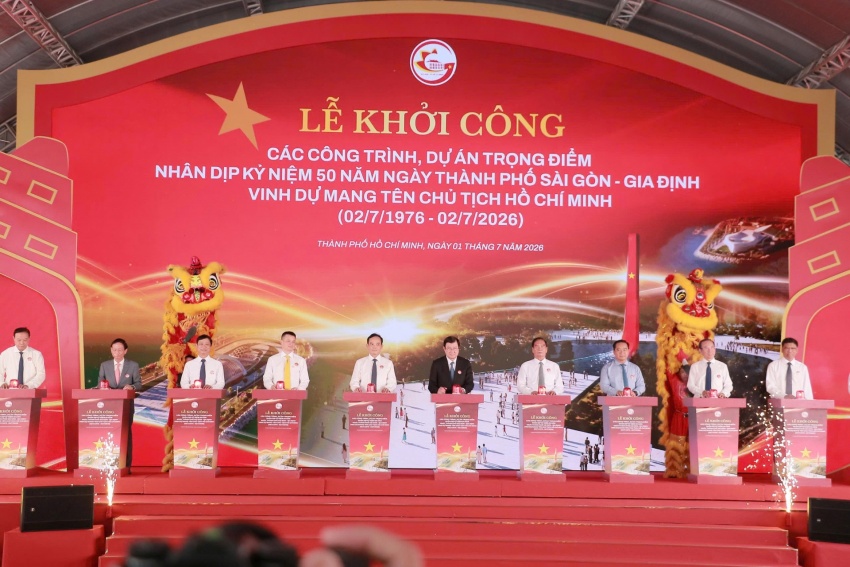 |
| Groundbreaking ceremony attended by Ho Chi Minh City People's Committee representatives and local officials |
The investment structure reflects the spirit of Politburo Resolution No.68-NQ/TW on private sector development under the guiding principle of the city’s committee: “Ho Chi Minh City for the whole country, and the whole country for Ho Chi Minh City.”
According to Hoang Nguyen Dinh, Vice Chairman of Ho Chi Minh City People's Committee, the eight groundbreaking projects represent strategic building blocks within the city's broader infrastructure development plan, supporting its vision of innovation and sustainable growth.
Among them, the most significant and symbolic is the Ben Nha Rong-Khanh Hoi Cultural Park and Bach Dang Riverside Public Green Space project, which commenced construction at the historic harbour where, 115 years ago, President Ho Chi Minh embarked on his journey to seek a path for Vietnam's national liberation.
Under the investment policy approved by Ho Chi Minh City People's Council, the project has a preliminary investment capital of nearly VND30 trillion ($1.15 billion) and will be implemented under a build-transfer contract within the PPP framework. Construction is scheduled to begin in 2026, with completion targeted for mid-2029.
The large-scale public infrastructure project will require approximately 73.3 hectares of land and water surface, encompassing parks, public squares, cultural spaces, heritage conservation facilities, green areas, sports amenities, commercial and service facilities, transport infrastructure, and other community-oriented public utilities.
“Once completed, the project will become a regional cultural, historical, and tourism landmark while addressing long-standing transport issues and creating a modern riverside urban landscape. More importantly, it will serve as a symbol connecting the past, present, and future, a place where Ho Chi Minh City's vibrant contemporary life converges with its rich historical heritage, preserving the nation's proud memories while embracing future development," Dinh said.
A key highlight of the project is the reconstruction of the 'Amiral Latouche-Tréville', the vessel associated with the historic departure of the young patriot Nguyen Tat Thanh from Nha Rong Wharf in 1911 on his journey to seek a path for Vietnam's national liberation. The reconstructed ship is planned to serve as a floating exhibition, tourism, and service venue, helping to preserve the site's historical and cultural significance while enhancing the city's tourism offering.
The project will also create an interconnected network of riverside green spaces and landscaped public areas, renovate existing structures such as steel-frame buildings and former warehouses, and develop a cruise passenger terminal, parking facilities, and supporting infrastructure. Together, these components will form a continuous waterfront park stretching from Ba Son to Bach Dang Wharf, Nha Rong Wharf, and Khanh Hoi.
Meanwhile, a series of strategic transport infrastructure projects is expected to generate new growth momentum for the city.
Ho Tram-Long Thanh Expressway, Can Gio-Vung Tau Sea Bridge, the Binh Tien bridge and road project, and interchanges linking to Ben Luc-Long Thanh Expressway are expected to ease major urban traffic issues while opening up new development corridors towards the coast, strengthening connectivity between Ho Chi Minh City, the Southern Key Economic Region, and Long Thanh International Airport.
At the same time, Ho Chi Minh City–Moc Bai Expressway will establish a vital northwestern transport corridor, enhancing overland connectivity between Vietnam and other ASEAN countries.
“The workload ahead is immense. The city's leadership calls on all municipal departments, agencies, and local administrations overseeing these projects to demonstrate the highest level of political responsibility and ensure there is absolutely no passing of responsibility, administrative delays, or reluctance in handling procedures. They must also take a proactive approach in resolving issues related to planning, site clearance, the relocation of technical infrastructure, and the supply of construction materials,” Dinh said
"Project developers, contractors, and investors are urged to mobilise maximum resources, machinery, and advanced technologies while implementing detailed and well-coordinated construction plans. They should work with the determination to overcome all weather conditions, accelerate construction to the greatest extent possible, deliver the highest quality standards, and ensure absolute workplace safety," he added.
 | Three major industry expos set to kick off in Ho Chi Minh City Three exhibitions focused on smart factories, hardware, and home products are set to take place in Ho Chi Minh City, bringing together nearly 500 enterprises. |
 | VIFC set to raise the bar for Ho Chi Minh City’s office market Vietnam's International Financial Centre is expected to add substantial office space to Ho Chi Minh City's market while raising competitive standards across the sector. |
 | Ho Chi Minh City to establish seven high-tech agricultural zones Ho Chi Minh City is set to establish seven high-tech agricultural zones, covering an area of 1,727 hectares, aiming to develop research centres and attract investment in modern agriculture. |
What the stars mean:
★ Poor ★ ★ Promising ★★★ Good ★★★★ Very good ★★★★★ Exceptional
 Tag:
Tag:Related Contents

Latest News

More News
- Vietnam’s registered FDI surpasses $50 billion in nine months (October 07, 2026 | 10:30)
- Samsung Electro-Mechanics to add $1.85 billion semiconductor investment in Thai Nguyen (October 06, 2026 | 18:23)
- Electronics funding will be won via a capable ecosystem: SGS (October 06, 2026 | 09:00)
- LNG power plant projects risk falling behind schedule (October 03, 2026 | 09:00)
- Pandora opens world’s largest fine jewellery crafting facility (October 02, 2026 | 22:21)
- An Phat 5 Industrial Park positions for new wave of investment in northern Vietnam (October 02, 2026 | 09:00)
- Hanoi to launch portal to ease hurdles for tech businesses (October 01, 2026 | 09:00)
- Foreign investors to be widened for market access (September 30, 2026 | 17:54)
- Phu Quoc Airport planning adjusted to serve APEC 2027 (September 30, 2026 | 17:35)
- Nearly 200 foreign-invested enterprises in Vietnam to pay global minimum tax (September 30, 2026 | 17:26)


Latest News



 Mobile Version