
Digital government push focuses on data connectivity and AI

In response to National Digital Transformation Day on October 10, the Vietnam National Digital Transformation Summit was held in Hanoi on the afternoon of October 9, focusing on solutions to translate digital transformation into practical improvements in public administration, enhance the quality of public services, and promote the application of emerging technologies in socioeconomic development.
The event was jointly organised by the National Digital Transformation Agency and the Vietnam Institute of Innovation and Digital Transformation, in collaboration with the Stamford Global Leadership Center, under the direction and with the patronage of the Ministry of Science and Technology, the Vietnam Union of Science and Technology Associations, and Hanoi People’s Committee.
Tran Duy Ninh, director general, National Digital Transformation Department, under the Ministry of Science and Technology, explained that to deliver tangible changes in the operations of state agencies and the daily lives of citizens and businesses, digital transformation must focus on addressing specific practical challenges rather than stopping at discussions about technology or the deployment of standalone digital platforms.
A key priority is the development and effective utilisation of data. According to Ninh, approximately 125 national, critical, and sectoral databases have been or are being developed. However, establishing these databases is only the first step. Their true value lies in the ability to connect, share, and reuse data to serve citizens more effectively.
“Accordingly, the once-only principle must be implemented consistently, alongside data reuse and the provision of proactive public services. Rather than repeatedly asking citizens to provide information that state agencies already possess, systems need to be able to access and use relevant data to help complete applications and process administrative procedures, thereby reducing paperwork and improving service quality,” he added.
In addition to data, the effectiveness of investment in digital transformation also warrants greater attention. Ninh argued that investment planning, quality management, and the measurement of the effectiveness of digital systems must be carried out in a coordinated manner to prevent fragmented and duplicative investment and the waste of resources.
“In this context, the National Digital Architecture Framework provides strategic direction for the organisation of digital systems, ensuring consistency nationwide while allowing room for solutions tailored to the specific circumstances of individual localities,” he said.
According to Ninh, the challenge is to strike a balance between consistency in national governance and the autonomy and innovation of local authorities, particularly at the commune level, where citizens interact directly with the government.
“The architecture framework should not become a rigid structure that constrains innovation. Instead, it should serve as a common foundation for ensuring that solutions are deployed in a coordinated, interoperable, and effective manner,” Ninh added. “At the same time, the application of AI in governance and the delivery of next-generation public services should be encouraged, alongside appropriate safety standards, controlled testing mechanisms, personal data protection, and a clear allocation of responsibilities among participating parties.”
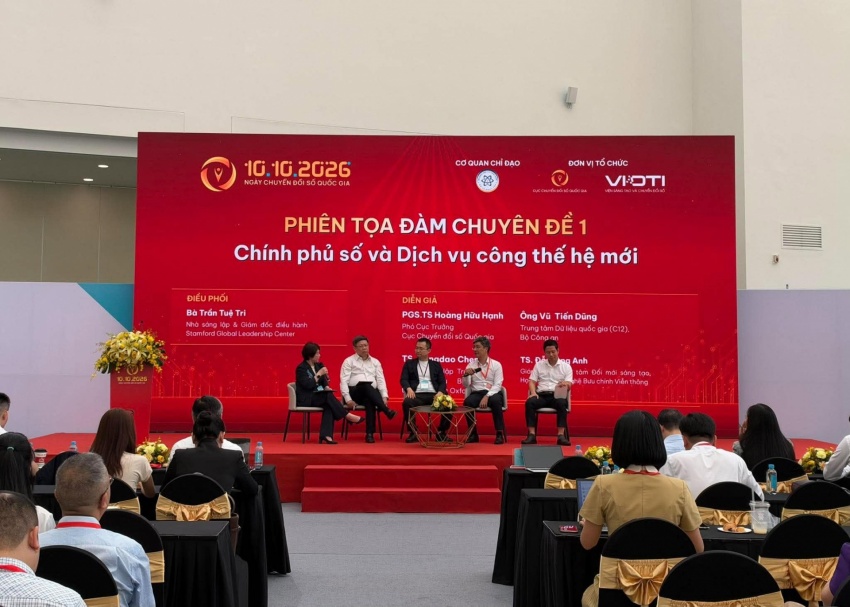 |
| Overview of the Vietnam National Digital Transformation Summit. Photo: Ha Vy |
Discussing the new provisions of Decree No.224/2026/ND-CP, which details certain provisions of and measures for implementing the Law on Digital Transformation, Le Anh Tuan, deputy director general of the National Digital Transformation Department, said the new regulations establish a foundation for making digital transformation more substantive, spanning strategy development, digital system organisation, public service delivery, and investment implementation.
“One notable change is the shift away from simply digitising existing processes towards redesigning how the state serves citizens and businesses. Under this approach, existing data must be accessed and reused to reduce paperwork, limit requests for information to be declared again, and progressively develop proactive public services that respond to users’ needs,” Tuan said.
“In addition, mechanisms for piloting solutions, commissioning solutions to address major challenges, investing in digital transformation, procuring relevant goods and services, and leasing digital transformation services are expected to help resolve implementation delays while creating better conditions for technology solutions to be developed and applied in line with practical needs,” he added.
From the perspective of the technology sector, Pham Dac Bao, director of VNPT UAV Lab, highlighted the potential of integrating unmanned aerial vehicles, data, and AI into natural resource and environmental management, agriculture, and infrastructure.
“The low-altitude economy is not limited to the operation of flying devices. It also encompasses an integrated ecosystem of aerial vehicles, connectivity infrastructure, data, AI platforms, and application services. When connected and effectively utilised, data collected during a single flight can serve multiple purposes, ranging from detecting forest fires and deforestation and monitoring changes in natural resources to tracking crop cycles, transport infrastructure, and public assets,” Bao stated.
“This approach calls for a shift away from investing in isolated systems towards developing shared platforms and common databases. Enabling data to be reused across multiple sectors not only improves interoperability between systems but also reduces duplicative investment and enhances resource utilisation,” he added.
One of the notable topics discussed during the panel session was the Agent City model, explored with Dr. Bangdao Chen, co-founder of the Blockchain Research Centre at University College Oxford.
“Unlike traditional smart city approaches, which focus primarily on sensors, data, and monitoring systems, Agent City introduces the possibility of adding a layer of AI agents capable of coordinating tasks across data platforms and through interfaces that connect different systems,” Chen stated.
Chen shared insights from international pilot projects, including measurable outcomes and practical lessons, as well as experiments that had not succeeded.
“These experiences raise several important questions to consider when exploring the model’s application in Vietnam: how should the scope of pilot projects be defined, who should be held accountable when AI agents take action, and how can safety, data sovereignty, and human control be ensured,” Chen said.
“Key prerequisites for implementing this model include open-standard application programming interfaces, identification and access-control mechanisms for AI agents, audit logs, human oversight proportionate to the level of risk, and a controlled testing environment.”
One proposed approach from the panel is to begin with low-risk internal tasks, allowing effectiveness to be assessed and governance mechanisms to be refined before expanding the model to services that directly affect citizens.
 | Vietnam’s finance sector moves to build an AI-driven digital ecosystem As digital systems across taxation, customs, the State Treasury, and securities become increasingly connected, Vietnam's finance sector is turning to AI and advanced data analytics to extract greater value from its expanding digital infrastructure. |
 | Hanoi to launch portal to ease hurdles for tech businesses Hanoi is plans an online portal and inter-agency task force to streamline case handling and address bottlenecks facing science and technology enterprises, innovative startups and digital technology businesses. |
What the stars mean:
★ Poor ★ ★ Promising ★★★ Good ★★★★ Very good ★★★★★ Exceptional
 Tag:
Tag:
Related Contents

Latest News




More News
- Ho Chi Minh City holds dialogue with businesses to address operational hurdles (October 09, 2026 | 17:27)
- AI beginning to reshape recruitment criteria (October 09, 2026 | 16:49)
- Electronics firms boost raw material reserves sevenfold amid supply concerns (October 09, 2026 | 08:00)
- NSRP navigates global energy supply volatility (October 08, 2026 | 16:59)
- Minitab launches campaign to combat illegal software use in Vietnam (October 08, 2026 | 15:54)
- Raising construction materials supply chain standards amid green transition (October 08, 2026 | 14:00)
- Samsung Vietnam to deepen cooperation with local manufacturers (October 08, 2026 | 12:00)
- Sojitz in Vietnam: 40 years from individual projects to a business cluster 'KATAMARI' (October 08, 2026 | 09:00)
- Coteccons targets 'Quality Growth' with 25 per cent dividend plan (October 07, 2026 | 13:00)
- Vietnam Education Forum opens UK Education Mission's Hanoi visit (October 07, 2026 | 12:27)








 Mobile Version