
Changes proposed to draft law on sci-tech and innovation

The Central Party Office, the Ministry of Science and Technology (MoST), and the National Assembly's Committee on Science, Technology, and Environment jointly organised a workshop on June 6 to gather comments for the draft. The event welcomed the participation of ministries, agencies, institutes, schools, enterprises, and experts.
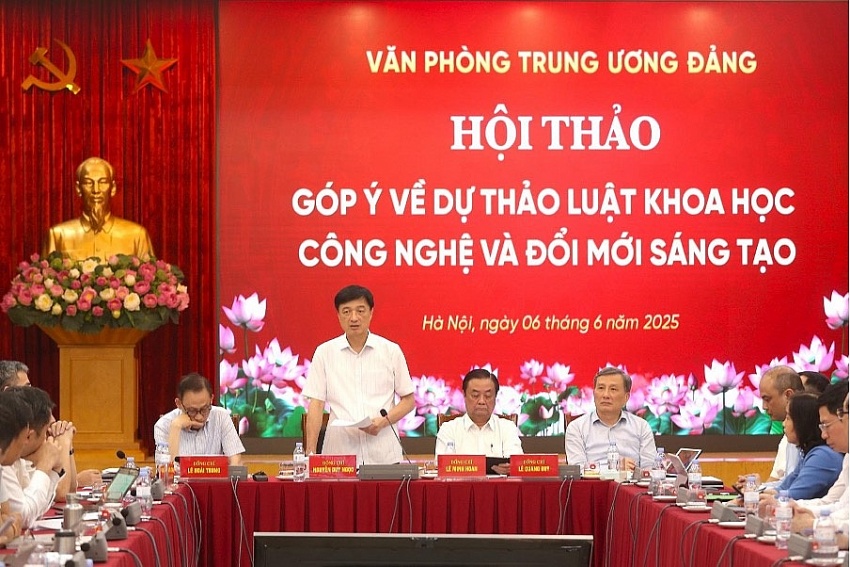 |
| Chairman of the Central Inspection Committee Nguyen Duy Ngoc made a speech at the event. Photo: MoST |
Nguyen Duy Ngoc, Politburo member, and Chairman of the Central Inspection Committee, emphasised the strategic role of the law for the country's development as Vietnam accelerates the transformation towards a digital and knowledge-based economy.
According to Ngoc, the law should take into account socioeconomic development, while creating a mechanism to attract and retain domestic and international sci-tech talents. The law needs to acts as a tool to institutionalise important Party resolutions, especially Resolution 57 on the development of science, technology, and innovation, Resolution 66 on the development of a knowledge-based economy, and Resolution 68 on innovation in the management of sci-tech tasks.
Bui The Duy, Deputy Minister of Science and Technology, said, “This draft law is more open than ever, reflecting open legal thinking, gathering more than 1,000 opinions from agencies, organisations, and individuals. The draft is linked with more than 10 specialised laws such as the Law on Public Investment, the Law on Tax, the Law on Technology Transfer, the Law on Intellectual Property, and the Law on Digital Technology Industry to ensure consistency and effective implementation.”
Policies supporting startups and sci-tech organisations have been integrated into the laws. This synchronisation will contribute to technology exchange, promoting the transfer and commercialisation of research results, removing administrative barriers, and strengthening the protection of intellectual property (IP) rights.
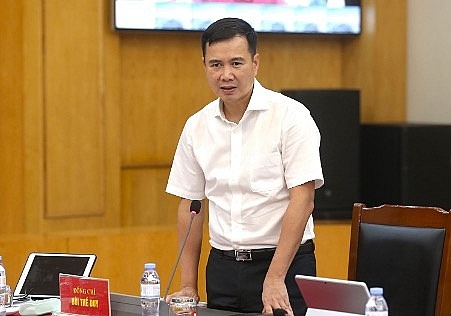 |
| Bui The Duy, Deputy Minister of Science and Technology. Photo: MoST |
At the event, participants made recommendations to perfect a financial mechanism to encourage cooperation among the state, enterprises, institutes, and universities.
Representatives of Hanoi Medical University requested clarification of regulations on international cooperation, especially in inviting foreign experts, receiving funding, and attracting high-quality human resources. In reality, there are still many legal and financial barriers to international cooperation in science and technology, making it difficult for universities and research organisations to access global resources.
Regarding IP, a representative from the Vietnam Chamber of Commerce and Industry said that the addition of regulations on technology trading floors is a breakthrough, contributing to the formation of a transparent technology market, effectively connecting research and businesses.
However, a major obstacle is the lack of a clear pricing mechanism for intellectual property. This makes it difficult to allocate capital for patents, transfer technology, and research collaboration. Therefore, many delegates recommended a specific pricing process, ensuring the rights of scientists and promoting innovation in the private sector.
A Masan Group representative suggested minimising administrative procedures for ordering, bidding, and accepting sci-tech tasks, so that businesses can focus on product development rather than reporting processes.
Le Minh Hoan, Vice Chairman of the National Assembly, said, “We need to work on specific regulations for science, technology, and innovation to increase national competitiveness and ensure technological initiatives in the context of globalisation and the Fourth Industrial Revolution.”
Ngoc noted, “The draft law on science, technology, and innovation needs to be developed based on expert opinions, reflecting real life and learning from international experience.”
He said that the MoST should continue to review regulations on the mechanism of assigning tasks and valuing IP, creating an effective legal corridor so that science and technology can truly become a driving force for national development.
 | Ministry pledges funding for science and technology development The Ministry of Finance (MoF) plans to allocate more state budget resources for science and technology development, digital transformation, and innovation. |
 | Keys to success for science, technology, and innovation Science, technology, and innovation are the foundation for industrialisation and modernisation of the country, enabling the country to develop further. In order to take advantage, we not only need to create a legal corridor and an effective implementation mechanism, but also need to clearly define the goals, resources, organisational, and implementation models. |
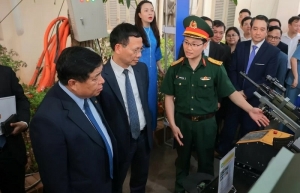 | Science and Technology Day puts innovation centre stage The Ministry of Science and Technology (MoST) held Vietnam Science and Technology Day 2025 in Hanoi on May 16, highlighting the importance of innovation and the digital transformation to Vietnam’s future development. |
What the stars mean:
★ Poor ★ ★ Promising ★★★ Good ★★★★ Very good ★★★★★ Exceptional
 Tag:
Tag:Themes: Digital Transformation
- STEM education evolves for AI era
- New research centre to drive technology development in Vietnam
- Vietnam and WEF to strengthen cooperation in AI and semiconductor technology
- Ho Chi Minh City High-Tech Park to expand with science and tech focus
- Digital technology park project kicked off in Thai Nguyen
Related Contents





Latest News



More News
- New research centre to drive technology development in Vietnam (July 16, 2026 | 15:06)
- Vietnam and Italy unlock new momentum for bilateral trade and investment (July 14, 2026 | 15:19)
- Haiphong partners with US on smart seaport development (July 14, 2026 | 14:00)
- Greenfeed retains spot among best companies to work for in Asia (July 14, 2026 | 11:00)
- Bayer Vietnam signs MoUs with three hospitals to advance diagnostic imaging (July 14, 2026 | 10:11)
- ASEAN fairs open new chapter for regional trade (July 14, 2026 | 08:00)
- Tay Ninh students gain hands-on experience at local Coca-Cola plant (July 13, 2026 | 16:00)
- Advancing green transformation in Vietnam's transport sector (July 10, 2026 | 17:41)
- ITL enhances international cooperation at Transport Logistic & Air Cargo China 2026 (July 10, 2026 | 17:26)
- Red River Delta builds momentum in industry, logistics and innovation (July 09, 2026 | 14:59)








 Mobile Version