

Agencies and market operators join forces to advance Vietnam carbon trading platform

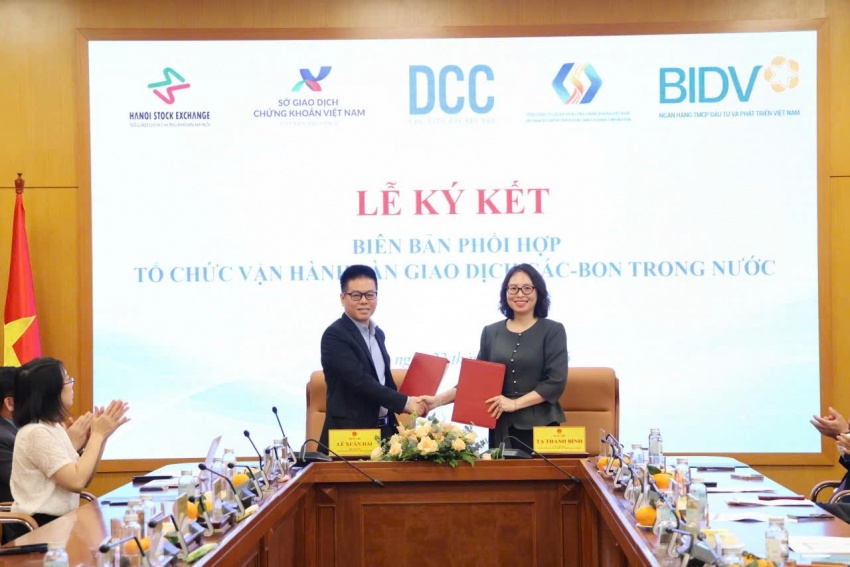 |
| Agreement between VSDC and VNX |
The agreements signed include a coordination agreement between the MAE - represented by the Department of Climate Change, and the Vietnam Exchange (VNX), the Vietnam Securities Depository and Clearing Corporation (VSDC), and the Hanoi Stock Exchange (HNX); a coordination agreement between VNX and VSDC; a coordination agreement between VSDC and HNX; and a coordination agreement between VSDC and the Joint Stock Commercial Bank for Investment and Development of Vietnam (BIDV).
The event was attended by representatives of the Department of Climate Change, the State Securities Commission of Vietnam, the Legal Department under the Ministry of Finance, leaders of VSDC, VNX, HNX and BIDV, as well as representatives from professional and technical units involved in preparations for the operation of exchange.
The signing of the coordination agreements marks an important milestone in implementing the government's Decree No.29/2026/ND-CP dated January 19, 2026, on the operation of the domestic carbon exchange.
It represents a concrete step toward establishing a coordinated mechanism between state management agencies and market infrastructure operators, laying the foundation for the safe, transparent and efficient operation of the domestic carbon market in line with the roadmap approved by the government.
Speaking at the ceremony, Nguyen Tuan Quang, acting deputy director general of the Department of Climate Change under the MAE, said climate change was posing increasingly significant challenges to sustainable development. Many countries have adopted carbon markets as an effective economic instrument to drive emission reductions at optimal costs for the economy.
Quang said that developing the carbon market was a key task stipulated in the 2020 Law on Environmental Protection, contributing to the implementation of Vietnam’s Nationally Determined Contributions and supporting businesses’ green transition.
"The government’s issuance of Decree 29 has provided an important legal basis for establishing a market-based system for trading greenhouse gas emission allowances and carbon credits," he added.
Under the model, the MAE manages the National Registry System for greenhouse gas emission allowances and carbon credits; VSDC performs depository and settlement functions; HNX organises and operates the trading platform; VNX supervises trading activities; and the settlement bank conducts financial transactions in accordance with regulations.
The new agreements clearly define the responsibilities of each agency and organisation in data exchange, incident handling, supervision, information disclosure and related operations. This is intended to ensure the safe, transparent, efficient and seamless operation of the domestic carbon exchange once it becomes operational.
“The Department of Climate Change will continue to serve as the focal point of the MAE in managing and operating the National Registry System, while closely coordinating with the Ministry of Finance, the State Securities Commission, VSDC, VNX, HNX, the settlement bank, market participants and other relevant agencies to gradually ensure the effective operation of the domestic carbon exchange in accordance with the government-approved roadmap,” Quang said.
 |
Hoang Van Thu, vice chairman of the State Securities Commission under the Ministry of Finance, commended the proactive coordination among regulators and market operators in preparing technical infrastructure, the legal framework and operational mechanisms. He noted that the signing ceremony demonstrated organisational and technological readiness as well as determination to launch the domestic carbon exchange on schedule.
“Today’s signing ceremony is of particular significance. It marks the close cooperation between state management agencies and market operators and also reflects the shared determination to fully prepare the necessary conditions for putting the domestic carbon exchange into operation,” Thu said.
He expressed confidence that the coordination agreements would establish a clear and effective framework among the parties, enabling them to maximise their respective capabilities, expertise and resources, thereby enhancing the implementation of the exchange. He also urged agencies and organisations to continue strengthening cooperation, sharing information, experience, and resources to ensure the exchange begins operating safely, transparently, and efficiently.
In recent years, carbon markets have expanded rapidly around the world. Alongside the growth of green trade and green investment and the emergence of cross-border carbon adjustment mechanisms, deeper participation in carbon pricing mechanisms has become increasingly essential for economies seeking to maintain competitiveness and fulfil international climate commitments.
Vietnam is developing its carbon market as an important tool to support greenhouse gas emission reduction targets and achieve net-zero by 2050. Through the trading of emission allowances and carbon credits, the market will help organisations and businesses optimise compliance costs, encourage investment in clean technologies and improve energy efficiency.
In parallel with building market infrastructure, the prime minister has approved the total greenhouse gas emission allowances to be allocated on a pilot basis to facilities in several key emitting sectors. This serves as an important step in creating an initial supply of tradable assets for the domestic carbon market and helping businesses gradually adapt to the mechanisms governing emission allowance management, trading and compliance.
Under government Decree 29, eligible greenhouse gas emission allowances and carbon credits will be registered in the National Registry System managed by the MAE, deposited at VSDC and traded on the exchange platform operated by HNX.
 | Vietnam sets launch date for domestic carbon exchange Vietnam will launch its domestic carbon exchange at the end of June, marking a major step in the country’s efforts to develop a carbon market and participate in a global carbon credit industry projected to reach $24 billion by 2030. |
 | Decree 112 sets legal framework for Vietnam's carbon market participation Vietnam formally entered the international carbon market legal framework in April, following the launch of its Carbon Exchange in January. Vaibhav Saxena, senior counsel at VILAF, examines how the move is reshaping the definition, regulation, and transaction of carbon assets within Vietnam's legal system. |
 | Vietnam lays groundwork for carbon market development Vietnam is laying the groundwork for a domestic carbon market as it seeks to meet its climate commitments and strengthen export competitiveness. Chi Dao, senior research manager at B&Company Vietnam, explores the progress made in building the legal and institutional foundations for market development. |
What the stars mean:
★ Poor ★ ★ Promising ★★★ Good ★★★★ Very good ★★★★★ Exceptional
 Tag:
Tag:Related Contents





Latest News



More News
- JBIC considers new financing options for Vietnam’s energy projects (October 03, 2026 | 08:00)
- Vestas to supply 16 turbines for two new Vietnam wind farms (October 01, 2026 | 07:00)
- Inter-sectoral cooperation on Montreal protocol (September 30, 2026 | 17:20)
- EV battery recycling rate proposed at 8 per cent from 2029 (September 29, 2026 | 16:00)
- Bankability remains hurdle for Vietnam's JETP projects (September 29, 2026 | 12:08)
- Binh Minh Plastics extends clean water project to border communities (September 29, 2026 | 10:57)
- Coca-Cola Vietnam expands packaging collection programme (September 25, 2026 | 08:15)
- Pacifico Energy secures sea survey licence for offshore wind project in Lam Dong (September 24, 2026 | 18:02)
- Vietnam secures $221 million in UN development programmes for 2027-2031 (September 23, 2026 | 17:39)
- Carlsberg Vietnam shows how resource efficiency can shape green industrial growth (September 18, 2026 | 09:03)


Latest News





 Mobile Version