
Vietnam’s trade tops $825 billion by mid-September

 |
| Photo: baodautu.vn |
Figures released on September 21 showed goods trade reached nearly $55 billion in the first 15 days of September alone, bringing cumulative turnover since the beginning of the year to more than $825 billion. The strong growth reflects robust trade flows, with demand for consumer goods and production inputs remaining high.
Exports surpassed $400.8 billion, up 23.2 per cent on-year, while imports stood at almost $424.4 billion, up 36 per cent. The faster growth in imports pushed the trade deficit to around $23.5 billion.
With trade flows expanding by nearly 30 per cent on-year, demand for consumer goods and production inputs remains strong. The National Statistics Office said export growth has been driven by processing and manufacturing, particularly electronics, machinery and equipment, supporting Vietnam’s industrialisation and deeper integration into global supply chains.
If the current momentum is maintained, Vietnam’s total trade turnover could reach or exceed $1.2 trillion this year, marking a significant milestone as the country pursues stronger economic growth.
Processing and manufacturing continued to account for a major share of Vietnam’s trade. Computers, electronic products and components remained the leading category, with exports of $9.6 billion and imports of $13.1 billion in the first half of September.
In the first nine months to September 15, exports of computers, electronic products and components reached about $111 billion, while imports approached $175 billion. Machinery, equipment, tools and spare parts followed, with exports of $50.7 billion and imports of nearly $51 billion.
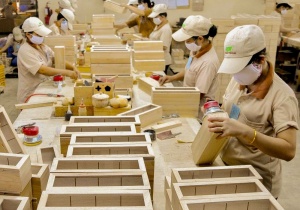
However, the strong overall trade performance masks growing difficulties among several domestic export sectors, including agriculture, forestry and fisheries, textiles and garments, footwear, and wood products, which are facing weaker export prices and tougher market conditions.
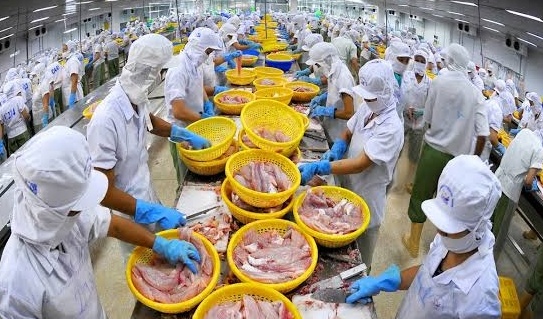
Seafood exporters said the period would normally mark the beginning of a peak season ahead of year-end consumption. This year, however, demand has been subdued amid rising global supply, putting greater pressure on producers to meet stricter quality requirements while maintaining competitive prices.
At the same time, production costs, including electricity, water, financing, interest payments, and wages, have risen sharply.
“We are trying to hold on and get through this difficult period,” an executive at a seafood exporter said.
Analysis from the Vietnam Association of Seafood Exporters and Producers also points to mounting pressure. Seafood exports reached $1.1 billion in August, up 6.4 per cent on-year, but growth slowed significantly compared with the 11.9 per cent increase recorded during the first eight months of the year.
The United States, an important market for Vietnamese seafood, saw exports fall 3.8 per cent in August to $182 million. Shrimp exports declined 12.6 per cent, while basa fish exports plunged 49.3 per cent. The EU market also contracted by 6.2 per cent, particularly for shrimp, tuna and octopus.
China, Vietnam’s largest seafood market and an important growth driver, also showed signs of slowing, with growth in August reaching 16.5 per cent, compared with 32 per cent during the first eight months.
Prof. Dr Vo Xuan Vinh, director of the Institute of Business Research at the University of Economics Ho Chi Minh City, said the widening trade deficit could weigh on GDP growth, particularly as Vietnam seeks to achieve double-digit economic growth this year.
However, he noted that the composition of imports remains an important consideration, as machinery, equipment and production inputs account for a large proportion of total imports.
“Imports are mainly serving two purposes: domestic consumption and the processing of goods for export,” Vinh said.
“The greater concern is that although the scale of trade is expanding, domestic businesses have yet to make a stronger breakthrough. High financing costs and difficulties in accessing capital are among the current constraints, alongside other factors related to businesses’ compliance costs,” he said.
These pressures are affecting the competitiveness of domestic exporters, while higher fuel prices and logistics costs are also contributing to the widening trade deficit, according to Vinh.
Foreign-invested enterprises (FIEs) continue to play a major role in Vietnam’s external trade. As of September 15, FIEs had generated over $321.4 billion in exports, accounting for about 80 per cent of the national total, while their imports approached $312.7 billion, or nearly 74 per cent of the total. The sector therefore recorded a trade surplus of approximately $8.7 billion.






What the stars mean:
★ Poor ★ ★ Promising ★★★ Good ★★★★ Very good ★★★★★ Exceptional
 Tag:
Tag:Related Contents





Latest News






More News
- Samsung Vietnam to deepen cooperation with local manufacturers (October 08, 2026 | 12:00)
- Sojitz in Vietnam: 40 years from individual projects to a business cluster 'KATAMARI' (October 08, 2026 | 09:00)
- Coteccons targets 'Quality Growth' with 25 per cent dividend plan (October 07, 2026 | 13:00)
- Vietnam Education Forum opens UK Education Mission's Hanoi visit (October 07, 2026 | 12:27)
- Tax authorities deactivate TINs of nearly 180,000 businesses (October 07, 2026 | 12:08)
- World Bank raises Vietnam's 2026 GDP growth forecast to 7.4 per cent (October 07, 2026 | 11:41)
- Vietstock 2026 to spotlight livestock innovation and green transition (October 07, 2026 | 09:00)
- Vietnam’s GDP grows over 9 per cent in first nine months (October 05, 2026 | 18:45)
- Vietnam earns $56.3 billion from agro-forestry-fishery exports (October 05, 2026 | 18:32)
- DSV balances resilience and decarbonisation in supply chains (October 05, 2026 | 18:20)










 Mobile Version