
Vietnam joins upper-middle income economies in World Bank classification

 |
| Source: World Bank Group |
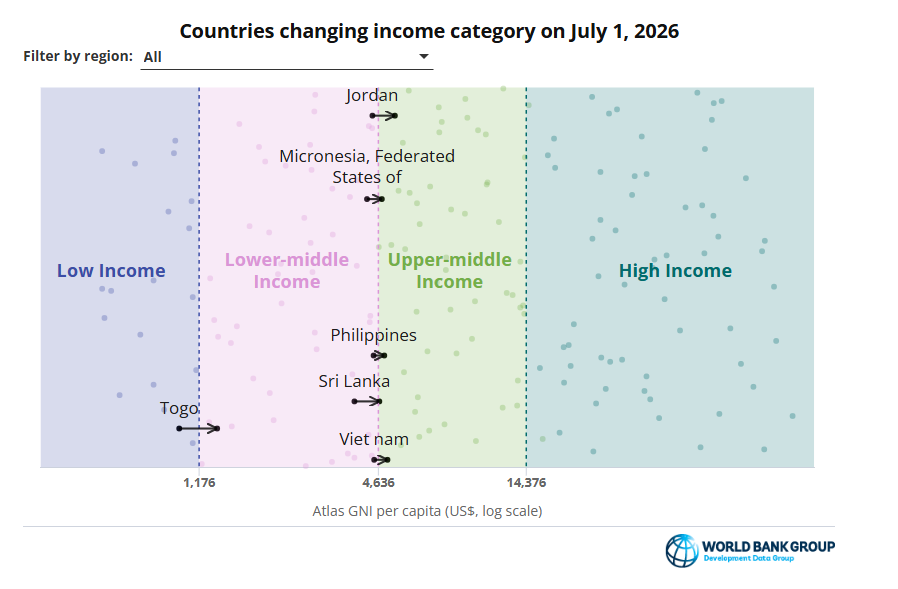
The World Bank Group on July 1 reclassified Vietnam from a lower-middle income economy to an upper-middle income economy in its latest Country Income Classifications, based on 2025 gross national income (GNI) per capita estimates.
The annual update, prepared by the World Bank Group's Development Data Group, covers 218 economies and will serve as the global reference for income classifications until the end of June 2027.
According to the World Bank, Vietnam's transition reflects a sustained period of strong economic performance driven by its export-oriented growth model. Exports expanded by more than 15 per cent in both 2024 and 2025, while GDP grew by 7 per cent and 8 per cent, respectively. Over the 2021-2025 period, the country's GNI increased by an average of 10 per cent annually, making it one of the strongest sustained growth performers in the region.
The World Bank noted that Vietnam's move tells "a story of growth", distinguishing it from other economies that reached higher income classifications through different circumstances.
Five economies were upgraded from lower-middle income to upper-middle income this year, including Vietnam, Jordan, Micronesia, the Philippines, and Sri Lanka. Togo was the only country to move from the low-income category to lower-middle income, while no economy was downgraded.
Although the six economies all crossed income thresholds, the World Bank said each followed a distinct path.
Vietnam's upgrade was underpinned by sustained export-led expansion. The Philippines advanced on the back of broad-based economic growth across major industries, with GDP averaging 5.8 per cent annually over the past five years.
Sri Lanka's reclassification reflected its recovery from the severe economic crisis of 2022. The country's real GDP grew by 5 per cent in 2025, supported by rebounds across industries as well as financial and tourism services, although it only narrowly exceeded the upper-middle income threshold.
Jordan's promotion resulted largely from a comprehensive rebasing of its national accounts, which found the economy to be nearly 10 per cent larger than previously estimated after updated surveys, new data sources, and improved statistical methodology were incorporated. Combined with GDP growth of 2.8 per cent in 2025, the revision lifted the country into the upper-middle income category.
Meanwhile, Micronesia recorded modest but steady growth following its post-pandemic recovery, driven mainly by construction and agriculture, while Togo's reclassification was primarily the result of revised population data following its 2022 census, which raised GNI per capita despite only moderate changes in total national income.
The World Bank updates its income classifications every July based on GNI per capita calculated using the Atlas methodology, which smooths short-term exchange rate fluctuations. Income thresholds are adjusted annually to account for inflation, while changes in economic growth, population, national accounts, and underlying statistical data can all influence a country's classification.
According to the World Bank, the classifications play an important role in determining eligibility for concessional financing and development assistance, while also providing governments, researchers, and international organisations with a consistent benchmark for tracking economic progress.
The institution noted that since 1987, the share of economies classified as low-income has declined from 30 per cent to 11 per cent, reflecting significant changes in the global economic landscape over the past four decades. However, it noted that countries have reached higher income groups through widely different development trajectories and that no single indicator can fully capture the complexity of economic development.
What the stars mean:
★ Poor ★ ★ Promising ★★★ Good ★★★★ Very good ★★★★★ Exceptional
 Tag:
Tag:Related Contents




Latest News




More News
- French experts share AI and digital governance insights in Hanoi (October 11, 2026 | 08:00)
- Digital government push focuses on data connectivity and AI (October 10, 2026 | 08:00)
- Ho Chi Minh City holds dialogue with businesses to address operational hurdles (October 09, 2026 | 17:27)
- AI beginning to reshape recruitment criteria (October 09, 2026 | 16:49)
- Electronics firms boost raw material reserves sevenfold amid supply concerns (October 09, 2026 | 08:00)
- NSRP navigates global energy supply volatility (October 08, 2026 | 16:59)
- Minitab launches campaign to combat illegal software use in Vietnam (October 08, 2026 | 15:54)
- Raising construction materials supply chain standards amid green transition (October 08, 2026 | 14:00)
- Samsung Vietnam to deepen cooperation with local manufacturers (October 08, 2026 | 12:00)
- Sojitz in Vietnam: 40 years from individual projects to a business cluster 'KATAMARI' (October 08, 2026 | 09:00)








 Mobile Version