

Vietnam-Australia Economic Partnership Ministerial Conference convenes a fifth time

The conference was attended by Australian Ambassador to Vietnam Gillian Bird and a high-level Australian delegation. Vietnamese participants included representatives from the Government Office, the ministries of Foreign Affairs, Industry and Trade, Culture, Sports and Tourism, and Home Affairs, as well as leaders of relevant units under the MoF.
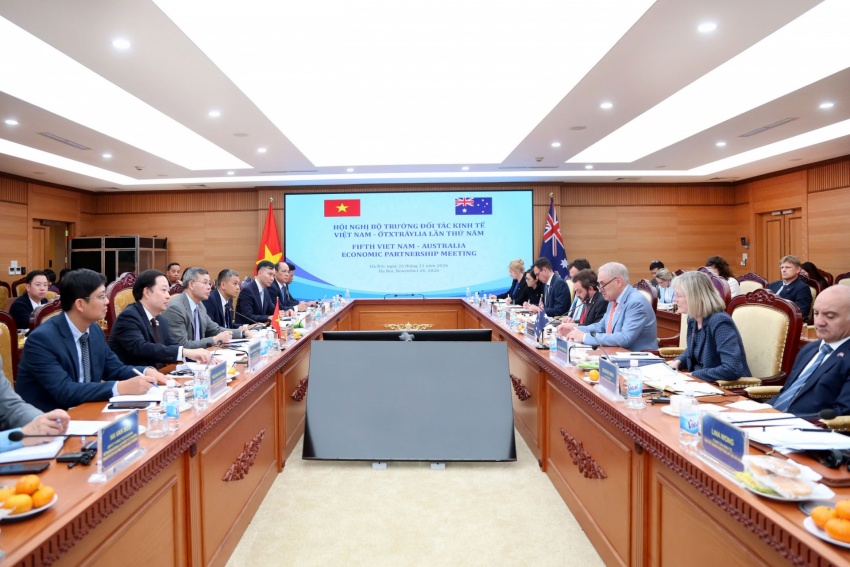 |
| Vietnam-Australia Economic Partnership Ministerial Conference convenes a fifth time. Photo: Duc Minh |
New momentum
In his opening remarks, Minister Tuan highlighted that the meeting took place just three months after a successful working visit by the Vietnamese delegation to Australia, continuing regular exchanges to implement commitments made by Party General Secretary and State President To Lam and the Australian PM.
"Since the signing of the Enhanced Economic Engagement Strategy, bilateral trade and investment have recorded strong growth. Trade turnover in the first 10 months of 2026 increased by 21 per cent on-year," Minister Tuan said.
Australia currently has more than 100 investment projects in Vietnam, with total capital exceeding $1.2 billion. Meanwhile, Vietnamese investment in Australia has reached more than $600 million, making Australia the 12th-largest destination among 87 countries and territories receiving Vietnamese investment. The conference also reviewed the outcomes of the Trade Working Group, Investment Working Group, and the sixth Annual Development Dialogue.
Providing an overview of Vietnam’s economic outlook, Minister Tuan said the country was pursuing two major objectives under its socioeconomic development strategy to 2035, with a vision to 2045: becoming a developing country with modern industry and upper-middle-income status by 2030, and a developed, high-income country by 2045.
To achieve these goals, Vietnam is committed to maintaining GDP growth of at least 10 per cent annually in the coming years, while ensuring macroeconomic stability and controlling inflation.
Vietnam regards domestic resources as fundamental while also prioritising external resources, particularly high-quality foreign direct investment from Australia. Following the National Assembly’s adoption of amendments to the Investment Law, the country has introduced incentives for high technology, technology transfer, workforce training, and participation in global value chains.
Small and medium-sized enterprises (SMEs) account for 98.4 per cent of Vietnam’s more than 1.28 million businesses and contribute 56 per cent of GDP.
"Vietnam is also prioritising official development assistance for essential infrastructure, including climate-resilient infrastructure in the Mekong Delta and northern mountainous regions, while allocating 3 per cent of the state budget to research and development (R&D) from 2025," Minister Tuan said. "The country is accelerating the development of international financial centres in Ho Chi Minh City and Danang, calling on major Australian corporations and financial institutions to participate."
Expanding trade, clean energy cooperation
Minister Farrell praised Vietnam’s economic achievements, describing the country as one of Australia’s leading free trade partners. He reaffirmed Australia’s commitment to supporting Vietnam and expressed the ambition to double bilateral trade over the next five years, following a record $30 billion in the previous year.
He also highlighted the more than 400,000 people of Vietnamese origin living in Australia as an important bridge in bilateral relations.
Discussing agricultural trade and labour cooperation, the two ministers agreed to leverage the complementary nature of their agricultural trade, which is worth approximately $1.5 billion in each direction, to expand market access for key products. These include Australian wheat, maize, soybeans, cotton, apples, and kiwifruit, alongside Vietnamese coffee, pepper, cashew nuts, green-skinned pomelos, oranges, and durian.
"Australia was ready to send experts to support Vietnam in meeting stringent biosecurity and quarantine requirements. We also welcomed proposals for cooperation in receiving trained Vietnamese workers, alongside efforts to expand markets for Australian speciality products such as venison, kangaroo meat, and wine," Minister Farrell said.
Australia pledged to remain a reliable, long-term supplier of coal, liquefied natural gas, and crude oil suitable for the Nghi Son and Binh Son refineries. This would help meet Vietnam’s projected annual energy demand growth of 13-15 per cent as the country pursues high economic growth and its commitment to achieving net-zero emissions by 2050.
The two ministers also agreed to strengthen supply chain connectivity for critical minerals and rare earths, and explore cross-border clean energy projects, including Sun Cable.
On investment, finance, and the digital economy, the two sides discussed ways to remove barriers and accelerate capital disbursement, building on more than $1.3 billion in funding and investment through Export Finance Australia’s Invested programme.
Australia proposed considering an exemption from withholding tax on interest payments, facilitating the expansion of RMIT University’s operations in Vietnam, and addressing investment procedures and land rental issues affecting companies such as BHP, Linfox, and NF Club.
Cooperation in the digital economy, cross-border e-commerce, cybersecurity, and submarine fibre-optic cable infrastructure was also identified as a new growth driver for the two economies.
Minister Tuan reaffirmed Vietnam’s commitment to improving its investment environment in a transparent, fair, and competitive manner in line with international standards.
"The country would also adjust its support mechanisms in line with the OECD Global Minimum Tax framework, based on mutually beneficial cooperation, and work with local authorities to review and resolve difficulties faced by Australian businesses in accordance with Vietnamese law," he said.
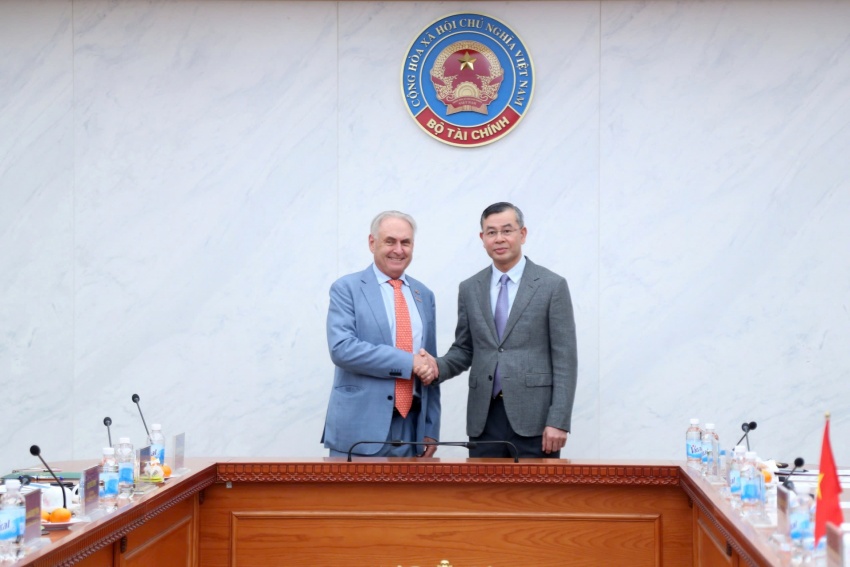 |
| Vietnamese Minister of Finance Ngo Van Tuan and Australian Minister for Trade and Tourism Don Farrell. Photo: Duc Minh |
During discussions on regional and multilateral issues, the two sides expressed support for a free, fair, and rules-based trading system amid geopolitical uncertainties, supply chain disruptions, and growing tariff protectionism.
Minister Tuan outlined Vietnam’s priorities as host of APEC 2027, centred on the theme of “Enhancing Labour Productivity”, covering six key areas: structural reform; digital transformation and innovation; human resource development; productivity improvements in the private sector and SMEs; productivity gains across economic sectors; and efficient allocation of financial resources.
He also introduced four priority themes for the APEC Finance Ministers’ Process in 2027: strengthening capital markets for innovation; data-driven finance to support SMEs; diversifying financial resources while ensuring fiscal safety and public debt sustainability; and improving the quality of young finance professionals.
The APEC Finance Ministers’ Meeting is expected to take place in Halong, Quang Ninh city, while the APEC Economic Leaders’ Meeting is scheduled to be held on Phu Quoc Island, Kien Giang province.
Minister Farrell reaffirmed Australia’s support for Vietnam’s priorities and its commitment to participating fully in APEC 2027 activities. Australia would cooperate on trade and services facilitation, SMEs, women’s economic empowerment, and the joint development of the APEC Finance Ministers’ Joint Statement. He also noted the ongoing expansion of the Comprehensive and Progressive Agreement for Trans-Pacific Partnership following Vietnam’s hosting of the agreement.
MinisterTuan summarised three key outcomes: identifying further opportunities for long-term investment aligned with Vietnam’s 2026-2030 development priorities, particularly in high technology, clean energy, and infrastructure; expanding markets for agricultural and aquatic products while encouraging the digital and green economies and facilitating two-way investment; and strengthening coordination at regional and multilateral forums, particularly APEC 2027.
What the stars mean:
★ Poor ★ ★ Promising ★★★ Good ★★★★ Very good ★★★★★ Exceptional
 Tag:
Related Contents




Latest News
More News
- Nutifood bridges Vietnam-US capabilities in nutrition science (November 27, 2026 | 16:13)
- Survey points to rising salaries and hiring in Vietnam (November 26, 2026 | 17:42)
- OECD flags governance gaps as Vietnam accelerates SOE reform (November 25, 2026 | 23:14)
- OECD calls for stronger SOE governance as global assets reach $141 trillion (November 25, 2026 | 23:01)
- C.P. Group chairman receives recognition for C.P. Vietnam's longstanding contributions to the community (November 24, 2026 | 14:00)
- Nestlé Vietnam wins 'Best Place to Work' for the third time (November 23, 2026 | 10:12)
- Vietnamese ambition to put local agricultural commodities on the global trading map (November 23, 2026 | 10:10)
- AEON Vietnam ranked No. 1 in retail for 4 consecutive years, breaking into Vietnam's Top 8 Best Places to Work (November 20, 2026 | 19:30)
- AEON Halong attracts crowds, lifting local trade and services (November 20, 2026 | 14:28)
- Mitsubishi Power to supply two M701JAC gas turbines to O Mon 3 Power Plant in Vietnam (November 20, 2026 | 11:28)





 Mobile Version