

OECD flags governance gaps as Vietnam accelerates SOE reform

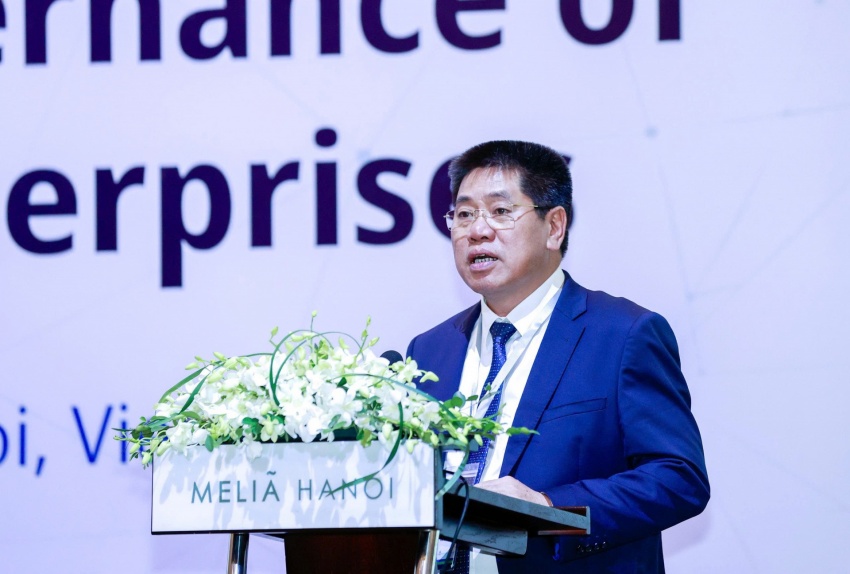 |
| Vu Hong Phuong, director general of the Department of State-Owned Enterprises Development. Photo: Duc Thanh |
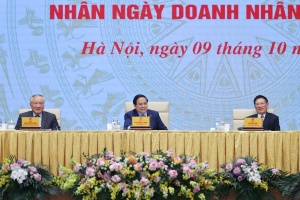
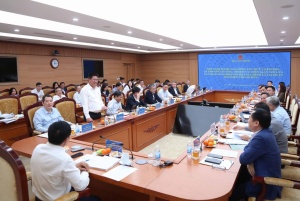
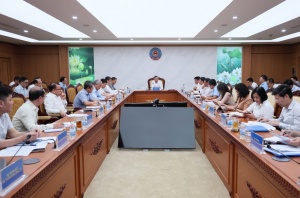
The event brings together government agencies, state ownership representatives, state-owned enterprises (SOEs), policymakers, experts, and international organisations to exchange experience and discuss approaches to improving SOE governance and performance.
The conference comes as governments across Asia face growing pressure to ensure that state-owned businesses operate efficiently, remain accountable for public resources, and adapt to changes in the global economy, including digitalisation, the green transition, and increasingly complex market conditions.
For Vietnam, hosting the network provides an opportunity to draw on international experience as it continues restructuring its SOE sector and seeks to strengthen the competitiveness of state-owned businesses.
Vu Hong Phuong, director general of the Department of State-Owned Enterprises Development, said hosting the conference reflected international confidence in Vietnam and closer cooperation between the Ministry of Finance and the OECD. “It also provides a valuable opportunity for Vietnam to strengthen exchanges, learn from experience, and boost cooperation with countries in the region on SOE governance and development,” he said.
SOEs continue to play a significant role in many economies, from providing essential services and supporting infrastructure investment to implementing public policy objectives. However, their scale and economic importance make governance quality critical to the efficient allocation of public resources and the wider business environment.
Yasushi Masaki, OECD deputy secretary-general, said effective SOE governance was essential to ensuring that state-owned businesses operated efficiently, competed on a level playing field, and contributed to sustainable growth without undermining public finances.
“SOEs play a significant role in delivering essential services, financing investment, and advancing public policy objectives. Strong governance is essential to ensure that they operate efficiently, compete on a level playing field, and contribute to sustainable growth while safeguarding public finances,” he said.
The scale of the sector underlines the importance of reform. According to the OECD Global SOEs Dataset, published earlier this year, approximately 33,800 large SOEs worldwide held $141 trillion in assets and employed around 43 million people in 2024, based on figures presented in the OECD’s Ownership and Governance of SOEs 2026 report.
Asia accounts for nearly 62 per cent of the large SOEs identified globally, representing more than 20,800 enterprises. The concentration of SOEs in the region makes corporate governance a major policy issue, with decisions on ownership objectives, board appointments, oversight, and performance management potentially affecting public services, investment efficiency, and economic resilience.
“The scale of the SOE sector also means that governance decisions have consequences far beyond individual enterprises,” Masaki said. “How governments set ownership objectives, appoint boards, and oversee performance can influence the quality of public services, the efficiency of public investment, and the ability of economies to respond to emerging challenges.”
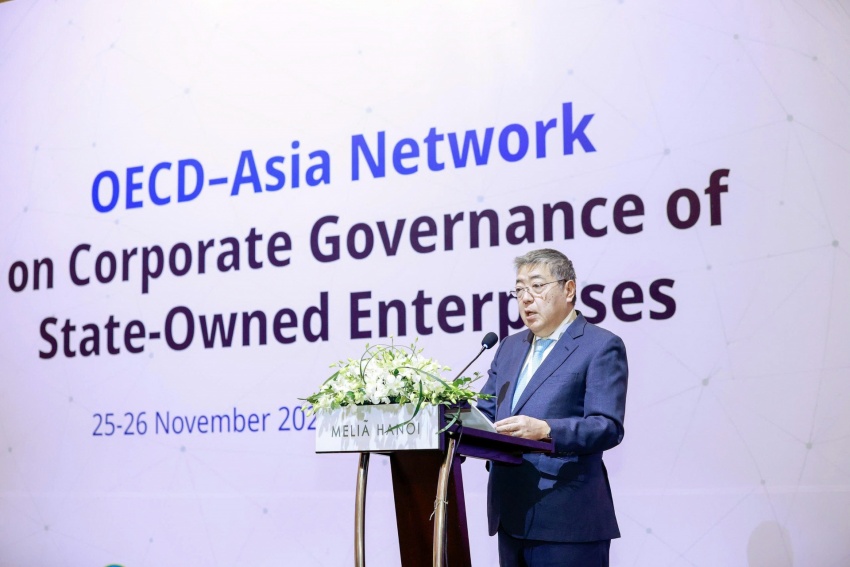 |
| Yasushi Masaki, OECD deputy secretary-general. Photo: Duc Thanh |
Gaps remain in ownership frameworks and competition
The OECD’s revised Guidelines on Corporate Governance of SOEs provide a framework for governments to strengthen state ownership and improve corporate performance. They emphasise professional and accountable ownership, competitive neutrality, transparency and disclosure, equitable treatment of shareholders, effective boards, and the integration of sustainability into corporate decision-making.
Since the regional launch of the revised Guidelines two years ago, the OECD has worked with regional partners to support their implementation, shifting the focus from adopting standards to embedding them in ownership practices and enterprise operations.
The latest OECD report, drawing on evidence from 58 jurisdictions, identifies progress in professionalising state ownership and strengthening oversight, but also highlights gaps in governance frameworks.
Only 43 per cent of surveyed jurisdictions have consolidated their ownership framework into a single ownership policy document or an overarching SOE law. Meanwhile, 57 per cent report applying the same regulatory and other legal requirements to SOEs as to private businesses.
The findings point to the need for clearer ownership objectives, more consistent institutional responsibilities, and stronger mechanisms to ensure that SOEs operate under conditions that support fair competition.
"Where SOEs are tasked with delivering public services or fulfilling public policy mandates, governments also need to clearly disclose the responsibilities involved, their costs, and the compensation provided. Greater transparency would help assess whether enterprises are fulfilling their mandates efficiently, while reducing potential distortions in the market," Masaki said.
"These issues are particularly relevant to Vietnam as it continues to refine the institutional framework for managing state capital and strengthening the autonomy and accountability of SOEs," he added.
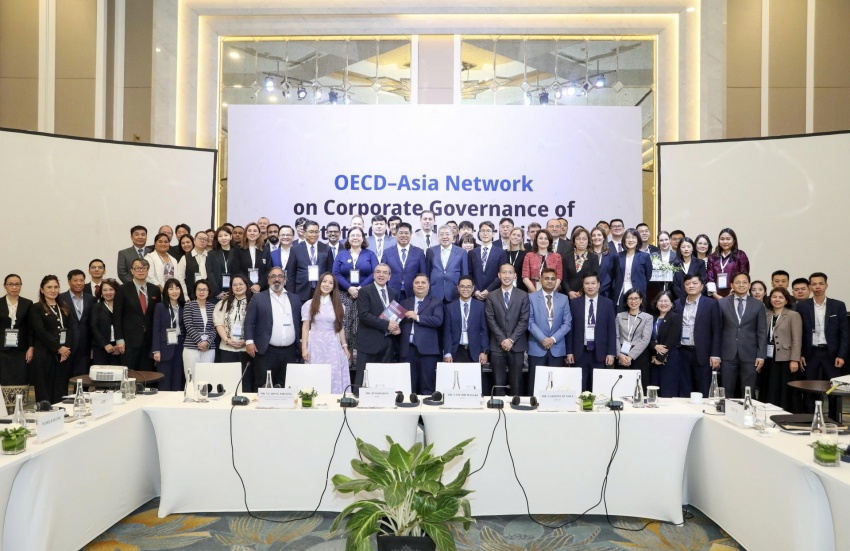 |
| Photo: Duc Thanh |
Vietnam targets OECD governance principles by 2030
Phuong said that Vietnam is continuing to restructure its SOE sector, with the objective of developing businesses that have modern governance systems, operate efficiently, and are more competitive regionally and internationally.
"Recent regulatory reforms have sought to increase enterprise autonomy while strengthening supervision, disclosure, and transparency. Vietnam has also set a target for 100 per cent of state-owned economic groups and corporations to apply OECD corporate governance principles by 2030," he said.
He added that international standards, including the OECD Guidelines on Corporate Governance of SOEs, were important references for Vietnam’s reform process.
“Principles concerning the role of the state as owner, ensuring a level playing field, strengthening board accountability, and improving information disclosure and financial transparency provide practical guidance for Vietnam’s SOE governance reforms,” Phuong said.
The reform agenda is becoming increasingly important as Vietnam pursues changes to its growth model, digital transformation, green transition, and productivity improvement. These developments require SOEs to adapt their governance structures and business strategies while balancing commercial objectives with public policy responsibilities.
Phương said the country was seeking to improve governance quality, operational efficiency, and transparency, while ensuring that state resources invested in enterprises were managed effectively.
She added that Vietnam hoped to continue receiving OECD support through international experience-sharing, policy advice, and technical assistance, particularly in refining the legal framework, reforming state ownership practices, and strengthening monitoring and performance evaluation.
The two-day conference will focus on five themes: Vietnam’s SOE reform experience; advancing sustainability through state ownership and SOE governance; strengthening board effectiveness and accountability; enhancing transparency, performance, and accountability in delivering public policy objectives; and improving risk management across SOEs.
Through five discussion sessions and international experience-sharing, the network aims to support policy dialogue and cooperation among regional economies, while helping participants adapt OECD principles and good practices to their own institutional and economic circumstances.
The discussions are expected to address practical challenges in implementing governance reforms, including how to strengthen board responsibilities, improve oversight, manage risks, and integrate sustainability considerations into corporate strategies.
For Vietnam, the conference is also an opportunity to exchange views on how international governance standards can be applied in practice, taking into account the country’s institutional arrangements and development priorities.
Phuong said Vietnam looked forward to expanding cooperation with the OECD through expert exchanges, training, in-depth research, and bilateral programmes to support the gradual improvement of SOE governance in line with OECD principles and good practices.
Vietnam also reaffirmed its commitment to actively participating in the OECD-Asia Network on Corporate Governance of State-Owned Enterprises and contributing to regional policy dialogue and the sharing of good practices.
As SOEs remain significant holders of public assets and participants in key economic sectors, improving their governance is increasingly viewed not only as an enterprise-level reform, but also as part of a broader effort to improve public resource allocation, strengthen market efficiency, and support sustainable economic growth.
What the stars mean:
★ Poor ★ ★ Promising ★★★ Good ★★★★ Very good ★★★★★ Exceptional
 Tag:
Related Contents


Latest News
More News
- OECD calls for stronger SOE governance as global assets reach $141 trillion (November 25, 2026 | 23:01)
- C.P. Group chairman receives recognition for C.P. Vietnam's longstanding contributions to the community (November 24, 2026 | 14:00)
- Nestlé Vietnam wins 'Best Place to Work' for the third time (November 23, 2026 | 10:12)
- Vietnamese ambition to put local agricultural commodities on the global trading map (November 23, 2026 | 10:10)
- AEON Vietnam ranked No. 1 in retail for 4 consecutive years, breaking into Vietnam's Top 8 Best Places to Work (November 20, 2026 | 19:30)
- AEON Halong attracts crowds, lifting local trade and services (November 20, 2026 | 14:28)
- Mitsubishi Power to supply two M701JAC gas turbines to O Mon 3 Power Plant in Vietnam (November 20, 2026 | 11:28)
- Carlsberg Vietnam wins slew of titles at Nordic Business Awards 2026 (November 19, 2026 | 15:34)
- MSD and VNVC step towards technology transfer, manufacturing, and localisation of vaccine technology (November 19, 2026 | 11:12)
- SCGJWD expands logistics strategy with proposed integration of Triple i (November 18, 2026 | 15:39)



Latest News


 Mobile Version