

OECD calls for stronger SOE governance as global assets reach $141 trillion

 |
| Photo: Duc Thanh |
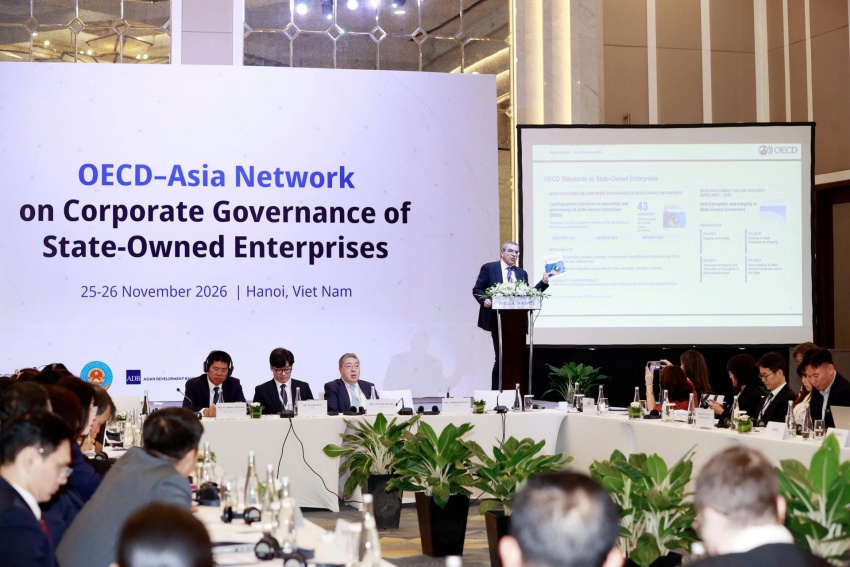
Presenting the Ownership and Governance of SOEs 2026 report in Hanoi on November 25, during the OECD-Asia Network on Corporate Governance of SOEs 2026, Carmine Di Noia, OECD director for Financial and Enterprise Affairs, highlighted significant differences between global and regional practices, with several findings having direct implications for Vietnam and other Asian economies.
The findings come as governments face increasing pressure to ensure that SOEs use public resources efficiently, operate under fair market conditions, and meet higher standards of transparency and accountability.
Globally, approximately 33,800 SOEs held $141 trillion in assets in 2024, equivalent to 126 per cent of global GDP, and employed around 43 million people. Emerging markets accounted for 70 per cent of non-financial SOEs worldwide and more than four-fifths of their combined assets and employment.
Asia's SOE landscape is particularly significant. Excluding China, financial SOEs account for 81 per cent of total SOE assets in the region, underlining the importance of robust governance and oversight in managing potential risks to financial stability and public finances.
However, the OECD's assessment suggests that the institutional frameworks governing these enterprises have not always kept pace with their growing economic importance.
Fragmented ownership and limited board autonomy challenge accountability
One of the report's key findings is that state ownership is becoming more professionalised, but fragmented ownership policies and overlapping institutional responsibilities continue to weaken accountability.
Governments typically own enterprises for several reasons. According to the OECD survey, 93 per cent of jurisdictions cite the provision of essential public services, such as transport, energy, and water, as a rationale for state ownership. Other common objectives include safeguarding national security and strategic interests (84 per cent), and supporting economic development or industrial policy (74 per cent).
However, SOEs often pursue several objectives simultaneously, making clearly defined ownership expectations particularly important.
In half of the countries surveyed globally, ownership objectives remain dispersed across different laws, regulations, and policy documents, rather than being consolidated into a government-wide ownership policy. This pattern is also common in Asia-Pacific, where fragmented legal sources remain the most prevalent approach.
Vietnam is among the economies adopting a co-ordinated state ownership model, alongside Indonesia and the Philippines. This model accounts for 25 per cent of surveyed Asia-Pacific economies, while dispersed ownership arrangements are the most common, at 33 per cent.
The OECD noted that professionalising state ownership requires a clearer separation between the government's role as an enterprise owner and its policymaking and regulatory functions.
"Clear boundaries between these functions are important to manage conflicts of interest and limit undue political interference," Di Noia said.
For Vietnam, this distinction is particularly relevant to the ongoing refinement of the institutional framework for exercising state ownership rights. Clearly assigning responsibilities among government agencies can help reduce potential conflicts of interest, improve oversight, and ensure that SOEs are not granted regulatory advantages over private-sector competitors.
Board autonomy is another area requiring attention. In 50 per cent of surveyed Asia-Pacific economies, strategies developed by SOE boards still require approval from the state shareholder. Meanwhile, only 25 per cent of jurisdictions in the region define independent board members as individuals without ties to the state.
The findings also reveal differences in the authority granted to boards. Across the Asia-Pacific sample, 58 per cent of jurisdictions allow boards to appoint and dismiss chief executives, compared with 81 per cent globally. Only half give boards authority to determine executive remuneration, against 72 per cent worldwide.
These figures suggest that boards in many Asian economies still have limited authority over key management decisions, potentially restricting their ability to exercise independent oversight and take responsibility for enterprise performance.
The OECD stressed the importance of transparent nomination procedures, merit-based appointments, and board compositions that combine relevant skills, experience, and independence.
 |
| Photo: Duc Thanh |
Transparency and competitive neutrality are essential to SOE reform
A second major challenge concerns the conditions under which SOEs compete with private businesses, particularly where enterprises receive preferential treatment or perform public service obligations.
The OECD found that only 25 per cent of surveyed Asia-Pacific economies reported having no exemptions for SOEs from generally applicable laws and regulations, significantly below the global average of 57 per cent.
Such exemptions most commonly relate to bankruptcy and public procurement, sometimes reflecting sector-specific mandates or national interests. However, they can weaken market discipline, create expectations of government support, and distort competition if not properly justified and transparently managed.
State support is also an important source of SOE financing. All surveyed Asia-Pacific jurisdictions identified state equity injections as a major financing source, while 92 per cent reported public debt markets and commercial bank loans among the available sources.
The OECD emphasised that state support should be governed by transparent criteria and safeguards to prevent distortions to competition, particularly when SOEs operate alongside private businesses.
Public service obligations present a related challenge. Although many SOEs are tasked with providing essential services, the mechanisms used to compensate them for these responsibilities remain uneven.
Only 17 per cent of surveyed Asia-Pacific economies have arrangements that link compensation to actual costs and require separate accounting for public service activities. Around one-third of the regional sample have no formal accounting mechanism for such compensation.
Without proper accounting separation, costs incurred in fulfilling public mandates may be covered through cross-subsidisation from profitable commercial activities or through foregone returns. This makes it difficult for governments and investors to assess the actual financial performance of SOEs and determine whether public resources are being used efficiently.
"Transparent compensation and clear financial performance expectations help SOEs fulfil their policy mandates while maintaining commercial discipline and a level playing field," the report's findings indicate.
Reporting and disclosure practices also need further improvement. While accounting and independent audit frameworks are relatively well established, only 33 per cent of surveyed Asia-Pacific economies require all SOEs to report in line with internationally recognised accounting standards. Independent external audits are required for all SOEs in 58 per cent of the regional sample.
The OECD also called for more comprehensive reporting on non-financial performance, including employment, sustainability, and board composition, alongside financial information. Publishing consolidated reports on entire SOE portfolios would allow governments to monitor progress against ownership objectives and strengthen public accountability.
Sustainability is another increasingly important aspect of corporate governance. Although expectations are becoming more formalised, only 40 per cent of surveyed Asia-Pacific economies require at least some SOEs to integrate sustainability risks into their risk management systems. Meanwhile, 58 per cent require sustainability disclosures from listed or economically significant SOEs, but none of the surveyed economies require all SOEs to report such information.
Di Noia outlined five priorities for governments: clarifying the state's role as an owner; separating ownership from policymaking and regulatory functions; improving financial and non-financial disclosure; strengthening board effectiveness through transparent and merit-based appointments; and integrating sustainability, risk management, due diligence, and anti-corruption measures into ownership and governance frameworks.
For Vietnam, these recommendations provide a reference point as it continues to restructure its SOE sector and improve the management of state capital. The challenge is not simply to maintain the economic role of state-owned businesses, but to ensure that their governance arrangements support greater efficiency, accountability, and competitiveness while allowing them to fulfil legitimate public policy objectives.
What the stars mean:
★ Poor ★ ★ Promising ★★★ Good ★★★★ Very good ★★★★★ Exceptional
 Tag:
Related Contents




Latest News
More News
- C.P. Group chairman receives recognition for C.P. Vietnam's longstanding contributions to the community (November 24, 2026 | 14:00)
- Nestlé Vietnam wins 'Best Place to Work' for the third time (November 23, 2026 | 10:12)
- Vietnamese ambition to put local agricultural commodities on the global trading map (November 23, 2026 | 10:10)
- AEON Vietnam ranked No. 1 in retail for 4 consecutive years, breaking into Vietnam's Top 8 Best Places to Work (November 20, 2026 | 19:30)
- AEON Halong attracts crowds, lifting local trade and services (November 20, 2026 | 14:28)
- Mitsubishi Power to supply two M701JAC gas turbines to O Mon 3 Power Plant in Vietnam (November 20, 2026 | 11:28)
- Carlsberg Vietnam wins slew of titles at Nordic Business Awards 2026 (November 19, 2026 | 15:34)
- MSD and VNVC step towards technology transfer, manufacturing, and localisation of vaccine technology (November 19, 2026 | 11:12)
- SCGJWD expands logistics strategy with proposed integration of Triple i (November 18, 2026 | 15:39)
- ITL Logistics, Viettel Post sign logistics partnership (November 18, 2026 | 09:57)



Latest News





 Mobile Version