
Roadmap shaping up to phase out gas bikes

The planned shift towards cleaner mobility in Hanoi presents significant socioeconomic challenges, especially for lower-income groups such as ride-hailing drivers, who rely heavily on motorbikes for their livelihoods.
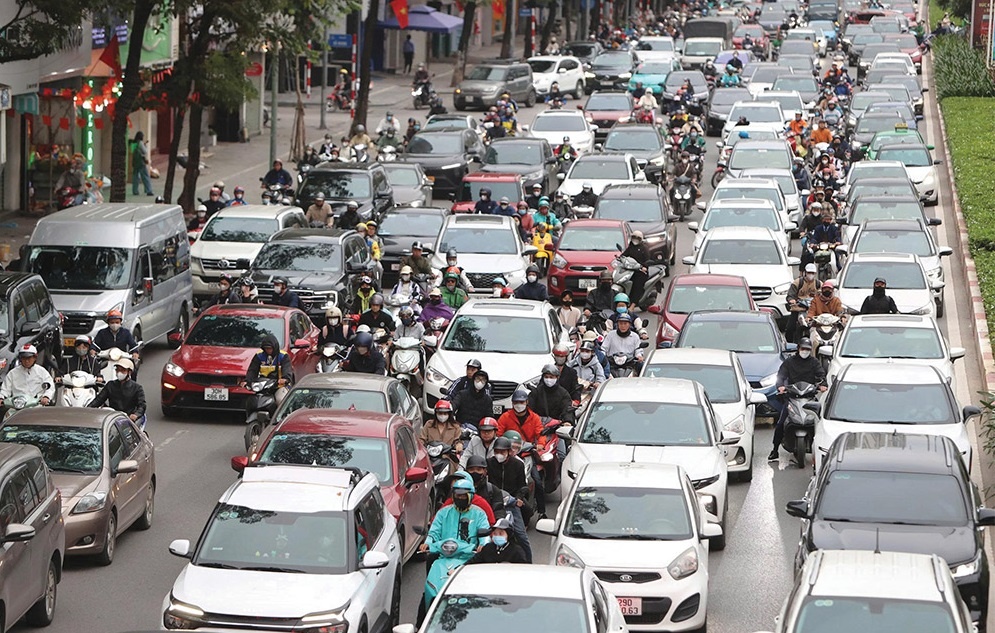 |
| There are millions of gas-powered motorbikes on the roads of the capital on a daily basis, Photo: Duc Thanh |
At a workshop on low emission zones held at the end of December, Dang Thuy Trang, director of public affairs at Grab Vietnam, noted that more than 70 per cent of ride-hailing drivers are freelance workers with unstable incomes. High upfront costs remain a major barrier to switching vehicles, with over 53 per cent of Grab drivers saying they can afford no more than $80 per month in instalments for an electric motorbike, while around 56 per cent lack access to home charging facilities. These constraints translate into considerable financial pressure for hundreds of thousands of drivers and their families.
“Grab has proposed that the city provide at least $400 in support per driver for vehicle conversion. For poor and near-poor households, we recommend a subsidy of up to 100 per cent, capped at $800,” Trang said. “In parallel, we are offering zero-interest loans over 24 months for electric vehicle purchases, along with proposals for tax and fee reductions and preferential electricity charging rates for service drivers.”
The establishment of low-emission zones has become a key pillar of the capital’s development strategy, particularly following Hanoi People’s Council’s issuance of Resolution No.57/2025/NQ-HDND in November. The resolution sets out a pilot roadmap from July 2026, including a ban on petrol motorbikes in nine inner-city wards, alongside measures to prioritise green transport, electric vehicles, and stricter emissions control.
According to Hanoi Department of Construction, the city currently has around seven million motorbikes in operation, including approximately 120,000 ride-hailing motorbikes, of which 88 per cent are petrol-powered.
Le Thi Thanh Thuy, deputy head of Environmental Management under Hanoi Department of Agriculture and Environment, warned that without effective oversight, the large-scale phase-out of non-compliant vehicles could generate a surge in end-of-life motorbike waste, creating new environmental pressures.
“We are advising the city to develop incentive schemes that encourage businesses to work with authorities to establish vehicle collection and recycling networks,” Thuy said. “Cost-sharing mechanisms between enterprises and the public sector will be critical to easing the burden on citizens, securing social consensus, and ensuring policies are workable.”
Environmental, social, and governance expert Pham Hoai Trung stressed that achieving emissions reduction targets will require close coordination with the business community. Transitioning to a low-emission model demands significant financial resources, particularly access to green finance. “When companies develop emissions reduction plans, their measurement and greenhouse gas inventories must be verified against internationally recognised standards,” Trung noted. “This means that every stage, from baseline assessment to emissions reduction pathways, must be grounded in clear and credible benchmarks.”
Resolution 57 also outlines the implementation progress. Some people’s committees in various city wards are proposing key solutions, emphasising the important role of communication and addressing issues in public opinion to achieve consensus.
Doan Thu Ha, Vice Chairwoman of Van Mieu-Quoc Tu Giam People’s Committee, said getting low emissions is an urgent need of the people and a pressing requirement of state management of the environment. “The people, officials, and party committees, government agencies, and organisations need to support and recognise that low emissions are necessary,” Ha said. “We believe that proposed solutions need to be carefully considered, maximising policies, resources, and details for all affected parties when implementing emission reduction policies.”
In the short term, the wards will comply with the city’s plan, with the spirit of ensuring low emissions and building on the effectiveness of previous campaigns, such as not using honeycomb coal, and other issues related to low-emission sources. In the medium and long term, these facilities will coordinate with relevant units to implement a roadmap for conversion.
Vice Chairwoman of Ba Dinh People’s Committee Nguyen Thi Doan Trang said they had carried out in-depth dissemination of information to ensure people understand the importance of low emissions.
“The dissemination followed a schedule rather than being rushed. Specifically, the ward clearly explained the emission levels according to each standard (levels 1-5) and the importance of complying with the new regulations when inspecting vehicles,” Trang said. “At the same time, the ward explained Resolution 57, at which we will explain in detail each implementation phase.”
Ba Dinh People’s Committee proposed a series of solutions. The priority is to establish target groups for appropriate outreach. It needs to create a list of groups needing support through neighbourhood committees, including households with old personal vehicles or vehicles used regularly requiring inspection; low-income workers, the elderly, small businesses dependent on vehicles, near-poor households; and agencies, units, and businesses located in the area.
Feedback from experts
Nguyen Tuyen, head, Transport Management and Traffic Safety, Hanoi Department of Construction
To implement low-emission zones, we have plans to implement measures such as developing infrastructure to support the transition to new modes of transport; reviewing and arranging stopping points and transfer points to connect different types of public passenger transport; and developing a system of public clean energy refuelling stations, and infrastructure for processing discarded electric vehicle (EV) batteries.
The department has deployed an inter-agency task force to survey locations for installing charging station infrastructure proposed by the people’s committees of communes and wards in the city. Through two survey phases, 110 locations were identified as suitable for installing charging station infrastructure. The department has proposed a pilot for installing charging stations and battery swapping cabinets for clean energy vehicles in Hanoi.
In the coming period, as head of the inter-agency task force, we will preside over and coordinate with the people’s committees of wards and communes, and relevant units to continue reviewing suitable locations for installing charging station infrastructure. We will identify suitable locations and land plots to finalise the planning and development plan for the system of charging stations in the city.
In addition, we will also advise the people’s committee on pilot implementation for areas and locations that meet the conditions and ensure compliance with common standards for green transportation vehicles.
Dr. Nguyen Minh Phong, economic expert
For Hanoi, the roadmap for creating low-emission zones needs to adhere closely to the Capital City Law. Hanoi People’s Council has specified the criteria and roadmap for identifying low-emission zones.
Firstly, it is necessary to identify the main objective as implementing low-emission zones and protecting the environment, avoiding extreme perceptions that contrast gasoline-powered and EVs and imposing a ban on gasoline-powered vehicles indiscriminately, regardless of whether their emission levels are high or low.
Secondly, the roadmap for banning gas-powered vehicles needs to be appropriate, avoiding shock to the Hanoi community and preventing negative impacts on the commuting hours of salaried workers.
Thirdly, penalties for gasoline-powered vehicles violating low-emission zones should be deterrent and gradually increase in proportion to the development, accessibility, and benefits of EVs and alternative public transportation.
Fourthly, the city needs to quickly deploy preferential policies and accelerate the development of infrastructure and a seamless, well-connected public transportation system to meet travel needs and promote green transportation.
Fifthly, it is necessary to strengthen communication and information dissemination, regularly assess the impact, and promptly address social criticisms and suggestions from citizens and businesses to avoid tension and social disorder caused by subjective impositions.
Sixthly, it is a must to implement other solutions in low-emission zones in a coordinated manner to protect the environment, such as thoroughly addressing dust emissions from daily life, construction, production, and business activities.
Nguyen Hoang Hai, vice president, Hanoi Public Passenger Transport Association
Restricting motorcycles that use fossil fuels, as outlined in the plan, will create at least four groups of pressures on the public passenger transport system. Firstly, there is pressure on transportation capacity. Passenger volume could increase by 15-25 per cent in areas with low emission zones (LEZs), requiring a rapid increase in the number and types of vehicles.
Next, there is pressure on service quality. As people shift from private vehicles to public transport, the demands for punctuality, convenience, safety, and door-to-door connectivity will be much higher.
Third is the financial pressure. Investing in EVs, charging infrastructure, and green depots requires significant resources, and in the initial stages, subsidies will still play a crucial role.
Fourthly, there is the pressure on organisation and management, ranging from adjusting routes and schedules to implementing intelligent operating technologies.
Faced with these challenges, the Hanoi Public Passenger Transport Association has determined that the approach to LEZ should not be defensive, but rather proactive, adaptable, and lead the transformation.
Regarding policy, the association recommends implementing LEZ in a multi-stage roadmap, by region and by target group, closely linked to giving absolute priority to public transport. Regarding vehicles, it is necessary to accelerate the transition to electric and green buses, while simultaneously developing smaller vehicles suitable for the urban core.
More importantly, LEZs present a historic opportunity to reposition public transport as a central hub, improve service quality, attract technology investment, and directly contribute to the goal of reducing emissions and improving the quality of life for Hanoi residents.
What the stars mean:
★ Poor ★ ★ Promising ★★★ Good ★★★★ Very good ★★★★★ Exceptional
 Tag:
Tag:Related Contents



Latest News




More News
- Raising construction materials supply chain standards amid green transition (October 08, 2026 | 14:00)
- Samsung Vietnam to deepen cooperation with local manufacturers (October 08, 2026 | 12:00)
- Sojitz in Vietnam: 40 years from individual projects to a business cluster 'KATAMARI' (October 08, 2026 | 09:00)
- Coteccons targets 'Quality Growth' with 25 per cent dividend plan (October 07, 2026 | 13:00)
- Vietnam Education Forum opens UK Education Mission's Hanoi visit (October 07, 2026 | 12:27)
- Tax authorities deactivate TINs of nearly 180,000 businesses (October 07, 2026 | 12:08)
- World Bank raises Vietnam's 2026 GDP growth forecast to 7.4 per cent (October 07, 2026 | 11:41)
- Vietstock 2026 to spotlight livestock innovation and green transition (October 07, 2026 | 09:00)
- Vietnam’s GDP grows over 9 per cent in first nine months (October 05, 2026 | 18:45)
- Vietnam earns $56.3 billion from agro-forestry-fishery exports (October 05, 2026 | 18:32)









 Mobile Version