
No more “cheap money” for real estate, experts say

Although Vietnam remains a global bright spot with solid macroeconomic fundamentals, the real estate market is facing a tough time, according to those at an industry seminar held on April 2 in Ho Chi Minh City.
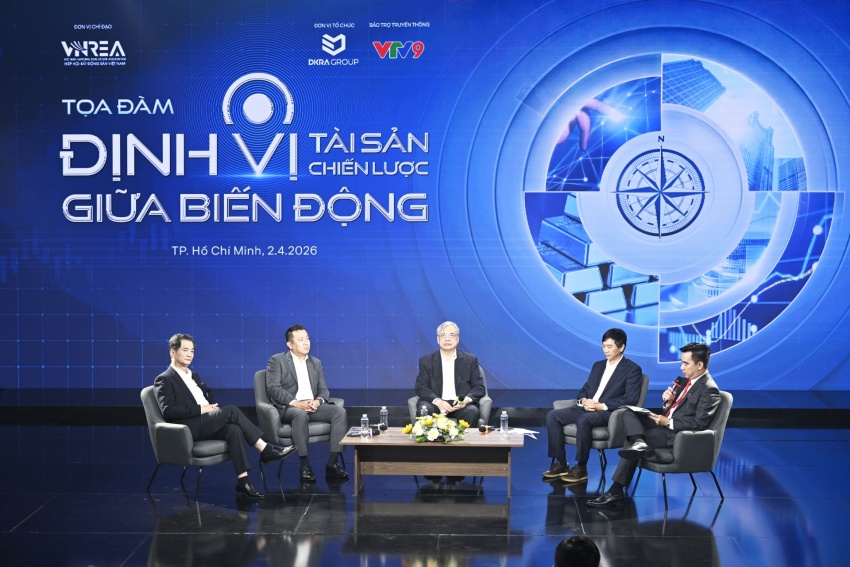 |
According to Tran Dinh Thien, former director of the Vietnam Institute of Economics, despite heightened global volatility, Vietnam has maintained impressive macroeconomic indicators. Specifically, the country is currently among the world’s top 10 fastest-growing economies, with its economy ranked 32nd globally and expected to soon rise to 30th place.
“The world is uncertain, but Vietnam is exceptional in its resilience and in sustaining strategic confidence,” Thien said.
Thien also warned that the upward trend in interest rates since late 2025 is placing considerable pressure on the broader economy, particularly the real estate sector, which remains heavily dependent on borrowed capital.
“For an economy with a high degree of openness and substantial outstanding debt, even a 1 per cent increase in interest rates can significantly raise financing costs,” he noted.
“A 1 per cent rise in interest rates is estimated to increase the economy’s annual interest burden by around VND184 trillion (around $7 billion), with the real estate sector alone facing an additional VND47 trillion ($1.8 billion) per year,” Thien said, adding that deposit rates reaching 9 per cent have pushed effective lending rates to 14-15 per cent, and in some cases as high as 16 per cent.
Another point of concern is the slowing velocity of money circulation, indicating that businesses’ capacity to absorb capital remains weak, while the economy continues to rely heavily on bank credit, which accounts for around 50-60 per cent of total funding.
“The mismatch between short-term capital and long-term investment demand is increasing liquidity risks, particularly for highly leveraged sectors such as real estate,” Thien added.
Meanwhile, Nguyen Van Dinh, vice chairman of the Vietnam Real Estate Association, noted that the real estate market had benefited for an extended period from cheap and readily accessible capital. This, in essence, reflected the government’s efforts to inject liquidity into the economy to stimulate growth, including in the property sector.
In the new context, capital flows will be allocated more selectively to support the economy’s double-digit growth objectives.
According to Dinh, financial resources can no longer be concentrated in only a few sectors, but must instead be distributed more efficiently across productive and higher-performing industries. This means capital will increasingly move towards areas generating real value, rather than speculative activities as seen previously.
“I do not believe the State Bank of Vietnam has any intention of tightening credit or monetary policy specifically for the real estate market. However, because capital must serve multiple sectors and prioritise more efficient locations and activities, speculative short-term trading aimed at taking advantage of overheated market conditions will inevitably be constrained,” Dinh said.
Dinh added that as money is no longer cheap or easily accessible, investors are being forced to reassess efficiency.
“In the past, when capital was inexpensive, short-term speculation could be profitable. Today, with financing costs rising and access to capital becoming more difficult, unsuccessful short-term trades can easily leave investors trapped in illiquid positions. This is a period in which the entire system is recalibrating towards a more substantive, higher-quality, and more efficient market,” Dinh said.
 | Vietnam moves to improve housing and real estate market Vietnam is amending the Law on Housing and the Law on Real Estate to create a more favourable, transparent market. |
 | Affordability and sustainability to define new real estate cycle In the new real estate cycle, success will favour developers who prioritise genuine affordability and sustainable financial structures over short-term sales tactics, according to Jerry Nguyen, deputy general director of Investment and International Market Development at Hoa Binh Construction Group. |
 | Q1 earnings picture mixed as cost pressures persist First-quarter 2026 earnings are forecast to diverge sharply across sectors, as high funding costs and macroeconomic uncertainties weigh unevenly on industries. |
What the stars mean:
★ Poor ★ ★ Promising ★★★ Good ★★★★ Very good ★★★★★ Exceptional
 Tag:
Tag:Related Contents





Latest News




More News
- MIK Group launches House of MIK in Ho Chi Minh City (October 03, 2026 | 17:00)
- Vietnam hospitality shifts towards integrated mixed-use developments (October 03, 2026 | 10:00)
- Stavian IP accelerates its modern expansion (October 02, 2026 | 14:00)
- ESG for future-ready industrial success (October 02, 2026 | 09:00)
- Green Future Awards honour five leading industrial park developers (October 01, 2026 | 22:20)
- Green transition leaders honoured at Green Future Awards 2026 (October 01, 2026 | 22:10)
- Six developers honoured as Emerging Green Industrial Property Developers (October 01, 2026 | 22:00)
- Why logistics will define the next phase of growth (October 01, 2026 | 09:00)
- Urban Development Law takes effect on October 1 (September 30, 2026 | 17:49)
- Phu My Hung to demolish Lawrence S. Ting Building for new development (September 30, 2026 | 17:43)



Latest News






 Mobile Version