
Untangling bottlenecks in Vietnam’s property market

 |
| Hoang Thu Hang |
Hoang Thu Hang, deputy director general of the Housing and Real Estate Market Management Agency under the Ministry of Construction
One of the key bottlenecks is that housing supply remains poorly aligned with underlying market demand. According to our data, more than 40,000 apartments were eligible for sale and rolled out to the market in Q1. However, the supply of low-cost, social and affordable housing remained limited, with just over 7,000 units available. Housing demand remains strong, while the supply of affordable homes continues to be constrained.
The key question is how to develop the mid-range apartments at price that are affordable for the average person. The government has also assigned the Ministry of Construction to research building affordable commercial houses.
Currently, the Ministry of Construction is working towards incorporating content related to the development of affordable commercial housing into the revised Law on Housing. As part of this process, we will continue to gather input from ministries, agencies, businesses, experts and the public.
The revised Law on Housing is expected to be submitted for approval in October. At present, we are in the policy proposal stage. Once approved, we will develop legal regulations.
We welcome further comments and recommendations from businesses, experts, regulators, and citizens to help refine the legal framework. Hopefully, once introduced, these policies will be effectively implemented, meet the housing needs of the public and ensure a balanced sharing of benefits between businesses and homebuyers.
 |
| Can Van Luc |
Can Van Luc, chief economist at BIDV and member of the National Financial and Monetary Policy Advisory Council
In recent times, speculation has decreased in Vietnam's real estate market. Speculative transactions in Hanoi have fallen by 30 per cent. Therefore, the issue of speculation isn't too worrying.
The main problem is the ongoing imbalance between supply and demand. It is worth noting that real estate businesses mainly focus on the high-end segment. Without proper direction, real estate businesses will continue to develop the high-end segment in the coming time.
I can say that the project licensing process has been very time-consuming, sometimes taking two to three years. Therefore, real estate businesses tend to prioritise projects that are truly worthwhile. Most of them apply for high-end project licences. Hopefully, in the future, the licensing process will be simpler and easier, allowing mid-range and low-end segments to develop more strongly.
We have made initial progress in addressing the low-cost and social housing segments, but more efforts are needed to better meet market demand. Meanwhile, the development of the mid-range housing segment at prices affordable to most households remains an area that requires further attention.
 |
| Nguyen Le Nam |
Nguyen Le Nam, director of Retail Banking Division at Asia Commercial Bank (ACB)
The bank is responding to the Prime Minister's directive to classify real estate segments to develop appropriate credit policies. This is a strategic step that will help the market become more transparent.
ACB does not provide financing for speculative real estate investments. Instead, the bank focuses its resources on serving genuine homebuyers, helping them access financing to improve their living conditions and build a better future for their families. The bank also works closely with developers to formulate reasonable financing packages and provides consulting solutions to support customers.
Indeed, the growth rate of home lending at ACB has declined. It stems not only from the bank's bank policies, but also homebuyers’ concerns over the uncertain economic outlook, high property prices and rising interest rates in recent times.
 |
| Huynh Anh Huy |
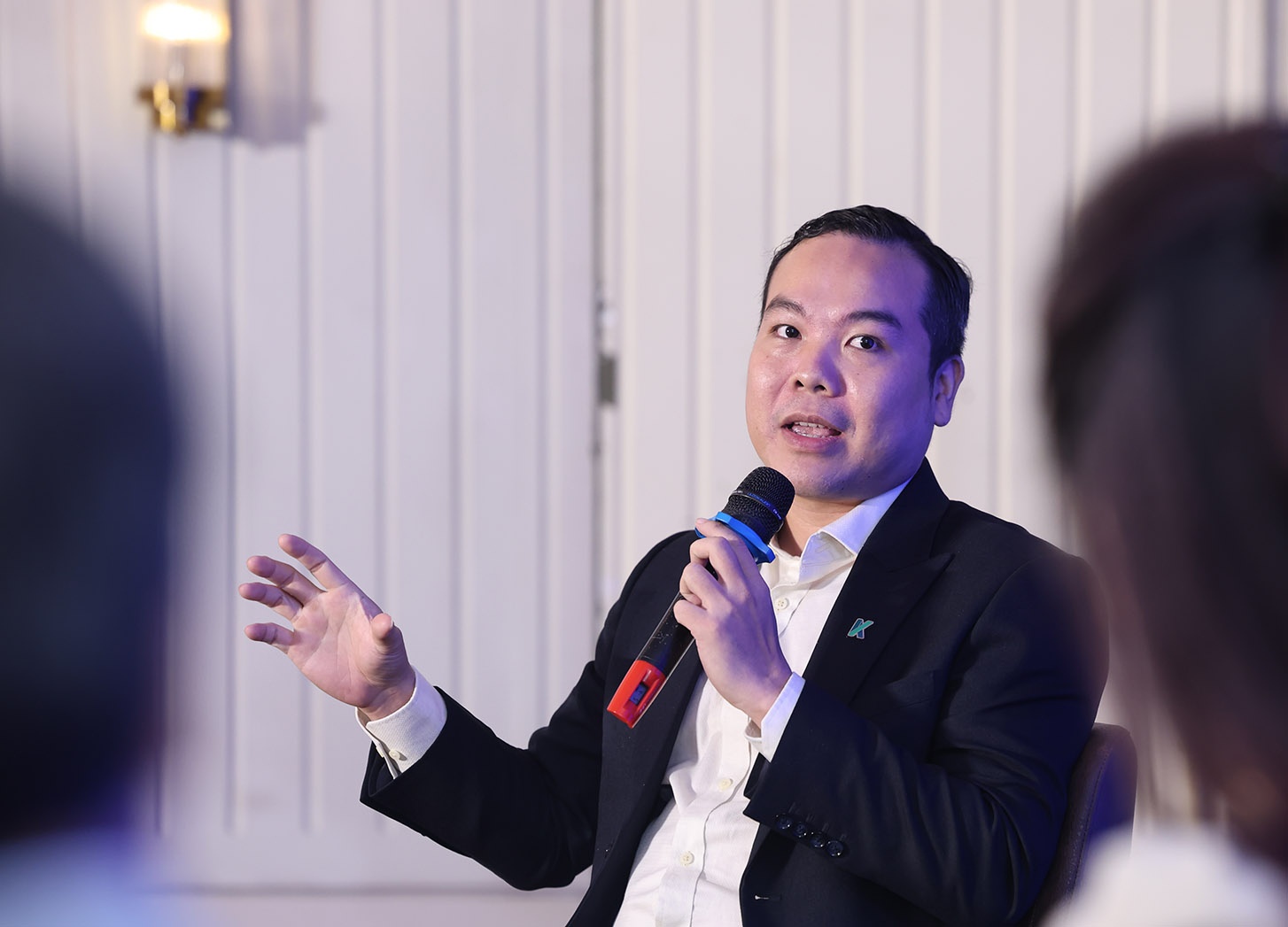
Huynh Anh Huy, director of Securities Industry Analysis at Kafi Securities Corporation
Market participants often cite banking stocks and a handful of large-cap names as the main drivers of the index’s gains. However, many real estate stocks are still undervalued. Thus, investors expect to see the real estate stocks in the next market wave.
Indeed, some real estate stocks are currently discounted by 30-40 per cent compared to their net asset value. This reflects the market’s continued cautious sentiment towards the sector’s outlook.
Nevertheless, the underlying fundamentals of many large real estate companies are considerably more positive. In the first quarter of 2026, a number of real estate companies recorded double-digit growth in business results. Some real estate companies posted a two- or threefold increase in profit thanks to project handover activities.
These results indicate that companies with strong financial foundations, sizable land banks and well-established market positions are recovering relatively quickly.
 |
| The discussion panel “Untangling Bottlenecks, Unlocking Resources” |
 | Real estate pressures could lead to healthier growth cycle Current headwinds could push Vietnam's real estate market into a more transparent, healthier, and sustainable growth cycle if capital flow and legal issues are effectively addressed, according to the editor-in-chief of VIR. |
 | Housing supply imbalance persists despite strong economic fundamentals Hanoi and Ho Chi Minh City continued to face a widening supply-demand imbalance in their housing markets in the first quarter of 2026, driven by a persistent shortage of affordable housing despite solid macroeconomic fundamentals. |
 | Listed companies deliver broad-based earnings surge in Q1 Vietnam’s listed companies posted a strong earnings rebound in the first quarter of 2026, with profit growth spreading across most sectors despite rising funding costs and persistent external uncertainties. |
What the stars mean:
★ Poor ★ ★ Promising ★★★ Good ★★★★ Very good ★★★★★ Exceptional
 Tag:
Tag:Related Contents



Latest News


More News
- MIK Group launches House of MIK in Ho Chi Minh City (October 03, 2026 | 17:00)
- Vietnam hospitality shifts towards integrated mixed-use developments (October 03, 2026 | 10:00)
- Stavian IP accelerates its modern expansion (October 02, 2026 | 14:00)
- ESG for future-ready industrial success (October 02, 2026 | 09:00)
- Green Future Awards honour five leading industrial park developers (October 01, 2026 | 22:20)
- Green transition leaders honoured at Green Future Awards 2026 (October 01, 2026 | 22:10)
- Six developers honoured as Emerging Green Industrial Property Developers (October 01, 2026 | 22:00)
- Why logistics will define the next phase of growth (October 01, 2026 | 09:00)
- Urban Development Law takes effect on October 1 (September 30, 2026 | 17:49)
- Phu My Hung to demolish Lawrence S. Ting Building for new development (September 30, 2026 | 17:43)



Latest News






 Mobile Version