
Vietnam moves to improve housing and real estate market

Deputy Minister of Construction Nguyen Van Van Sinh on March 23 chaired a meeting to discuss amendments of the Law on Housing and the Law on Real Estate, which was attended by representatives from the National Assembly's committees, ministries, agencies; associations, businesses, and localities.
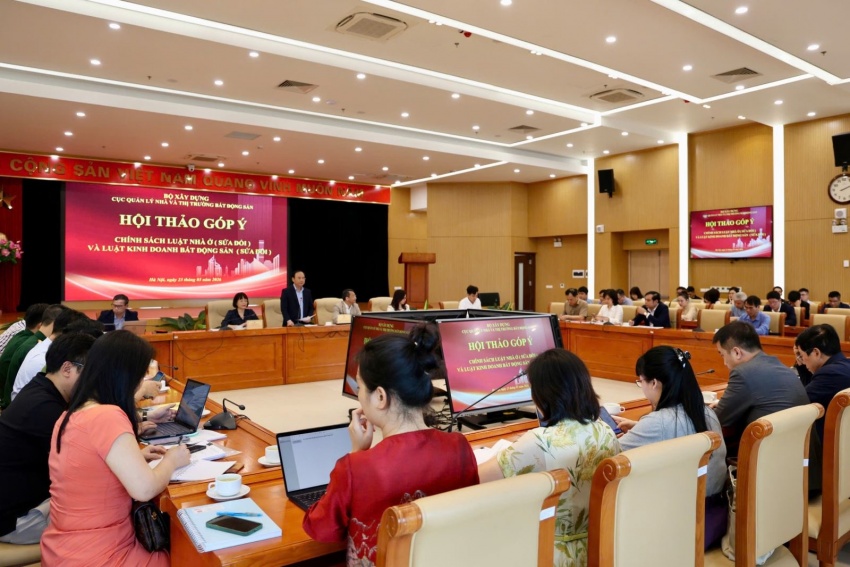 |
| Photo: The Ministry of Construction |
He said that the Ministry of Construction (MoC) had reviewed and developed policies related to the two laws. The review focused on strengthening decentralisation of power linked to the two-tiered local government model; reducing and simplifying business conditions and administrative procedures; reviewing to ensure consistency and uniformity with related legal documents.
During implementation, certain pilot policies may be developed. At the same time, the ministry will continue to review and aim to codify the policies currently being piloted into law.
Vuong Duy Dung, deputy director of the Department of Housing and Real Estate Market Management, said the amendment and supplementation of several provisions of the 2023 Housing Law aims to institutionalise Party and state policies on developing a socialist-oriented market economy.
The revisions are intended to create a more open, transparent, and secure legal environment with lower compliance costs, improve the investment and business climate, streamline administrative procedures in investment and construction, address practical shortcomings, and ensure greater consistency across the legal system.
Accordingly, the policies amending and supplementing the Housing Law focus on perfecting current regulations, comprehensively regulating all types of housing, avoiding legal gaps regarding development, management, use, ownership, finance, transactions, and state management of housing.
The amended Housing Law focuses on 11 specific policy groups: General policies on housing development; homeownership; national housing development strategy, provincial-level housing development programmes and plans; housing development; renovation and reconstruction of apartment buildings; social housing development; financing for housing development; housing management and use; apartment building management and use; regulations on the management and use of housing for residential purposes; and housing transactions.
Hoang Thu Hang, deputy director of the Department of Housing and Real Estate Market Management, stated that the policy aimed to create a complete, synchronised, and unified legal framework to manage the real estate market, support and encourage its development; ensuring consistency, uniformity, and avoiding overlap with other related legal systems such as the Investment Law, the Housing Law, the Land Law, and the Civil Law.
It also aims to create better conditions for real estate transactions, ensuring the stable, healthy, open, and transparent development of the real estate market; limit the emergence of administrative conditions and procedures in the management of real estate transactions and the real estate market; encourage the operation of real estate business relationships in line with the socialist-oriented market mechanism, accelerate administrative reforms, improve the capacity of real estate businesses, boost real estate transactions, and develop a transparent, healthy real estate market.
To achieve the objectives of amending the Law on Real Estate as set out above, the proposed amendments will focus on addressing eight major policy groups: adjusting general regulations; amending and supplementing regulations on business of housing and construction works; regulations on business of housing and construction works under construction; regulations on business of land use rights with technical infrastructure in real estate projects.
The others are amending regulations on the transfer of real estate projects; real estate business contracts; real estate service business and training, professional development, and certification in real estate service business; amendments regarding the management of information systems and databases on housing and real estate.
Hang stated that each policy group would include specific content, elaborating on existing regulations, or containing newly proposed content.
The deputy minister said that the MoC acknowledges and seriously considers the feedback, and will finalise the policy document.
 | Housing operations must be effective In 2025, the real estate market is expected to maintain a broadly stable growth trajectory. However, a number of persistent shortcomings and constraints remain and need to be addressed in order to ensure sustainable and effective development in the years ahead. |
 | Construction firms poised for growth on public investment and capital market support Building firms posted strong profit growth in 2025 and are entering the new year with expanding projects, supported by record public investment and signs of private sector recovery. |
 | Vietnam shifts into new real estate cycle A new real estate cycle is taking shape in Vietnam, driven by tighter capital, regulatory reform and shifting buyer behaviour, writes Jerry Nguyen, a board member and deputy general director of Investment and International Market Development at Hoa Binh Group. |
 | Vietnam's real estate market active but cautious Vietnam’s property market is expected to remain active this year, with housing demand continuing to underpin growth despite a more cautious investment climate. |
What the stars mean:
★ Poor ★ ★ Promising ★★★ Good ★★★★ Very good ★★★★★ Exceptional
 Tag:
Tag:Related Contents









Latest News




More News
- MIK Group launches House of MIK in Ho Chi Minh City (October 03, 2026 | 17:00)
- Vietnam hospitality shifts towards integrated mixed-use developments (October 03, 2026 | 10:00)
- Stavian IP accelerates its modern expansion (October 02, 2026 | 14:00)
- ESG for future-ready industrial success (October 02, 2026 | 09:00)
- Green Future Awards honour five leading industrial park developers (October 01, 2026 | 22:20)
- Green transition leaders honoured at Green Future Awards 2026 (October 01, 2026 | 22:10)
- Six developers honoured as Emerging Green Industrial Property Developers (October 01, 2026 | 22:00)
- Why logistics will define the next phase of growth (October 01, 2026 | 09:00)
- Urban Development Law takes effect on October 1 (September 30, 2026 | 17:49)
- Phu My Hung to demolish Lawrence S. Ting Building for new development (September 30, 2026 | 17:43)



Latest News





 Mobile Version