
Journalism in the AI age: Verification matters more than ever

Taken together, these developments highlight a clear reality: AI is becoming an indispensable part of modern journalism, but the more powerful the technology becomes, the greater the need for professional responsibility.
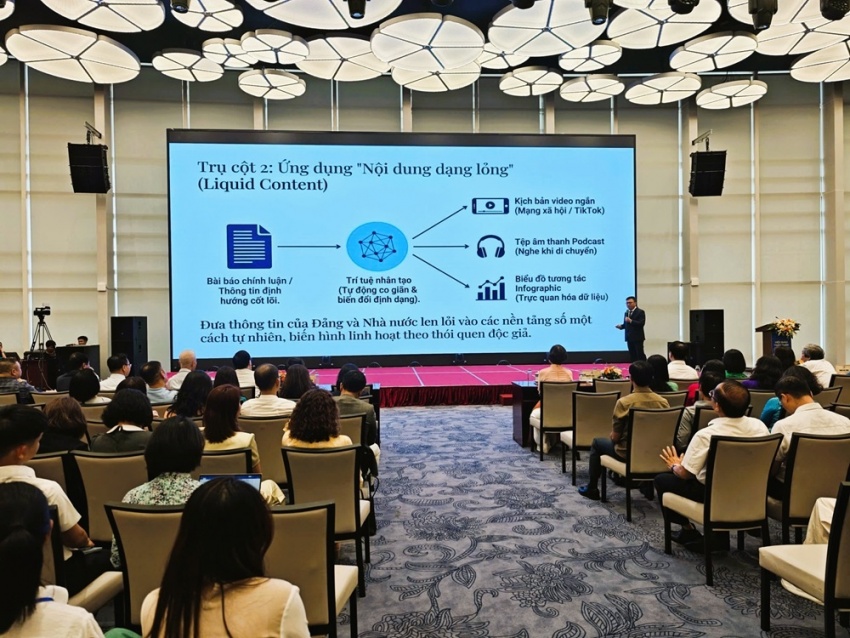 |
| Le Quoc Minh, chairman of the Vietnam Journalists Association, presenting at the National Press Forum 2026. Photo: Thanh Son |
Speaking at the closing session of the National Press Forum 2026 on June 19 in Haiphong city, Le Quoc Minh, chairman of the Vietnam Journalists Association, said, "In an era characterised by an explosion of AI-generated content and an overwhelming flow of information from social media, mainstream journalism cannot compete solely on speed. Instead, it must distinguish itself through credibility, verification and professional ethics."
His remarks reflect a challenge facing newsrooms around the world. AI can now generate text, images, videos and audio within seconds. While automation can significantly improve efficiency and reduce costs, it also introduces risks related to misinformation, copyright infringement and the erosion of public trust.
Against this backdrop, the Vietnam Journalists Association unveiled its 10 guidelines on AI use in journalism, providing what is effectively the first framework for news organisations navigating the adoption of emerging technologies.
At the heart of the guidelines is a simple but important principle: AI is a tool, not a replacement for journalists. Human professionals must retain control over all journalistic output, exercise editorial judgement and remain ultimately accountable for published content.
Another key principle is that AI should never be treated as a source of information. Any facts, figures, quotes or analyses generated by AI must be independently verified through reliable sources before being used in journalistic work. This is particularly important given that AI systems can still produce inaccurate information while presenting it in a highly convincing manner.
The guidelines also prohibit the use of AI to create fake news, fabricate data, invent sources or manipulate public understanding. Likewise, the use of deepfake technologies to deceive audiences through synthetic voices, images or videos is strictly forbidden.
Additional provisions focus on protecting confidential sources, safeguarding personal data, respecting copyright and ensuring transparency when AI plays a significant role in content production.
For sensitive topics such as politics, national security, natural disasters, public health emergencies, children and criminal investigations, AI may only serve as a technical support tool. Analysis, interpretation and editorial judgement must remain firmly in human hands and be subject to multiple layers of verification.
The message is clear: in the AI era, journalism's core value does not lie in producing content faster, but in ensuring that what is published is accurate and trustworthy.
 |
While media leaders were discussing principles for responsible AI adoption, the technology sector continued to push the boundaries of what AI tools can achieve.
Also in June, Google announced a major upgrade to NotebookLM, transforming it from an experimental project into a sophisticated global research platform capable of handling complex analytical tasks.
Unlike conventional AI chatbots, NotebookLM works primarily with sources uploaded by users themselves, including documents, PDFs, websites and research materials. This feature has made it particularly attractive to academics, researchers and journalists who require greater control over source material.
According to Google, Vietnam now ranks among the top 10 countries worldwide in NotebookLM usage and leads globally in views of publicly shared notebooks.
The latest version is powered by Gemini 3.5 and Antigravity technologies and can write and execute code to perform advanced data analysis. It is capable of synthesising large volumes of information, identifying relationships across multiple sources and generating outputs in various formats, including PDF reports, Excel spreadsheets and PowerPoint presentations.
For journalists, these capabilities can significantly reduce the time required to process extensive documentation, policy papers, industry reports or investigative materials. Instead of spending days reviewing hundreds of pages, reporters can use NotebookLM to identify key findings, cross-reference information and develop an initial research framework more efficiently. Alongside NotebookLM, Google is also expanding the capabilities of Gemini, its flagship AI assistant.
The company recently announced that Gemini has surpassed 900 million monthly active users worldwide, doubling its user base within just one year. At Google I/O 2026, the company introduced Gemini 3.5 Flash, the first model in the next generation of Gemini systems, designed to combine high-speed processing with advanced reasoning capabilities.
Several of Gemini’s features have direct relevance to journalism and knowledge work. Deep Research can help users plan research projects, gather information from multiple sources and generate structured reports. Canvas provides a dedicated workspace for drafting and editing long-form content, reports and presentations. Meanwhile, Gemini Live enables real-time interaction through voice and visual inputs, offering greater flexibility in information gathering and analysis.
Beyond productivity tools, Google is also strengthening Gemini’s creative capabilities. Nano Banana allows users to generate and edit images through natural-language prompts, while Lyria enables AI-assisted music creation. Google’s newly introduced Gemini Omni takes things a step further by combining text, images, audio and video generation into a unified workflow capable of producing coherent multimedia content.
These developments offer significant opportunities for modern multimedia newsrooms, where journalists are increasingly expected to create content across multiple formats and platforms. At the same time, they underscore why principles such as transparency and verification have become more important than ever.
When images, audio clips and videos can be generated in minutes, the line between authentic and synthetic content becomes increasingly blurred. Verifying the origin and authenticity of information is therefore emerging as one of the most critical responsibilities of professional journalism.
Google notes that all AI-generated content within its ecosystem is supported by SynthID, a digital watermarking technology designed to help identify and trace AI-created material. However, technological safeguards alone are not enough. Ultimately, responsibility still rests with human users.
The introduction of the Vietnam Journalists Association’s 10 AI guidelines is not intended to slow innovation. Rather, it aims to ensure that technological advances are adopted responsibly and in ways that strengthen, rather than undermine, the role of journalism.
As tools such as Gemini and NotebookLM become increasingly capable, journalists will gain access to powerful assistants that can enhance productivity, improve research and unlock new forms of storytelling. Yet in a world flooded with AI-generated content, professional integrity, rigorous verification and ethical judgement remain the qualities that distinguish trusted journalism from everything else.
AI may help journalism work faster, go deeper and operate more efficiently. But public trust, the profession’s most valuable asset, remains something only human beings can earn and protect.
 | AI and innovation reshape Vietnam’s journalism industry Technology is fast becoming a strategic cornerstone of modern journalism, influencing not only how news is produced and consumed, but also how media organisations sustain themselves in an increasingly competitive landscape. |
 | Redefining journalism amid social media disruption Vietnam’s revolutionary press has played a vital role in the country’s development for a century, from documenting key historical moments and shaping public opinion to reflecting social and economic changes. |
 | AI pushes journalists to rethink roles, skills, and responsibility The rapid rise of AI is prompting journalists to reconsider how they work, learn, and adapt in a shifting media landscape. |
What the stars mean:
★ Poor ★ ★ Promising ★★★ Good ★★★★ Very good ★★★★★ Exceptional
 Tag:
Tag:
Related Contents








Latest News



More News
- Sojitz in Vietnam: 40 years from individual projects to a business cluster 'KATAMARI' (October 08, 2026 | 09:00)
- Coteccons targets 'Quality Growth' with 25 per cent dividend plan (October 07, 2026 | 13:00)
- Vietnam Education Forum opens UK Education Mission's Hanoi visit (October 07, 2026 | 12:27)
- Tax authorities deactivate TINs of nearly 180,000 businesses (October 07, 2026 | 12:08)
- World Bank raises Vietnam's 2026 GDP growth forecast to 7.4 per cent (October 07, 2026 | 11:41)
- Vietstock 2026 to spotlight livestock innovation and green transition (October 07, 2026 | 09:00)
- Vietnam’s GDP grows over 9 per cent in first nine months (October 05, 2026 | 18:45)
- Vietnam earns $56.3 billion from agro-forestry-fishery exports (October 05, 2026 | 18:32)
- DSV balances resilience and decarbonisation in supply chains (October 05, 2026 | 18:20)
- Electronics exports reach $175.4 billion in the first nine months (October 05, 2026 | 18:12)



Latest News





 Mobile Version