
Data and governance key hurdles to AI scaling for Vietnamese firms

This operational hindrance took centre stage at a business seminar co-hosted by the Malaysia Business Chamber Vietnam and PwC Vietnam in Ho Chi Minh City on June 16, entitled “Making AI Work: Turning Proof of Concept to Value.”
Presenting the opening remarks, consul general of Malaysia in Ho Chi Minh City Firdauz Othman highlighted that bridging the commercial divide requires an immediate internal overhaul.
“The widening divergence between automation plans and actual commercial results requires companies to urgently restructure their data management, internal capabilities, and operational systems,” he said.
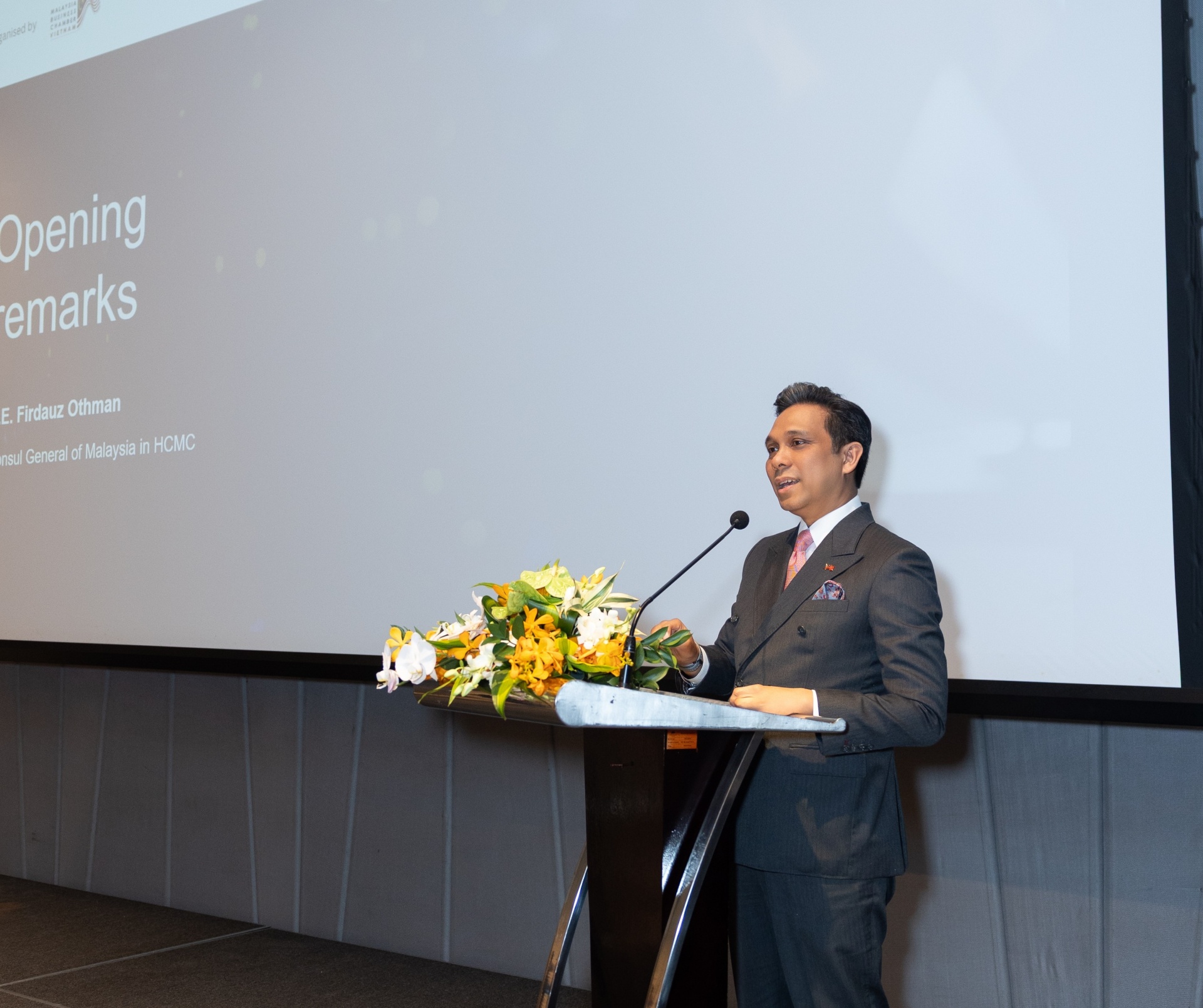 |
| Firdauz Othman, consul general of Malaysia in Ho Chi Minh City |
Vishy Narayanan, Asia Pacific digital and AI leader at PwC, pointed out that although capital expenditures for technological infrastructure had reached record levels in global and the Asia-Pacific region, financial value remained locked within technology owners rather than enterprise consumers.
According to the latest AI Adoption Survey conducted by PwC, while base adoption stands at 82 per cent, only 39 per cent of chief executives report generating additional revenue, while approximately half see zero financial upside.
“Organisations must treat AI as a permanent capability and a cognitive extension of their workforce, rather than an isolated software application,” Narayanan said.
Detailing these institutional barriers, Pho Duc Giang, partner at PwC Vietnam, explained that regulatory ambiguities and weak oversight structures often freeze enterprise rollouts.
“Firms face four distinct operational structural gaps blocking expansion: undefined ownership over risk, fragmented databases unable to provide clean information, compliance anxieties regarding the updated AI Law enacted in March, and an inability to explain complex machine methodologies to corporate boards,” Giang said, adding that corporate governance had to be embedded at inception rather than treated as an afterthought.
Narayanan explained that corporate groups focused too heavily on structured systems, ignoring the unstructured text and internal documents that held authentic commercial value. This is worsened by human resource hurdles and a unique cultural psychology.
“Employees frequently hide their automated tool usage from executives due to a fear that using automation will be misconstrued as incompetence or a lack of effort. Additionally, traditional departments tend to hoard information, whereas cross-functional sharing is essential to turn technology into a permanent corporate capability,” Narayanan said.
To combat these operational issues, business entities in Vietnam are moving from broad strategic mandates to rigid performance frameworks.
Le Ngoc Quoc Khanh, head of Digitalisation and Data Unit at Gamuda Land Vietnam, demonstrated how the property group integrated automation adoption directly into its leadership metrics.
“To drive true accountability, our organisation established that automated implementation must determine exactly 50 per cent of the annual performance appraisal for personnel at the senior manager level and above,” Khanh said.
To facilitate this, Gamuda utilises an opportunity statement framework, where departments must mathematically map manual workflows against automated timelines before receiving capital clearance.
Initiatives that solve genuine operational friction, such as generating design configurations within strict corporate branding guidelines, are green-lit, while novelty programmes are rejected.
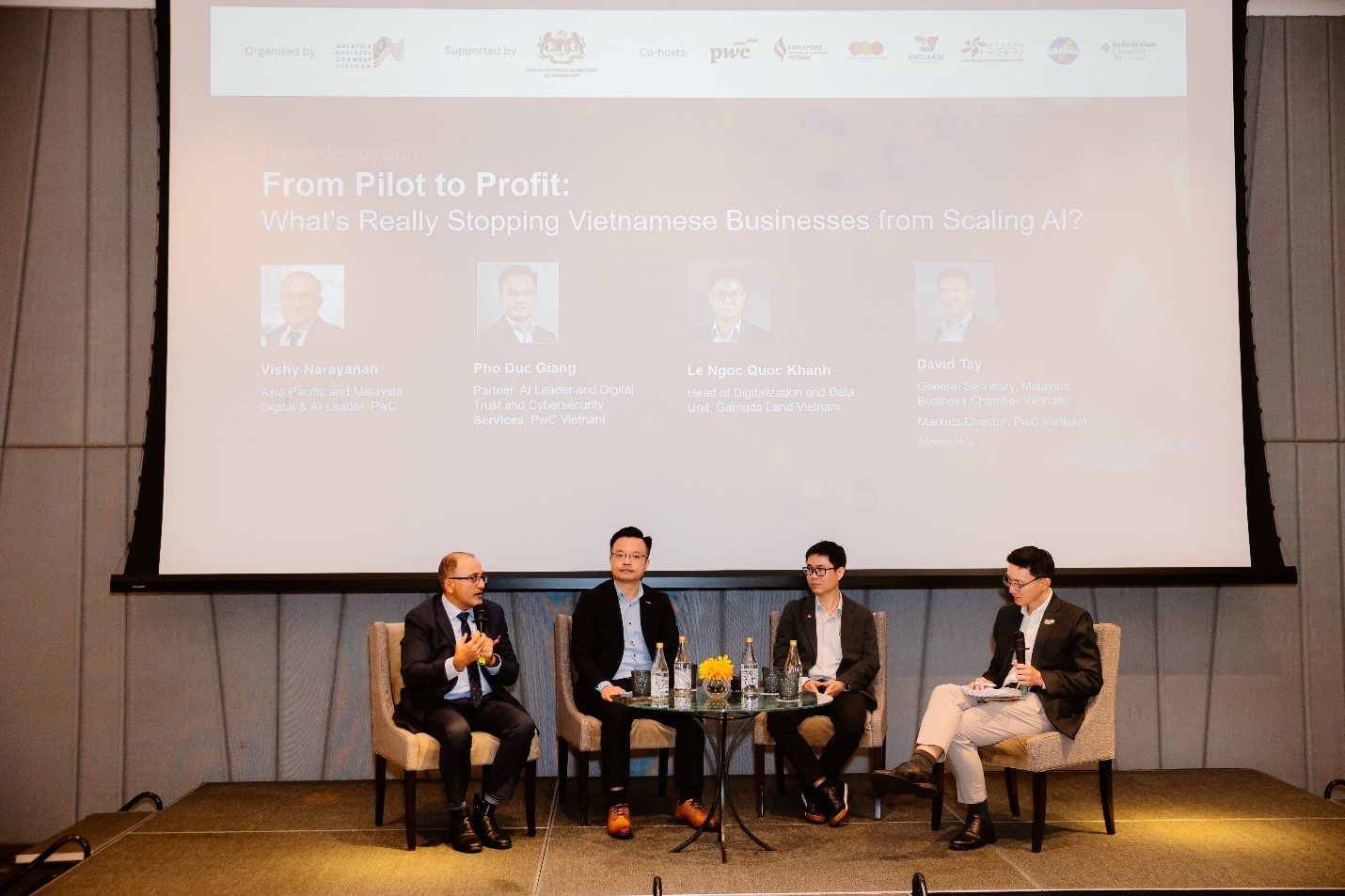 |
| The panel discussion “From Pilot to Profit - What’s Really Stopping Vietnamese Businesses from Scaling AI?" |
The Malaysia Business Chamber Vietnam (MBC) is a non-governmental, not-for-profit, non-political organisation registered in Vietnam. Established in August 2000, MBC provides interaction, assists Malaysian individuals and corporations established in Vietnam with valuable connections within the community whilst enhancing business relationships with the Vietnamese authorities and other multinational corporations.
MBC objectives involves bringing Malaysians together from diverse businesses to encourage and enhance interpersonal and professional development whilst engaging in community service initiatives.
 | PwC 2025 Family Business Survey: navigating a new era of agility and purpose PwC Vietnam has announced the launch of its 12th Family Business Survey, part of PwC's global study that gathered insights from 1,325 family businesses across 62 territories, including 32 from Vietnam. |
 | Vietnam a strategic growth engine for Asia-Pacific: CEO survey On March 5, PwC Vietnam announced the launch of its newest Global CEO Survey, revealing a profound transition for business leaders across the Asia-Pacific. |
 | Vietnam’s green push requires further hurdles to clear Vietnam’s energy transition is entering a decisive phase, where ambition is rapidly giving way to the harder realities of execution, bankability, and scale. |
What the stars mean:
★ Poor ★ ★ Promising ★★★ Good ★★★★ Very good ★★★★★ Exceptional
 Tag:
Tag:
Related Contents








Latest News


More News
- Leading in AI: from pilot initiatives to enterprise value (August 10, 2026 | 07:00)
- Programme launched to develop new Vietnamese business leaders (July 28, 2026 | 13:50)
- Family businesses face succession hurdles (June 30, 2026 | 17:05)
- Global shocks and tightening cash for Vietnamese business (June 22, 2026 | 06:00)
- Vietnam second fastest growing automotive market in ASEAN‑6 (April 20, 2026 | 20:34)
- Vietnam’s green push requires further hurdles to clear (March 30, 2026 | 08:00)
- The use of artificial intelligence to advance ESG goals for businesses (March 06, 2026 | 11:50)
- Vietnam a strategic growth engine for Asia-Pacific: CEO survey (March 05, 2026 | 17:12)
- PwC launches global workforce survey (February 09, 2026 | 17:42)
- Delivering urban railways and transit-oriented development (January 26, 2026 | 10:25)



Latest News






 Mobile Version