

Insurtech reshapes Vietnam’s insurance sector

The development of digital transformation in the insurance industry raises a pressing issue: as AI becomes directly involved in decision-making processes such as underwriting, pricing, and claims handling, insurers face unprecedented challenges in transparency and cybersecurity risks.
GreenNode said cyberattacks are becoming increasingly sophisticated as attackers harness AI to enhance their capabilities.
“Technology risk is no longer an internal IT issue, but a critical business risk. The insurance industry needs to shift its mindset from passive defence towards resilience, where systems can recover autonomously and maintain business continuity even in the face of a crisis,” said Mai Hai Duong, AI Product Manager at GreenNode.
To build this resilience, Duong said the key question for business leaders is how to use AI reliably.
“Insurance is one of the industries with the largest and most complex volumes of documents, paperwork and records, and every minute of processing delays directly affects the policyholder experience,” Duong said.
“For GreenNode, AI creates real value when it is deployed on infrastructure that is secure, compliant and stable enough to process sensitive data at scale. This is why we developed GreenNode IDP, an advanced evolution of conventional OCR tools and a comprehensive automated document processing platform designed to adapt to the diversity and unstructured nature of insurance records in real-world operations.”
 |
| Source: tinnhanhchungkhoan.vn |
Thai Huy Chuong, head of Software Development Department at BAOVIET IT Centre, BAOVIET Holdings said that rather than replacing existing systems, BAOVIET has adopted a Hybrid AI approach.
“Claims that can be handled efficiently through rule engines continue to follow the traditional automated process, while exception cases are routed to Agentic AI for deeper analysis and decision support. For high-value claims, AI serves only as an advisory tool, with final decisions remaining the responsibility of claims professionals,” Chuong said. “We also believe that deploying Agentic AI must go hand in hand with a robust AI governance framework. This includes explainability, complete audit trails covering the entire reasoning process, human oversight over key decisions, and strict standards for data privacy and security. Only when these governance mechanisms are in place can AI be deployed responsibly and generate sustainable value for the insurance industry.”
 |
| Nguyen Ngoc Tu, chief customer and digital officer of Chubb Life Vietnam. Photo: IEC Group |
In an interview with VIR, Nguyen Ngoc Tu, chief customer and digital officer of Chubb Life Vietnam, identified three values that technology will struggle to replace and that life insurers need to preserve to build lasting customer trust: clarity, consistency and care.
“Technology will continue to develop rapidly, from supporting advisory services and data analysis to digitising transactions end-to-end. However, life insurance remains fundamentally a business built on trust,” he said. “In the digital era, customers can access more information than ever, but trust comes from understanding the products they purchase. Insurers therefore need to be transparent about benefits, costs, terms and conditions, and the claims settlement process.”
“Technology can speed up processes, but trust is built when insurers consistently deliver on their commitments. Life insurance is a decades-long commitment, and trust is tested throughout the policy lifecycle, particularly when customers need to make a claim, receive post-sale support or seek assistance during difficult times,” Tu said.
Tu highlighted care, or human empathy, as the final key element.
“However far technology advances, life insurance remains closely connected to everyday decisions about protecting families, preparing for the future and dealing with unexpected events. At such moments, customers need accurate answers as well as someone they trust to listen, empathise and provide advice,” he said.
| Bach Ngoc An
Deputy CEO of Technology, OPES Insurance From our experience implementing AI in insurance, the most important criterion for deciding whether an AI application is worth investing in and scaling is its ability to create tangible business value. Insurers should not adopt AI simply because it is the latest trend. Every project must be evaluated carefully before investment. AI must first demonstrate clear advantages over existing approaches. In insurance, this can be seen in applications such as intelligent document processing for claims classification and processing, or AI-powered quality assurance that enables managers to focus on high-risk cases instead of conducting random reviews. Data is equally critical. AI models can only perform effectively when trained on sufficient volumes of high-quality data. Insurers should avoid an 'AI first, data later' approach. For example, vehicle recognition and damage assessment models require tens of thousands of training samples before they are ready for production. Finally, AI must be supported by strong governance. Because AI is inherently non-deterministic, insurers need clear risk management frameworks, contingency plans and human oversight. For high-impact decisions such as automated claims rejection or policy approval, AI should support, not replace, human judgment, with appropriate human-in-the-loop controls to ensure accountability. |

| Ho Quoc Thang
Data and AI solutions consultant, SVTECH Before deploying any AI model, insurers should ask four fundamental questions: whether premiums truly reflect underlying risks, whether emerging risks can be predicted early, whether AI models are integrated into daily operations rather than remaining proof-of-concept projects, and whether business users trust model outputs enough to incorporate them into decision-making. Insurance data is typically scattered across core systems, claims databases, customer records, distribution channels and external sources such as weather and public datasets. Individually, these data sources solve only isolated problems. Real value emerges when they are connected to provide a comprehensive view of risk. Data utilisation should be built as a continuous cycle. Every AI model should support a clearly defined business decision rather than simply demonstrating technological capability. Technology alone, however, is not enough. Successful AI adoption requires a strong trust layer comprising data governance, model validation, explainability, continuous monitoring and human oversight. Insurers should start with high-value use cases, implement them on a manageable scale, while designing data architecture and AI models that can scale over time. |

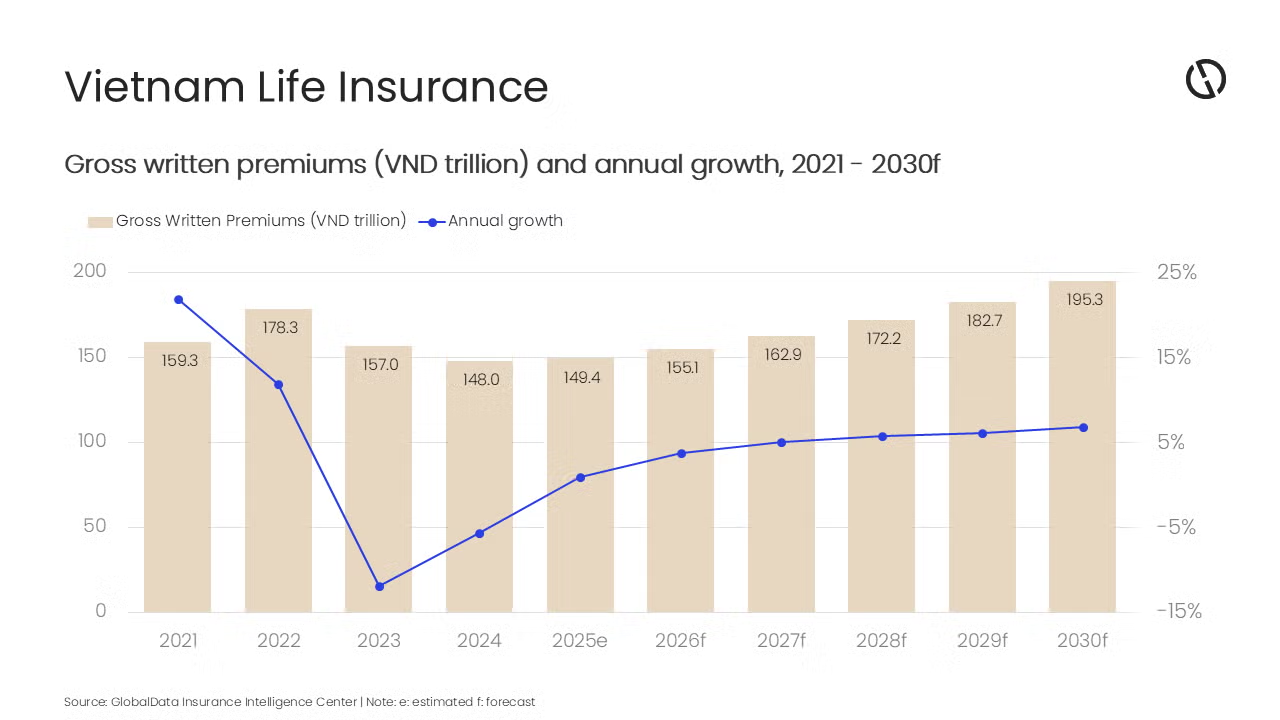 | Vietnam's life insurance industry to surpass $7 billion by 2030 Vietnam's life insurance industry is projected to grow at a compound annual growth rate of 5.9 per cent, increasing from $6 billion in 2026 to $7.2 billion by 2030 in terms of gross written premium, according to a report by GlobalData on April 15. |
 | Igloo expands into life insurance with Chubb Life partnership in Vietnam On June 2, Igloo, Southeast Asia’s only full-stack AI insurtech company, announced a strategic partnership with Chubb Life Insurance Vietnam Co., Ltd. and PT Chubb Life Insurance Indonesia, to distribute insurance solutions across Vietnam and Indonesia through Ignite by Igloo, its insurance sales intermediary platform. |
What the stars mean:
★ Poor ★ ★ Promising ★★★ Good ★★★★ Very good ★★★★★ Exceptional
 Tag:
Tag:Related Contents





Latest News



More News
- Insurance's next frontier lies beyond AI (August 01, 2026 | 09:00)
- Insurance struggles to keep pace with electric vehicle boom (July 28, 2026 | 17:27)
- AM Best maintains stable outlook on Vietnam's non-life insurance sector (July 27, 2026 | 11:59)
- Non-life insurers rebound on strong first-half results (July 24, 2026 | 16:24)
- Hanoi Re named “Best (Re)Insurer” as record profits and ratings upgrade mark 15th anniversary (July 24, 2026 | 09:00)
- NNX opens first insurance centre in Hanoi (July 08, 2026 | 16:17)
- Vietnam to unlock long-term savings through expanded pension fund (June 11, 2026 | 14:04)
- Infrastructure boom fuels expansion of non-life insurance market (June 06, 2026 | 14:40)
- Igloo expands into life insurance with Chubb Life partnership in Vietnam (June 06, 2026 | 11:25)
- Vietnam targets 25 per cent micro-insurance coverage by 2030 (June 05, 2026 | 14:42)










 Mobile Version