
Industrial parks to underpin Vietnam's next industrial breakthrough

The annual conference and exhibition, held on July 10 in Haiphong, "Developing Vietnam's Industrial Parks in Alignment with National Industrial Growth Objectives," brought together policymakers, local authorities, international organisations and businesses to discuss how industrial parks (IPs) can underpin Vietnam's next stage of industrialisation.
The event comes as Vietnam's industrial sector maintained solid momentum during the first half of the year despite external uncertainties. The Index of Industrial Production rose 10.8 per cent on-year, while manufacturing and processing expanded by 11.4 per cent, reaffirming its position as the country's principal growth engine.
However, widening disparities in industrial development among localities, together with growing demands for energy security, infrastructure upgrades, high-quality foreign investment and green transformation, are creating new challenges for Vietnam's industrial park system.
The event aimed to identify new growth drivers for Vietnam's IPs, ranging from integrated planning and infrastructure, reliable energy supply and logistics to digital transformation, green standards and the capacity to meet the evolving requirements of global supply chains. More than a platform for policy dialogue and the exchange of practical experience, the forum also served as a venue to foster cooperation, enhance the quality of investment attraction and support the country's industrial growth objectives in the years ahead.
Speaking at the forum, Nguyen Duc Hien, Deputy Head of the Central Committee for Policy and Strategy, stressed that Vietnam's IPs should move beyond their traditional role as production zones and infrastructure providers.
"Instead, IPs must become modern industrial ecosystems that bring together innovation, AI-enabled digital technologies and a highly skilled workforce. They should also serve as the foundation for forming innovation-driven industrial clusters that enhance productivity, competitiveness and the resilience of the economy, thereby contributing directly to Vietnam's next-generation industrial growth objectives," he said.
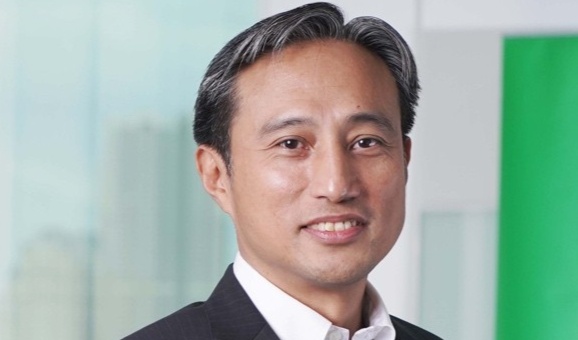
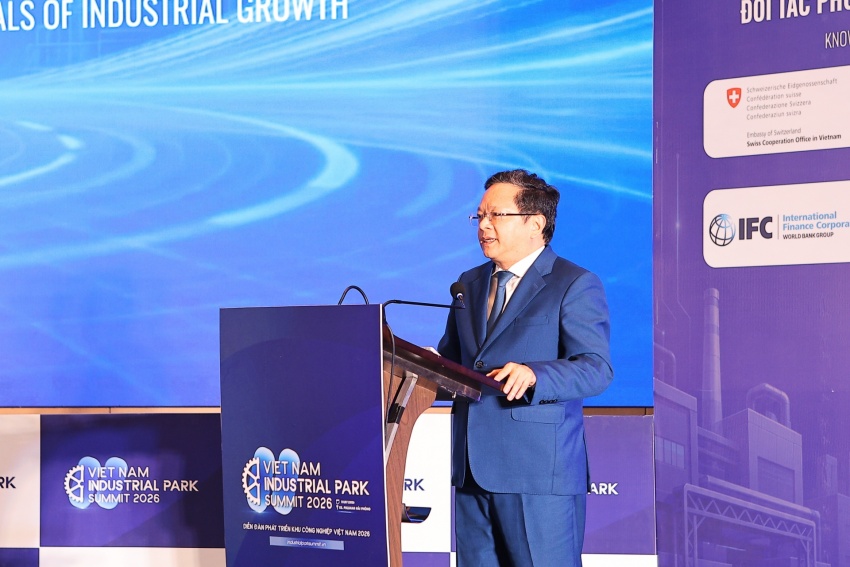 |
| Nguyen Duc Hien, Deputy Head of the Central Committee for Policy and Strategy. Photo: IEC Group |
Hien also revealed that the Central Policy and Strategy Commission was working with agencies to finalise the proposal entitled "Renewing the National Development Model Based on Science, Technology, Innovation and Digital Transformation."
"The proposal's core philosophy is to fundamentally shift from a growth model driven primarily by capital, natural resources and low-cost labour to one powered by sci-tech, innovation, data, highly skilled human resources and national self-reliance. Under this vision, next-generation IPs will no longer be merely production spaces, but platforms that integrate technology, innovation and strategic industries, creating new growth engines for the country," he added.
International partners shared a similar view, emphasising that sustainability and innovation will be key to the next phase of Vietnam's industrial development. Sibylle Bachmann, Chargé d'Affaires of the Embassy of Switzerland in Vietnam, noted that Vietnam had set two ambitious and mutually reinforcing national goals: becoming a high-income economy by 2045 and achieving net-zero emissions by 2050. These objectives, she said, require the country not only to industrialise, but to do so sustainably.
"The IPs of tomorrow can no longer simply provide land and infrastructure. They must become platforms for innovation, resource efficiency, low-carbon growth and industrial collaboration," she said. "Innovation does not happen in isolation. It requires ecosystems where businesses, researchers, infrastructure providers and public institutions work together. Modern industrial parks can provide exactly such ecosystems."
Bachmann stressed that this transformation was not only an environmental imperative, but also an economic necessity.
"Around the world, investors are increasingly choosing locations based not only on costs and logistics, but also on renewable energy, carbon performance, circular economy solutions and ESG standards. Industrial parks therefore play a decisive role in attracting the next generation of high-quality investment," she said.
"This direction is reflected both in international assessments and in Vietnam's own strategic vision. Recent policy reforms and Politburo Resolution 10 the development of the foreign-invested economy underline an important shift: from attracting more FDI to attracting better investment that brings technology, innovation, skilled jobs and supports Vietnam's green transition."
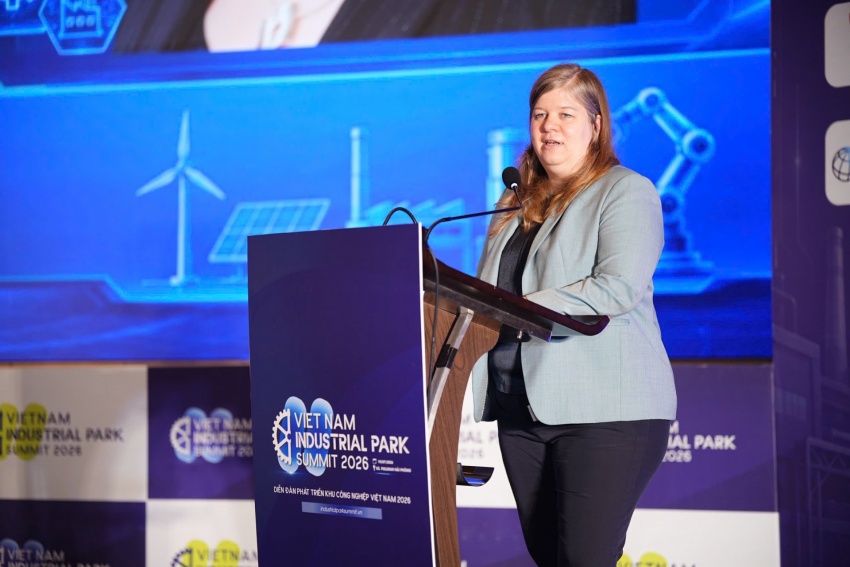 |
| Sibylle Bachmann, Chargé d'Affaires a.i. of the Embassy of Switzerland in Vietnam. Photo: IEC Group |
At the event, Bachmann also revealed that Switzerland and the United Nations Industrial Development Organisation are jointly developing the proposed Global Energy District Programme in Vietnam (GEDP Vietnam). The initiative aims to encourage energy districts powered by renewable energy, capable of providing efficient cooling, heating, electricity and other energy services for clusters of buildings, urban areas and IPs.
"This initiative is highly complementary to the Eco-Industrial Park Programme. While eco-industrial parks strengthen resource efficiency, circularity and industrial symbiosis at park level, GEDP can help provide the integrated, low-carbon energy infrastructure needed to make these parks cleaner, smarter and more competitive," she said.
"The next decade presents a unique opportunity for Vietnam to develop a new generation of smart, resource-efficient and climate-resilient IPs. Switzerland remains committed to supporting this journey by strengthening quality infrastructure, encouraging green finance, supporting innovation and creating better conditions for sustainable private sector development."
Dr. Nguyen Van Khoi, chairman of the Vietnam Association of Realtors and member of the Prime Minister's Advisory Council for Administrative Procedure Reform, said the ongoing restructuring of global supply chains, together with accelerating trends in green development, digital transformation, AI and the circular economy, is creating both opportunities and challenges for Vietnam as it seeks to strengthen its industrial competitiveness.
"To achieve the double-digit economic growth target in the coming years, in line with the direction set by General Secretary and President To Lam, we must create new growth drivers, with the development of modern industry continuing to play a pivotal role," he said.
"If we want industry to grow rapidly, we must first build a modern industrial park system. If we want to attract the world's leading technology corporations, we must provide development space that matches their requirements," Khoi said. "To enhance national competitiveness, IPs can no longer be limited to leasing land. They must evolve into high-quality ecosystems for manufacturing, innovation and supporting services."
Tran Van Quan, Vice Chairman of Haiphong People's Committee, reaffirmed the city's commitment to supporting the sustainable development of IPs nationwide. As one of Vietnam's leading industrial and economic hubs and a key international gateway in the northern region, Haiphong, he said, stands ready to accompany businesses and investors in this transition.
"During 2026-2030, Vietnam targets average annual GDP growth of at least 10 per cent, with manufacturing and processing industries continuing to serve as the primary growth engine. To achieve this goal, the industrial park system must continue to evolve through integrated planning and infrastructure development, green and digital transformation, stronger capacity to accommodate high-tech, semiconductor and innovation-driven projects, while significantly improving the investment environment and administrative procedures to reinforce the confidence of both domestic and international businesses and investors," he said.
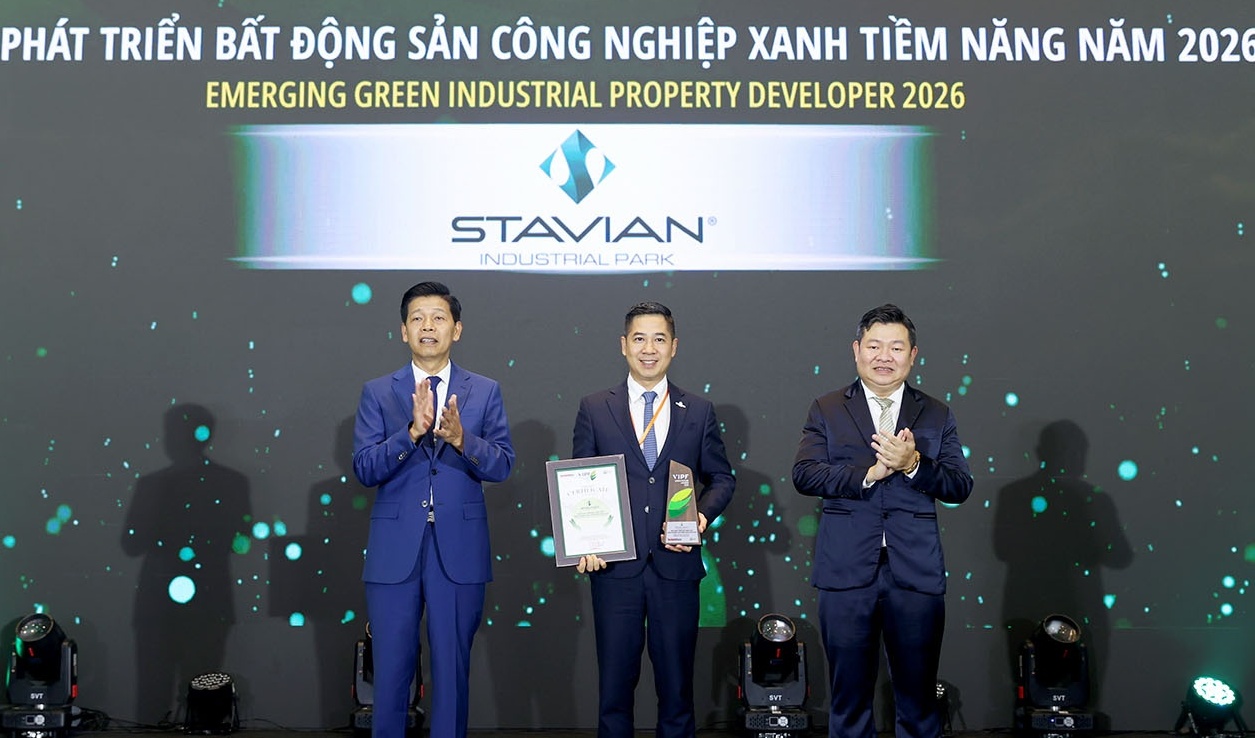
 | Stavian IP chief on building sustainable industrial ecosystems Stavian Industrial Park is expanding its network of green, smart, and sustainable industrial parks across Vietnam. General director Nguyen Tuan Anh shared the company's strategy and growth plans with VIR's Thanh Van. |
What the stars mean:
★ Poor ★ ★ Promising ★★★ Good ★★★★ Very good ★★★★★ Exceptional
 Tag:
Tag:
Related Contents


Latest News
More News
- Enterprises honoured for sustainability in industrial parks (October 06, 2026 | 11:49)
- Honouring businesses in Vietnam’s industrial property development (October 05, 2026 | 18:31)
- Soilbuild wins three awards at Green Future Awards 2026 (October 05, 2026 | 18:23)
- Vietnam emerging as an industrial location of choice (October 05, 2026 | 16:21)
- Investors interest amid ongoing reshuffling of global manufacturing (October 02, 2026 | 22:10)
- LŌ-GOI Group sets up industrial estate venture with three Asia-based institutional investors (October 02, 2026 | 16:00)
- Stavian IP accelerates its modern expansion (October 02, 2026 | 14:00)
- ESG for future-ready industrial success (October 02, 2026 | 09:00)
- Green Future Awards honour five leading industrial park developers (October 01, 2026 | 22:20)
- Green transition leaders honoured at Green Future Awards 2026 (October 01, 2026 | 22:10)



Latest News






 Mobile Version