
Ho Chi Minh City calls for investment in 38 new industrial parks

According to Truong Van Phong, deputy head of Ho Chi Minh City Export Processing and Industrial Zones Management Authority (HEPZA), the city currently has 67 export processing zones and industrial parks (IPs) that have been established.
Of these, 58 are already operational, with an average occupancy rate of 80 per cent, while the remaining nine parks have been approved but have yet to commence operations.
“Under the city's master plan to 2030, with a vision to 2050, Ho Chi Minh City will develop 105 IPs covering a total area of around 50,000ha, including 38 new parks spanning approximately 23,000ha. We are currently preparing detailed zoning plans to serve as the basis for calling for investment,” Phong said at a consultation workshop on governance models and financing mechanisms for emissions reduction projects in IPs, jointly organised by the Climateworks Centre at Monash University and the Ho Chi Minh City Institute for Development Studies (HIDS) on July 10.
Under the plan, the central area will focus on high-tech industrial development; the former Binh Duong area will serve as the city's industrial hub by leveraging its existing industrial land to support high-tech industries and innovation and science parks in the northern part of the city; while the former Ba Ria–Vung Tau area will be developed into a marine economic zone and free trade zone.
"With the expansion of industrial space, the transition towards eco-IP models has been identified as one of the city's key development priorities," Phong said.
Since 2020, HEPZA has collaborated with the United Nations Industrial Development Organization, the Japan International Cooperation Agency, and the World Bank piloted eco-IP models at Hiep Phuoc IP in Ho Chi Minh City, Bau Bang Expansion IP and Cay Truong IP in Binh Duong, as well as Phu My 3 Specialised IP in Ba Ria–Vung Tau.
“We are very encouraged that these IPs have now largely met the criteria for eco-IPs,” he said.
In particular, Phu My 3 Specialised Industrial Park, which spans 999ha, has fulfilled the required eco-industrial park criteria. The project has completed consultations with central ministries and agencies and is currently being finalised for submission to the city authorities for approval very soon.
“This will certainly become Vietnam’s first officially recognised eco-industrial park, creating an important foundation for the future development and transformation of IPs nationwide,” said Phong.
Despite the encouraging results from the pilot projects, HEPZA said that scaling up the transition across the broader IP network will require overcoming a number of significant challenges.
The first is the high upfront investment cost. To meet eco-IP standards, developers and tenants must make substantial investments in environmental infrastructure, clean energy systems, wastewater treatment facilities, and integrated management platforms. However, existing incentives related to land, taxation, and green finance remain insufficient to encourage widespread participation.
Another major obstacle is that most existing industrial parks have already completed their core infrastructure. Retrofitting these parks to meet eco-industrial standards is costly and can disrupt the ongoing operations of manufacturers.
According to HEPZA, there is also a shortage of skilled personnel capable of operating eco-IPs. At the same time, the regulatory framework governing industrial symbiosis, a core principle of the eco-IP model – remains fragmented. Businesses continue to face legal and regulatory barriers when seeking to use another company's by-products or waste materials as production inputs.
Beyond transforming IP development models, the energy transition has also emerged as a key priority in the city's green industrial transformation agenda.
Phong noted that the government's decision to raise the proportion of rooftop solar power allowed to be exported to the national grid from 20 per cent to 50 per cent is a positive policy signal that will encourage greater investment in renewable energy.
“However, in practice, rooftop solar systems installed in export processing zones and IPs are still largely unable to sell electricity to the national grid. Most projects continue to operate under a self-generation, self-consumption model,” he said.
According to Tran Van Bich, former head of the Economic Development Division at HIDS, Ho Chi Minh City currently accounts for more than 20 per cent of Vietnam's industrial output and oversees 116 IP projects covering a combined area of more than 48,400ha. The city's industrial development strategy is centred on high-tech industries, electronics, and food processing.
“During the 2030–2045 period, Ho Chi Minh City plans to restructure its industrial sector towards green, high-tech, and high value-added industries, while gradually phasing down resource-intensive and high-emission sectors. Priority will instead be given to strategic industries such as semiconductors, AI, biotechnology, and advanced materials,” said Bich.
At the same time, he added, existing IPs will be transformed into eco-IPs and smart IPs, supported by greenhouse gas inventories and the development of a carbon credit market.
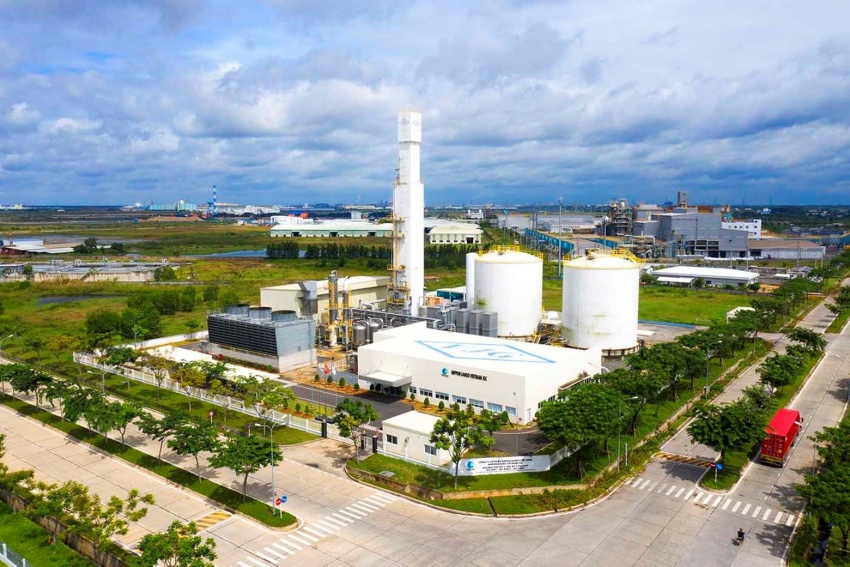 |
| Photo: Le Toan |
 | Enterprises ready for ESG Eco and Environmental, Social, and Governance are essential requirements for Vietnamese enterprises to integrate into global value chains, experts revealed at the seminar “Economic Outlook 2026: FDI Businesses and the Roadmap for Vietnam’s Rise” held in Ho Chi Minh City on April 2. |
 | Eco-industrial parks offer solution for foreign-led businesses amidst global volatility Against the backdrop of evolving global geopolitical shifts and stricter ESG standards, the eco-industrial park model is emerging as a pivotal solution for foreign companies to ensure self-reliance and maintain their position in the global supply chain. |
 | Industrial parks to underpin Vietnam's next industrial breakthrough Modernising industrial parks into innovation-led, sustainable industrial ecosystems will be critical for attracting high-quality investment, strengthening competitiveness and helping Vietnam achieve its next-generation industrial growth ambitions. |
What the stars mean:
★ Poor ★ ★ Promising ★★★ Good ★★★★ Very good ★★★★★ Exceptional
 Tag:
Tag:Related Contents


Latest News
More News
- Enterprises honoured for sustainability in industrial parks (October 06, 2026 | 11:49)
- Honouring businesses in Vietnam’s industrial property development (October 05, 2026 | 18:31)
- Soilbuild wins three awards at Green Future Awards 2026 (October 05, 2026 | 18:23)
- Vietnam emerging as an industrial location of choice (October 05, 2026 | 16:21)
- Investors interest amid ongoing reshuffling of global manufacturing (October 02, 2026 | 22:10)
- LŌ-GOI Group sets up industrial estate venture with three Asia-based institutional investors (October 02, 2026 | 16:00)
- Stavian IP accelerates its modern expansion (October 02, 2026 | 14:00)
- ESG for future-ready industrial success (October 02, 2026 | 09:00)
- Green Future Awards honour five leading industrial park developers (October 01, 2026 | 22:20)
- Green transition leaders honoured at Green Future Awards 2026 (October 01, 2026 | 22:10)







 Mobile Version