
Capital mobilisation essential for Vietnam's growth targets

 |
| Ha Thu Giang, director general of SBV's Credit Department |
The sustainable capital market development conference took place on July 23, organised by The Investor magazine. Ha Thu Giang, director general of the Credit Department under the State Bank of Vietnam, said the central bank has implemented monetary, and credit measures aimed at balancing inflation control, financial stability, and economic growth.
Bank lending has continued to increase since the beginning of the year, helping meet businesses' financing needs while remaining aligned with the economy's capacity to absorb capital.
As of July 13, outstanding credit had reached nearly VND20.1 quadrillion ($770 billion), up 7.86 per cent from the end of 2025. The increase represents an additional VND1.46 quadrillion ($57 billion) in financing provided to the economy over the period.
"The SBV has implemented credit policies in a proactive and flexible manner, directing capital towards production and business activities, priority sectors, new growth drivers, and key national projects," Giang said.
However, she noted that the banking sector continues to face several significant challenges. External uncertainties, including supply chain disruptions, strategic competition among major economies, trade conflicts, reciprocal tariffs, geopolitical tensions, rising energy prices, and higher transport costs, continue to weigh on business activity and affect credit demand.
At the same time, although deposit mobilisation has improved, the gap between credit growth and deposit growth remains substantial, creating funding pressure for banks.
According to the Ministry of Finance, Vietnam's total social investment demand is estimated at VND5.1 quadrillion ($200 billion) in 2026 and VND38.5 quadrillion ($1.5 trillion) over the 2026-2030 period.
Another structural issue is the economy's heavy dependence on bank lending. Credit outstanding was equivalent to approximately 145 per cent of GDP in 2025, while capital markets have yet to develop sufficiently to meet rising demand for medium- and long-term financing.
This imbalance is becoming increasingly challenging as Vietnam accelerates investment in major infrastructure projects and strategic industries. Banks continue to rely primarily on short-term deposits to finance longer-term loans, increasing maturity mismatch and liquidity risks across the banking system.
To support the government's growth objectives, Giang said the SBV will continue refining credit regulations to improve businesses' access to financing while directing credit towards productive sectors, priority industries, innovation, energy, agriculture, private enterprises, and nationally important projects.
The central bank will also strengthen monitoring of credit flows across industries, coordinate with ministries to resolve financing delays, and continue expanding the bank-business connectivity programme to better understand and address financing constraints faced by companies.
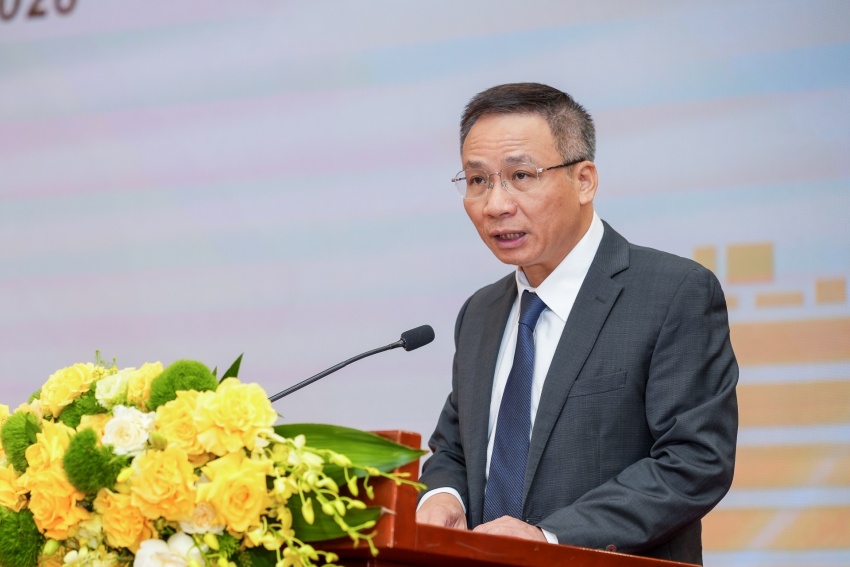 |
| Ha Duy Tung, vice chairman of State Securities Commission |
Alongside the banking sector, Vietnam's capital market has continued to grow, reinforcing its role as an increasingly important source of long-term financing. Ha Duy Tung, vice chairman of the State Securities Commission, said both macroeconomic conditions and the stock market delivered encouraging results during the first half of 2026.
As of June 30, total stock market capitalisation had reached approximately VND10.8 quadrillion ($423 billion), up 6 per cent from the end of 2025 and equivalent to 82.6 per cent of Vietnam's estimated 2025 GDP.
The market now includes 54 listed companies with market capitalisations exceeding $1 billion, including four companies valued at more than $10 billion. Meanwhile, the listed bond market reached around VND2.8 quadrillion ($109 billion), equivalent to 22.1 per cent of GDP.
Capital raising through equity issuance and corporate bonds also continued to increase, reaching VND325.3 trillion ($12.7 billion) during the first six months of the year, up 15.8 per cent year-on-year.
"The stock market continues to affirm its role as a key medium- and long-term capital channel for the economy. After nearly 30 years of development, Vietnam's stock market has established itself as one of the most dynamic markets in ASEAN," Tung said.
Officials also highlighted the government's recent policy agenda aimed at accelerating capital market development. Resolution No.10-NQ/TW, issued by the Politburo in June, calls for accelerating institutional reforms, developing different financial markets in a coordinated manner, and restructuring medium- and long-term capital markets to reduce dependence on short-term bank credit.
Government resolutions issued earlier this year have also prioritised removing obstacles, improving regulations, and developing transparent, efficient capital markets, including the stock and corporate bond markets.
Tung said these policies provide the strategic framework for the next phase of capital market reform. He also pointed to Vietnam's forthcoming upgrade by FTSE Russell from Frontier Market to Secondary Emerging Market status, which will take effect on September 21.
The upgrade is widely expected to attract billions of dollars in foreign investment over time. Estimates by HSBC and the World Bank suggest Vietnam could receive between $8 billion and $10 billion in long-term capital inflows.
 |
However, Tung argued that the significance of the upgrade extends beyond foreign investment. "The market upgrade is not just about attracting foreign capital. Its greater value lies in the reform momentum that it creates," he said.
Maintaining emerging market status will require Vietnam to align its market infrastructure and regulatory framework with international standards.
This includes shifting from a traditional supervisory approach towards one focused on market development and risk management, removing long-standing barriers such as pre-funding requirements for foreign investors, expanding English-language disclosure, and simplifying account-opening procedures for overseas investors.
These reforms, Tung said, would strengthen transparency, improve market accessibility, and enhance Vietnam's standing among international investors.
A higher market classification could also improve the country's investment profile, strengthen sovereign credit perceptions, and help Vietnamese companies raise capital internationally at lower financing costs. "The market upgrade is not the final destination. It is a strategic lever to help Vietnam build a more professional capital market that meets increasingly demanding global standards," he said.




What the stars mean:
★ Poor ★ ★ Promising ★★★ Good ★★★★ Very good ★★★★★ Exceptional
 Tag:
Tag:Related Contents


Latest News





More News
- Policy loans open new paths for people rebuilding their lives (October 07, 2026 | 17:24)
- FTSE upgrade opens door to $2 billion in passive fund inflows (October 07, 2026 | 12:12)
- VIB raises $1 billion from international markets in record funding plan (October 07, 2026 | 10:28)
- From loans to women’s economic empowerment (October 06, 2026 | 17:58)
- VIB named Outstanding Retail Bank 2026, targets transaction banking (October 06, 2026 | 10:52)
- FTSE upgrade paves way for stronger stock market development (October 05, 2026 | 18:44)
- coLoan to empower women through inclusive green finance (October 05, 2026 | 18:42)
- Techcombank CEO: AI no longer a tool but a new operating foundation (October 05, 2026 | 18:11)
- Banks sustain profit growth as funding costs squeeze margins (October 02, 2026 | 22:22)
- Nam A Bank delivers strong breakthrough in 2026 (October 02, 2026 | 19:00)







 Mobile Version