
Promising sectors identified for Vietnam's next growth phase

Those opportunities were highlighted by Nguyen The Minh, head of Investment Banking and member of the Executive Board at ABS Securities, during the Restructuring Capital Channels seminar hosted by Vietnam Investment Review on July 15 in Hanoi.
Among the sectors with the strongest long-term prospects, Minh placed energy at the top of the list, arguing that achieving Vietnam's ambitious growth targets will require substantial investment in electricity generation and supporting infrastructure.
"We are targeting a high level of economic growth. Energy will be a core pillar in the coming period, and I believe this is a sector that requires substantial investment," he said.
Semiconductors were also identified as a promising destination for future investment. While the global restructuring of technology supply chains is creating new opportunities, Vietnam's semiconductor industry still has only a limited presence in the capital market.
“Domestic technology companies such as CMC Corporation have made initial moves into the sector, but their contribution to the global semiconductor value chain remains modest,” he added.
Minh pointed to growing openness in technology transfer, particularly from China, as an opportunity for Vietnamese enterprises to strengthen their capabilities. Although Beijing is gradually tightening controls over advanced technologies, the broader market environment continues to create opportunities for Vietnamese companies to access new technologies and integrate more deeply into global supply chains.
“However, turning these opportunities into investment will require easier access to long-term capital,” Minh said.
One obstacle lies in the relatively high cost of capital faced by Vietnamese businesses, whose funding structures continue to rely heavily on bank credit. Lower financing costs, Minh argued, would enable companies to invest more aggressively while strengthening their competitiveness over the long term.
“Access to international funding presents another challenge,” he said.
Vietnamese companies remain subject to the country's sovereign credit rating ceiling, meaning their international credit ratings cannot exceed Vietnam's own rating regardless of their financial strength. Minh compared the mechanism to margin lending limits in the stock market, where borrowing capacity is constrained despite the quality of the underlying assets.
“The impact can be seen even among Vietnam's largest companies,” Minh said. “Vinamilk, for example, holds the highest domestic credit rating of AAA but cannot obtain an international rating higher than Vietnam's sovereign rating, currently BB+. As a result, leading Vietnamese enterprises may still find it difficult to secure funding from major international financial institutions because they fall short of global credit rating requirements.”
Improving both Vietnam's sovereign credit rating and the credit standing of domestic companies should therefore become a priority in the coming years. Besides expanding businesses' access to overseas funding, stronger credit profiles would also help banks diversify their own funding sources.
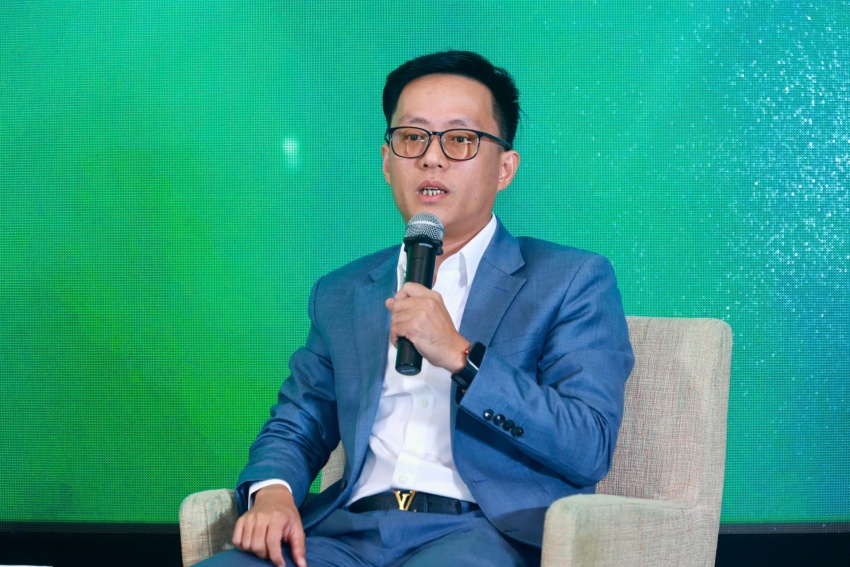 |
| Nguyen The Minh, head of Investment Banking and member of the Executive Board at ABS Securities. Photo: Chi Cuong |
According to Minh, two years ago, when domestic liquidity was abundant, banks relied primarily on local funding. With domestic funding costs now approaching those in international markets, many lenders have started issuing bonds overseas to secure medium- and long-term capital.
Beyond conventional financing channels, Minh identified ESG finance as another important source of long-term funding that remains largely underdeveloped in Vietnam.
Although more businesses are incorporating environmental, social, and governance (ESG) into their development strategies, the country still lacks a clear and consistent framework capable of attracting meaningful ESG investment. Most ESG transactions continue to take the form of private placements, where financing is arranged with a limited group of designated investors rather than through broader capital mobilisation.
International financial institutions, including the World Bank, International Monetary Fund and International Finance Corporation, remain willing to provide ESG financing at competitive costs. Unlocking these funding sources, however, will require Vietnamese enterprises to strengthen investor confidence while demonstrating greater alignment with internationally recognised ESG standards.
“Improving access to affordable capital will ultimately determine how quickly strategic industries such as energy and semiconductors can expand, attract investment and become new drivers of Vietnam's next phase of economic growth,” Minh said.
 | VIR to host capital restructuring seminar in Hanoi with policymakers VIR is set to host a seminar in Hanoi on restructuring capital channels, bringing together policymakers and market participants. |
 | Capital channel reform critical to Vietnam's next growth phase Restructuring Vietnam's capital channels has become increasingly urgent as the country seeks to mobilise an estimated $1.54 trillion to support its double-digit growth ambitions over the next five years, delegates heard at a seminar in Hanoi. |
 | Capital concentrated in later-stage startups, leaving funding gaps for early ventures Capital remains available for Vietnam's innovation economy, but it is becoming increasingly concentrated in later-stage companies, exposing critical funding and exit gaps that could constrain the next generation of startups. |
What the stars mean:
★ Poor ★ ★ Promising ★★★ Good ★★★★ Very good ★★★★★ Exceptional
 Tag:
Tag:Related Contents




Latest News



More News
- Vietnam and Switzerland to deepen financial cooperation (October 19, 2026 | 13:24)
- Carbon finance hinges on viable ventures (October 19, 2026 | 09:59)
- AI to transform the future of finance (October 19, 2026 | 09:04)
- Government proposes relaxing IPO conditions (October 19, 2026 | 08:00)
- Citi warns of intensifying competition for capital amid higher rates (October 16, 2026 | 16:54)
- Banks poised for Q3 profit growth amid margin pressure (October 16, 2026 | 16:51)
- Eximbank to strengthen corporate governance structure (October 16, 2026 | 11:32)
- Citi honours 13 banks with 2025 STP Awards (October 15, 2026 | 16:01)
- Green transition requires realistic roadmap (October 14, 2026 | 17:31)
- VIR workshop explores credit policy and carbon market development (October 14, 2026 | 11:22)








 Mobile Version