
FIEs' listing on Vietnam's stock exchange, unlocking new capital

At a seminar on the listing roadmap for foreign-invested enterprises (FIEs) in Hanoi on July 28, policymakers, regulators, and market experts said unlocking FIE participation will require clearer regulations, stronger corporate governance, greater transparency, and closer coordination between regulators, advisers, and businesses. The event was jointly organised by SSI and Daiwa Securities Group.
Thomas Nguyen, chief global markets officer at SSI Securities, said that the initial public offering (IPO) market has shown signs of recovery, although the overall quality of new listings remains uneven.
“Many recent IPOs and listings have involved subsidiaries of companies already listed on the market. While these transactions add supply, they do not necessarily broaden sector representation or significantly expand investment opportunities,” stated Nguyen. “Some recent offerings have also struggled to attract sufficient investor demand, with arrangers occasionally required to purchase unsold shares. This suggests that Vietnam has not yet developed the deep, confident institutional IPO market seen in more mature markets.”
“Going forward, the market will require more large-scale, high-quality issuers with strong corporate governance, sustainable growth prospects and exposure to sectors that remain underrepresented on the exchange. Vietnam's listed market is still heavily concentrated in banking, real estate and a limited number of blue-chip companies. The next wave of IPOs should broaden sector diversity and expand the investable universe,” he said.
In this scenario, Nguyen noted that one particularly important milestone would be the listing of a major foreign-invested enterprise.
“Despite contributing around 80 per cent of Vietnam's exports, FIEs remain largely absent from the domestic equity market. Their participation would broaden sector representation, raise corporate governance standards, introduce internationally managed issuers to the market and demonstrate that Vietnam's capital market is capable of supporting companies operating under global ownership structures and international investor expectations,” said Nguyen.
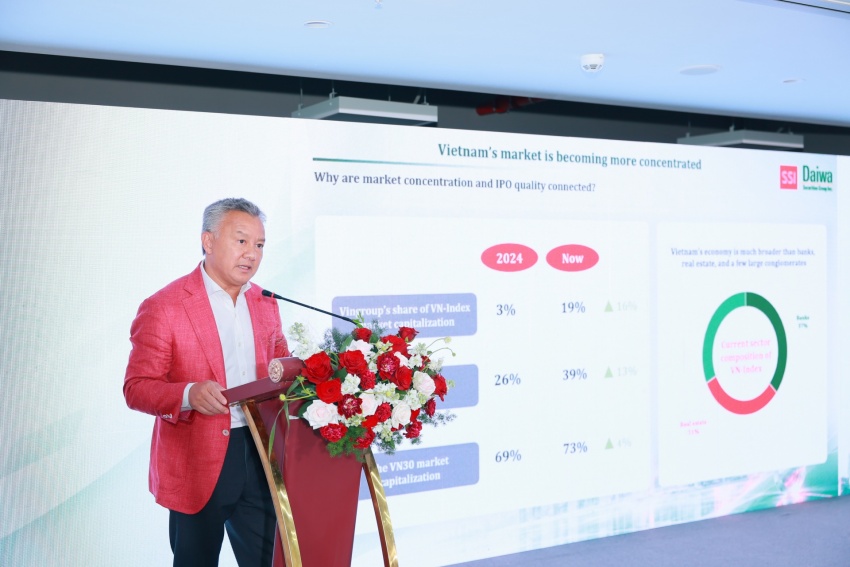 |
| Thomas Nguyen, chief global markets officer at SSI Securities. Photo: SSI |
Tran Kim Dung, deputy director of the Department of Securities Offering Regulation under the State Securities Commission (SSC), said that in the process of finalising the legal framework for the stock market, the SSC received significant support from Japanese experts and partners, particularly regarding advice on shortening the IPO process linked with listing.
“One of the key outcomes is that Decree 245 has been amended to integrate IPO procedures with listing, while shortening processing time to 30 days. This is considered a significant reform aimed at enhancing market efficiency and boosting attractiveness to investors,” she added.
According to Dung, prior to submitting applications for public company registration, IPO, or listing, enterprises must review all existing conditions, commitments, and outstanding obligations in their investment certificates.
“If an enterprise still has commitments to fulfill, it must first complete or fully resolve these obligations before submitting its application to the SSC,” she said. “Upon receiving the dossier, the SSC will coordinate with functional departments under the Ministry of Finance, such as the Foreign Investment Agency, the Agency for Enterprise Development, and the Agency for Private and Collective Economic Development, to verify whether the enterprise faces any outstanding issues related to its investment licence or other legal regulations. If no issues arise, the application will be appraised through the standard procedure.”
Dung noted that the SSC also sends information to relevant agencies such as the Ministry of Public Security, the Ministry of Justice, the State Bank of Vietnam, and local Departments of Finance to verify the legal status of the enterprise.
“In cases where an enterprise still has violations or unfulfilled commitments with the government or local authorities, relevant agencies will immediately notify the SSC for joint review and resolution. If there are no issues, the entire appraisal process will proceed normally, fairly, and transparently, as with any Vietnamese enterprise,” she added.
 |
Assessing the role of FIEs in supplying quality market products, Trinh Son Hong, acting chairman of the Ho Chi Minh Stock Exchange, noted that having more listed FIEs will bring significant value to the development of Vietnam’s stock market.
“First and foremost, the participation of FIEs will contribute to diversifying the structure of financial products on the stock market. Currently, overseas funding operates across various manufacturing, business, and service sectors, including many enterprises with large capital scale, high operational efficiency, and strong financial foundations. The listing of these enterprises will add more high-quality stocks to the market,” stated Hong.
“The majority of FIEs have foreign parent companies and have already adopted advanced corporate governance standards. Upon joining Vietnam’s stock market, this group of enterprises is expected to contribute to elevating corporate governance quality, enhancing information disclosure transparency, and promoting modern governance standards across the listed business community,” he added.
Hong expressed hope that more FIEs will carry out IPOs and listings in the future. However, according to him, the decision to go public still depends on each enterprise’s development strategy and internal conditions, including capital-raising needs, orientation towards becoming a public company, and the capacity to meet higher requirements regarding corporate governance and information disclosure.
Sharing from an advisory perspective, Tran Son Phu, general director of Ernst & Young Vietnam, noted that through years of accompanying FIEs, including many Japanese companies and enterprises listed on the stock market, he observed that listing is not merely a capital-raising activity, but also requires enterprises to undergo a comprehensive upgrade in governance, finance, and compliance.
“When deciding to enter the stock market, FIEs enter an environment with higher demands for governance and information transparency. Firstly, enterprises need to thoroughly review all legal conditions and compliance obligations, particularly for cases belonging to specific conditional investment sectors identified by regulatory authorities,” stated Phu.
“In addition, FIEs must upgrade their accounting and finance functions to meet stock market reporting requirements,” he added. “Previously, many FIEs were only required to prepare and submit annual financial statements. However, upon becoming a listed company, enterprises must comply with periodic reporting obligations, such as reviewed semi-annual financial statements, quarterly financial statements, and various other disclosure requirements.”
Phu noted that beyond periodic reports, FIEs must also fulfill extraordinary information disclosure regulations within very short timeframes, in some cases within just 24–72 hours from the occurrence of the event.
“This means that reporting systems, data management processes, and the capability of the finance team must be upgraded to fully satisfy stock market requirements and legal regulations,” he said. “Another critical requirement is that enterprises must establish a corporate governance model aligned with listing standards. Under current regulations, the governance structure will differ significantly from that of a standard FIE. For instance, the company must have an appropriate number of board members, with at least 30 per cent being independent board members.”
What the stars mean:
★ Poor ★ ★ Promising ★★★ Good ★★★★ Very good ★★★★★ Exceptional
 Tag:
Tag:
Related Contents


Latest News



More News
- Stronger carbon market needed to unlock climate finance (October 14, 2026 | 11:00)
- Carbon market opens new avenues for green finance (October 14, 2026 | 10:00)
- VPBank and Western Union enhance digital remittance experience (October 13, 2026 | 15:44)
- Eximbank’s next chapter: Richa Goswami on purpose, relevance and trust (October 13, 2026 | 10:52)
- Vietnam and Luxembourg sign MoU to strengthen financial cooperation (October 13, 2026 | 10:20)
- Vietnam seeks stronger cooperation with Fitch Ratings to improve sovereign credit rating (October 13, 2026 | 10:07)
- Nam A Bank named in top 10 largest listed banks in Southeast Asia (October 13, 2026 | 09:46)
- Citi appoints Michael Zezas as global head of research (October 12, 2026 | 17:23)
- From carbon value to greener capital (October 12, 2026 | 09:15)
- From cost advantage to ecosystem strength (October 12, 2026 | 09:00)







 Mobile Version