
5G to drive next growth phase in Vietnam

 |
| Rita Mokbel, president at Ericsson Vietnam |
How has 5G commercialisation been performing in Vietnam since its rollout last year, and what new 5G use cases has Ericsson brought forward?
5G has been commercialised since October 2024, with all our customers, Viettel, VNPT and MobiFone launching their 5G services in Vietnam. In major cities, we already have strong 5G coverage that will continue to grow.
Vietnam did very well in terms of deploying 5G in a short timeframe; what usually takes years in other countries. In Vietnam, 5G was licensed in March and went live in October. In less than 12 months, the government licensed operators, and together we deployed 5G. This was very impressive and very smart.
Now, together with our customers, we are exploring use cases. For example, we have started trialling fixed wireless access with some of them. With the investment in 5G, it’s possible to leverage this network to provide fixed wireless access to other areas.
In addition, we are also testing 5G functionalities with our customers such as network slicing, network exposure and UE routed selection policy. These features provide the 5G network with clear distinction over 4G, to expose and use various network characteristics to address new enterprise and retail use cases.
We are now working to establish vertical ecosystems in Vietnam by connecting solution providers of AI camera, autonomous cars, drones, and robots; end-users such as manufacturing and ports; and operators to boost the utilisation of 5G technology to drive digitalisation in Vietnam.
There are many other use cases. Together with our customers, we are working to bring this 5G technology closer to enterprises and consumers faster.
What challenges face the local market in its path of anticipating the next growth phase?
While our customers are deploying 5G in major cities, there’s still a lot to be done to expand coverage to at least 90 per cent of the nation. This requires significant effort and resources from both the government and our customers. But I believe we are getting closer.
For example, the Ministry of Science and Technology’s (MoST) initiative to sponsor 15 per cent of the investment for any operator deploying 20,000 sites is already a great step forward. Not all operators will reach 20,000 sites this year, but we have great progress cross the board.
The other challenge, which is also an opportunity, is market readiness. When we showcase global references, they often asked for examples from Vietnam. This is because building local competence is essential. That’s why, as we work across different industries, it’s important to demonstrate capabilities locally to gain momentum and attract interest.
Traditionally, our customers have focused on providing the best network performance and delivering strong consumer use cases and customer experiences.
But now, they need to extend this to enterprises as well. We see 5G as critical for mission-critical applications today, those involving public safety, security, and defence. And all of this requires expertise and competence from both our customers and ourselves.
Vietnam has issued strategic resolutions to accelerate innovation and digital transformation. How is their importance to the business community, and Ericsson as well?
Vietnam has set a very ambitious goal to become a high-income country by 2045, and to make the digital economy even stronger, contributing up to 30 per cent of total GDP by 2030.
We commend the government’s leadership in trying to achieve this ambition. It has issued several resolutions and are driving digital transformation across different enterprises, considering 5G as critical national infrastructure.
The 700 MHz auction is in progress and will ensure good 5G coverage for standalone networks in Vietnam.
All these initiatives align with the government’s ambition and support its vision and goals. The government is eager to introduce more research and development (R&D) investments, focusing on scaling and strengthening talent in Vietnam. We believe we can contribute to this initiative by supporting more R&D investments and enhancing talent competence in Vietnam.
We are working with different universities on how to upskill talent in Vietnam, not only in 5G technology but also in emerging technologies like AI, the cloud, digital twins, and others. Ericsson wants to continue being a trusted partner in Vietnam’s journey towards becoming a leading digital economy in Asia.
What new prospects for enterprises and industries do you foresee?
We believe that 5G is a game changer, not only for consumers, but also for enterprises. We have a 5G business study showing that 5G will create new revenue for our customers in Vietnam, estimated at $1.5 billion by 2030. This is huge. For cloud and AI to scale, you need strong connectivity. Now, when we see a lot of new applications, whether in AI or new cloud requirements, none of these can happen without 5G. The government also believes that 5G is critical national infrastructure because it’s the foundation on which the economy can be built.
Obviously, some industries will benefit the most. One of the industries is manufacturing, which is undergoing a huge transformation thanks to 5G and advanced connectivity. We have seen these benefits ourselves in our US 5G smart factory, where engagement and productivity doubled, waste management was reduced by 32 per cent, and even product quality improved.
Another sector that will benefit from 5G is healthcare. With 5G, healthcare will shift from offline to more online, remote care. In Vietnam, and globally, while healthcare is a huge industry, it is still very difficult in rural areas to access highly competent and skilled doctors. With digital healthcare, it’s possible to reach any doctor or hospital remotely.
In order to capture that growth and those opportunities, one way is to join forces with operators engaging enterprises in manufacturing, healthcare, and areas like airports or seaports, and see how we can leverage 5G to bring automation.
Another way is to work with academia to train students, build national competence, and create an ecosystem where the government, academia, and both public and private sectors work together to drive stronger transformation.
 | 5G subscriptions expected to hit 2.9 billion globally The telecom industry is entering an exciting new chapter with strong 5G adoption and a growing ecosystem that will drive innovation and reshape the way people live, work, and connect. |
 | Vietnam’s adoption of 5G networks driving innovation The telecom industry is entering an exciting new chapter with strong 5G adoption and a growing ecosystem that will drive innovation and reshape the way people live, work and connect. |
What the stars mean:
★ Poor ★ ★ Promising ★★★ Good ★★★★ Very good ★★★★★ Exceptional
 Tag:
Tag:
Related Contents




Latest News




More News
- Preparing professionals for a new business environment (October 19, 2026 | 09:13)
- KN Holdings honoured for ESG efforts in Vietnam (October 18, 2026 | 11:00)
- APEA 2026 Vietnam honours 65 outstanding leaders and enterprises (October 17, 2026 | 10:00)
- MEXC highlights AI-driven trading and broader market access at TOKEN2049 (October 17, 2026 | 09:00)
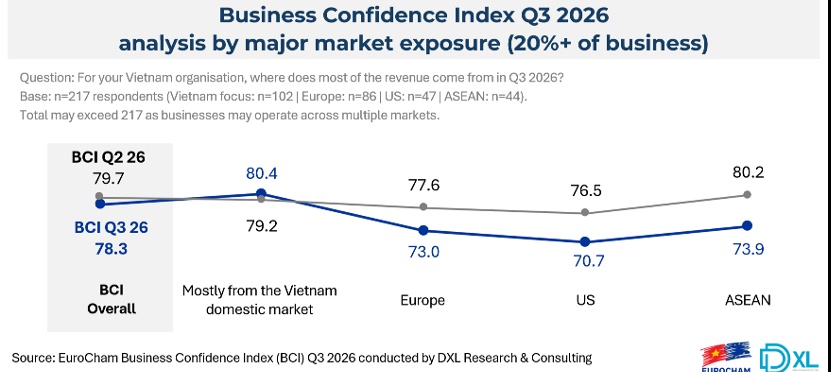
- EuroCham confidence index holds at 78.3 despite operational hurdles (October 16, 2026 | 17:27)
- Shrimp and rice firms face rising standards in export markets (October 16, 2026 | 09:00)
- SCG and Prime Group add value to the ecosystem (October 15, 2026 | 15:55)
- Project readiness key to unlocking green finance (October 15, 2026 | 12:35)
- Sovereign AI and human oversight key to secure digital government (October 15, 2026 | 12:32)
- MEXC Ventures partners with Corelia Academy: Bringing digital asset education closer to Vietnamese students (October 15, 2026 | 09:00)









 Mobile Version