
Vietnam moves to fast-track railway projects

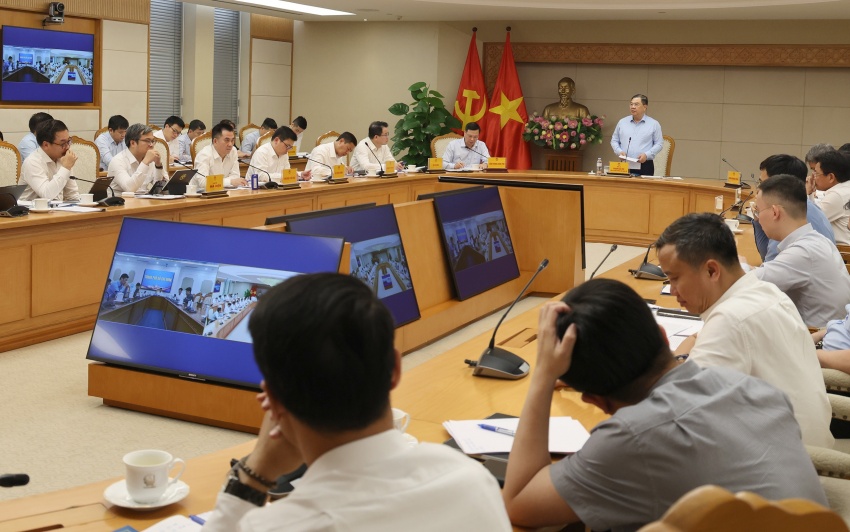
According to the Ministry of Construction (MoC), the North-South high-speed railway has completed a pre-feasibility study, and prepared terms of reference, cost estimates, and bidding documents for the study's consultation package.
 |
| Photo: VGP |
Local authorities and Vietnam Electricity are assessing the volume of land to be cleared, relocating power lines, and implementing the construction of resettlement areas.
According to Deputy Minister of Construction Bui Xuan Dung, the key task of the North-South high-speed railway is selecting a consulting firm to prepare the feasibility study report, and a partner for technology supply and transfer.
The MoC and the Ministry of Science and Technology have reviewed, and issued over 600 technical regulations and standards for the North-South high-speed railway; over 100 regulations and standards for the Lao Cai - Hanoi - Haiphong railway line; and more than 630 technical regulations and standards for urban railway projects.
In addition, the MoC is reviewing over 16,000 general construction norms, focusing on amending them to suit new requirements.
At the meeting, Vice Chairman of the Hanoi People's Committee Truong Viet Dung reported on the preparation of resettlement areas for land clearance for the North-South high-speed railway, and the progress of the Hanoi Station - Yen So, Ha Dong - Xuan Mai, Nho Son - Hanoi Station, Nam Thang Long - Tran Hung Dao, and Van Cao - Lang - Hoa Lac urban railway lines.
In Ho Chi Minh City, Vice Chairman of Ho Chi Minh City People's Committee Bui Xuan Cuong said that after the merger, the city was reviewing the planning of 28 previously planned urban railway lines, and continuing to implement lines such as Ben Thanh - Tham Luong, Ben Thanh - Can Gio, and Ben Thanh - Thu Thiem.
Bui Xuan Cuong requested the MoC promptly hand over the boundary markers and corridor of the North-South high-speed railway line to determine overlapping boundaries with other key transportation projects; and to provide design and architectural plans for the terminal station of the North-South high-speed railway line.
The leaders in Hanoi and Ho Chi Minh City hope that the ministries will finalise the national regulations and standards for urban railways to be applied uniformly nationwide. The Ministry of Finance is reviewing and will report on the investment task for the railway industrial complex. This will serve as a basis for localities to encourage domestic investors and enterprises in urban railway projects.
Strong direction
The deputy prime minister emphasised that investing in the construction of the North-South high-speed railway was a new task, with unprecedented issues, requiring the involvement of the entire political system.
He instructed relevant ministries and agencies to coordinate to finalise, and approve technical regulations and standards for the North-South high-speed railway, in accordance with developed country standards. This will serve as the basis for selecting technology, consulting firms, and contractors.
“We must carefully calculate and balance the investment budget, focusing on key areas, ensuring a ripple effect, and contributing to growth to build a modern railway line, guaranteeing technological self-reliance, and having a long-term vision," the DPM said.
The MoC and other ministries and agencies need to accelerate the work already underway, while also proposing new requirements and suggestions to ensure the completion of the political task of having the North-South high-speed railway as soon as possible/
He requested ministries and agencies to continue improving regulations on management and operation to ensure efficiency, and to minimise administrative procedures
He added that the government was directing ministries and agencies to implement the simplification of administrative procedures, business conditions, and conditional business sectors.
Regarding investment capital for railway projects, the deputy prime minister suggested that a proactive and diversified plan is needed, encompassing sources from the state budget, official development assistance funds, private investment, public-private partnerships, and plans for each project.
He emphasised the need to be one step ahead, cooperating closely with partners, from basic training to advanced training, linked to ongoing projects; training using multiple sources from the state budget, enterprises, social mobilisation, and international support, linked to the requirements of management, and operation.
Regarding norms and unit prices, he stated that regulations must be consistent with the situation on-the-ground and ensure a long-term vision.
Commenting on the Lao Cai – Hanoi – Haiphong and Hanoi – Dong Dang railway projects, the deputy prime minister stated that they would contribute to facilitating economic, trade, and tourism activities between Vietnam and China, as well as connecting with Russia and Central Asia.
Specifically, the Lao Cai – Hanoi – Haiphong railway line must be implemented ensuring quality, efficiency, and progress, coupled with technology transfer; safety amid natural disasters; and attention to landscape along the line.
He also requested that localities with railway projects passing through them implement land clearance and resettlement plans.
The deputy prime minister also emphasised the importance of route selection, as related to land acquisition and total investment.
He stressed that the construction of each station along the North-South high-speed railway would be like a small city, and local economic centre. Localities need to urgently develop plans to maximise the economic efficiency, while considering the advantages of each region and locality.
 | Strengthening Vietnam-China railway connectivity Vietnam plans to boost railway connectivity with China to open up more cooperation opportunities. |
 | Vietnam and EU seek to strengthen ties in transport infrastructure and urban development Vietnam and the EU will enhance cooperation in transport infrastructure and sustainable urban development in the future, a meeting has heard. |
 | Vietnam Railways restructuring plans approved With the approval of the restructuring plan for 2026-2030, Vietnam Railways will develop into a group model, aiming to create a driving force for the industry development and attract more investment. |
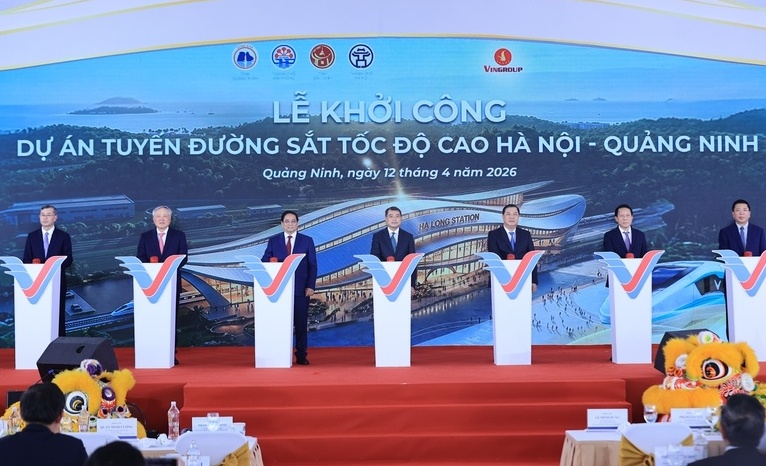
 | Construction begins on Hanoi-Quang Ninh high-speed railway line Work has begun on the Hanoi-Quang Ninh high-speed railway, a project expected to reduce travel times significantly and drive regional development. |
What the stars mean:
★ Poor ★ ★ Promising ★★★ Good ★★★★ Very good ★★★★★ Exceptional
 Tag:
Tag:
Related Contents







Latest News



More News
- Thanh Hoa urged to remove obstacles to Cong Thanh LNG project (October 23, 2026 | 10:14)
- Vietnam pledges transparent tax and customs policies for South Korean businesses (October 23, 2026 | 10:08)
- KUKA Vietnam inaugurates new Hanoi headquarters (October 22, 2026 | 09:00)
- OJI Group invests in $110 million aseptic carton packaging plant in Vietnam (October 22, 2026 | 08:23)
- EVN begins construction on the Quang Trach II LNG plant (October 22, 2026 | 07:00)
- Foreign investors pour billions into Vietnam's semiconductor sector (October 21, 2026 | 14:49)
- Hyosung TNC begins bio-BDO production in Vietnam (October 21, 2026 | 12:12)
- Ho Chi Minh City to unveil new projects worth $13.5 billion at AEF 2026 (October 21, 2026 | 11:51)
- Market upgrade is just the beginning: Vietnamese companies face tougher test to attract capital (October 20, 2026 | 16:04)
- EFTA–Vietnam Free Trade Agreement opens up opportunities to enhance supply chain (October 20, 2026 | 15:56)







 Mobile Version