

Which investing structure should foreign investors choose?

 |
| Nguyen Ngoc Phuc |
Vietnam continues to refine its investment environment with a view to facilitating foreign investment and improving procedural efficiency. One notable development is that foreign investors may now adopt a more flexible sequence for implementing direct investment procedures than was previously available.
At first glance, this change may appear to relate merely to procedural sequencing. In practice, however, its implications may be considerably broader. The choice between obtaining an investment registration certificate (IRC) first or establishing a company first may affect transaction structuring, the timing of cost incurrence, cash flow management, and the allocation of legal risks for investors.
Beyond the traditional IRC-first approach
For many years, foreign investors have typically implemented direct projects in Vietnam through a familiar sequence: first obtaining an IRC, then establishing a company and obtaining an enterprise registration certificate (ERC), and only thereafter commencing the implementation of the investment project.
This model reflected a pre-screening approach under which government authorities assessed the legal feasibility of an undertaking before allowing an investor to establish a legal entity for implementation purposes.
However, the current legal framework now provides investors with an additional option. Foreign investors may establish a company first and subsequently proceed with the IRC application process.
From a policy perspective, this development should not necessarily be viewed as a relaxation of investment conditions applicable to foreign investors. Rather, it may be regarded as an adjustment to the timing of regulatory oversight. While much of the regulatory assessment was previously conducted before the establishment of the company, the current framework provides investors with greater flexibility in procedural sequencing while maintaining the requirement to satisfy all applicable investment conditions.
Different functions
To assess the implications of this development, it is important first to distinguish between an IRC and an ERC, as the two serve fundamentally different purposes.
As a general principle, a foreign investor seeking to make a direct investment in Vietnam must have a project. Such a venture must be registered with the competent authority in order to obtain an IRC.
In essence, an IRC records the key characteristics of a project, including its objectives, scale, implementation location, total investment capital, implementation schedule, and operational term. In other words, the IRC focuses on identifying what the investor intends to invest in, where the investment will be made, how it will be implemented, and at what scale.
By contrast, the ERC focuses on the legal identity of the enterprise itself. It records basic information relating to the company, such as its name, registered address, legal representative, and charter capital. The enterprise acquires legal entity status upon the issuance of the ERC.
If the IRC establishes the legal parameters of the project, the ERC establishes the legal identity of the enterprise implementing it. This distinction is particularly important because the current change does not alter the legal nature or function of either certificate. What has changed is merely the sequence of procedures.
Changing the sequence, not the requirements
Allowing a company to be established before obtaining an IRC may provide practical benefits in certain situations. Investors may be able to establish a legal presence in Vietnam at an earlier stage in order to enter into contracts, lease office premises, recruit employees, or undertake other preparatory activities in connection with a proposed investment.
However, the principal benefit of this mechanism may not necessarily lie in accelerating the implementation of the project itself. It still cannot be formally implemented unless the IRC has been obtained.
This point can easily be misunderstood. Establishing a company first does not necessarily mean that an investor can commence the project earlier. In many cases, the greater value of this mechanism may lie in facilitating preparatory activities or providing investors with greater flexibility in organising internal resources during the initial stages of the investment process.
Underestimated risks
However, greater flexibility does not necessarily mean lower legal risk. Although a company may be established before obtaining an IRC, the project itself still cannot be implemented in practice unless the IRC has been issued.
As a result, situations may arise where a company has already been established and statutory tax, administrative, and reporting obligations have already begun to accrue, while the required IRC is ultimately not granted. This risk is not merely theoretical.
The issuance of an IRC generally requires the investment registration authority to assess a range of factors, including market access conditions applicable to foreign investors, rights relating to the initiative's location, compliance with planning requirements, investment capital intensity requirements, technology-related requirements, and other sector-specific regulatory conditions.
By contrast, the issuance of an ERC is generally focused on the validity of the application dossier and basic enterprise registration requirements.
This highlights an important practical point: establishing a company may be considerably easier than ensuring that an investment project satisfies all applicable investment conditions. Accordingly, the successful establishment of a company should not be regarded as an indication that the venture itself will necessarily be approved.
A consequence that is often underestimated is that where a company has already been established but the IRC is ultimately not granted, the investor may need to proceed with the dissolution of the company. This is not merely a matter of closing down the entity, but may involve tax finalisation, settlement of employment-related obligations, termination of contracts, and completion of various statutory reporting requirements.
In certain cases, the cost of unwinding the structure may exceed the benefits that the investor initially expected to gain from establishing the company at an earlier stage.
Another issue concerns direct investment capital accounts (DICAs). Under Vietnam's current foreign exchange regime, foreign-invested enterprises are generally required to open a DICA for capital contributions and other investment-related transactions.
In practice, banks may require the IRC as one of the key documents for opening and operating a DICA. This is generally not an issue under the traditional IRC-first approach. However, where a company is established before the IRC is issued, uncertainty may arise because the current regulations of the State Bank of Vietnam do not expressly address this situation. As a result, foreign investors may face practical difficulties in remitting charter capital into Vietnam within the 90-day statutory deadline for capital contribution.
The State Bank of Vietnam appears to be addressing this issue through a draft circular. One notable proposal would allow enterprises to open capital accounts for capital contributions and project formation expenses before the IRC is issued. If adopted, this change would help align the foreign exchange regime with the ERC-first approach.
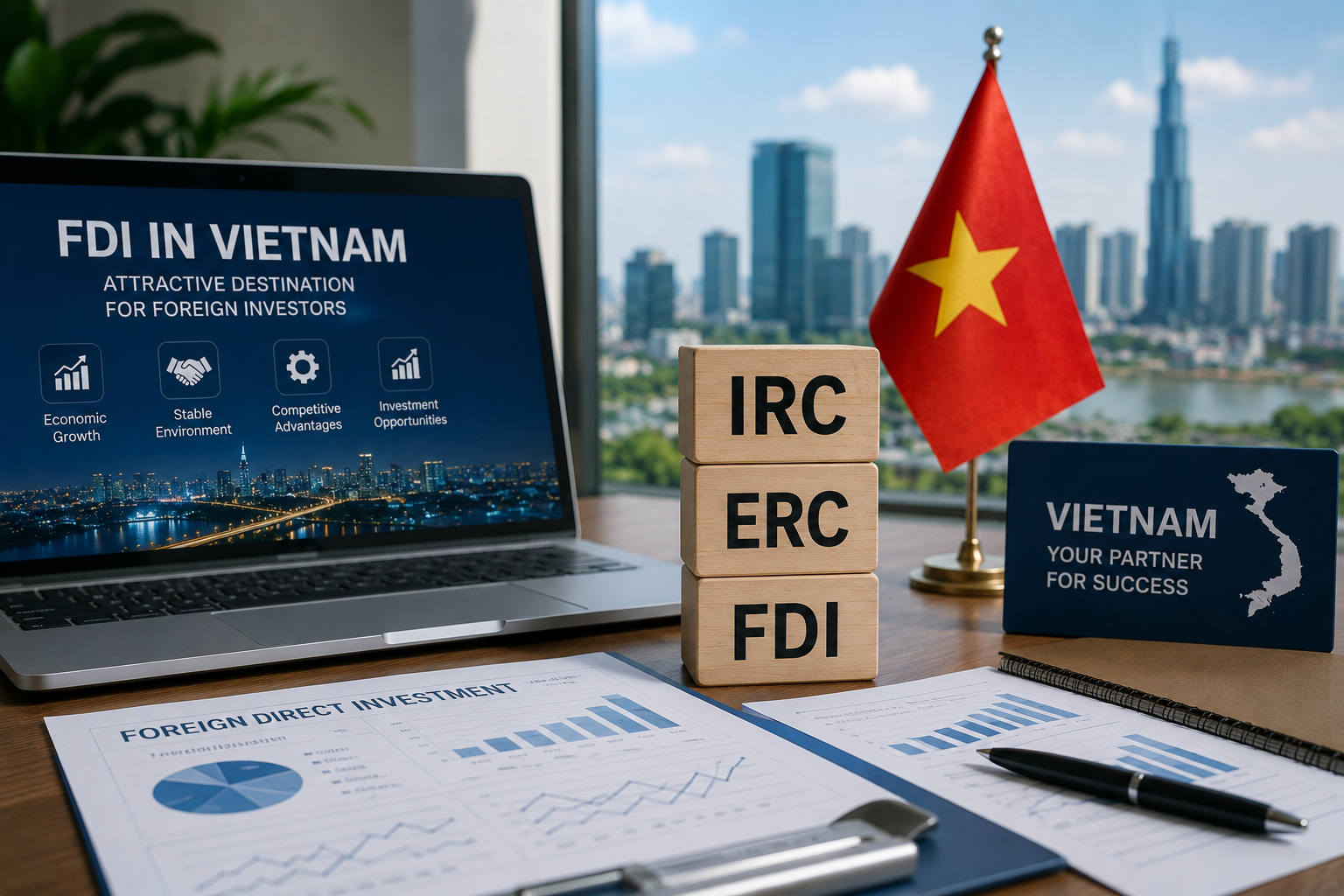 |
| Which investing structure should foreign investors choose? Photo by AI |
IRC or ERC first?
There is no universal answer, as the appropriate structure ultimately depends on the characteristics of the project and the investor’s commercial objectives. However, as a general rule, obtaining an IRC before establishing a company may still be the preferred approach for most projects involving substantive regulatory review, particularly those involving land-related issues, planning considerations, regulated sectors, or foreign ownership restrictions.
This is primarily because the IRC process generally involves a broader and more substantive regulatory assessment than the ERC process. Obtaining the IRC at an earlier stage may therefore allow investors to identify potential legal or regulatory issues before costs and ongoing compliance obligations begin to accrue at the company level.
By contrast, establishing a company before obtaining an IRC may be more suitable where investors need to establish an early legal presence in Vietnam for purposes such as hiring personnel, securing office premises, entering into preliminary arrangements, or organising internal resources.
In such cases, the benefit may lie less in accelerating implementation and more in providing operational flexibility during the initial stages of the investment process.
As a practical matter, obtaining an IRC before establishing a company may remain the more prudent approach for most foreign-led projects, while the ERC-first structure may be better viewed as a practical alternative for specific situations rather than a new default model.
 | Navigating beneficial enterprise ownership disclosure in Vietnam Vietnam's new guidance on beneficial ownership tightens disclosure obligations for enterprises, but raises complex legal and practical questions about compliance, stakeholder cooperation, and the interpretation of control under the Law on Enterprises 2025. |
 | Unprecedented opportunities in commercial residential segment Vietnam’s commercial residential housing sector is on the verge of transformative change thanks to a pilot that addresses longstanding challenges in land use policies and introduces greater flexibility for real estate businesses. Nguyen Ngoc Phuc, a partner at Nishimura & Asahi, shared with VIR’s Thanh Van his insights on the implications of the move and its potential to reshape the real estate sector. |
 | Foreign investors strike big as Vietnamese firms enter new growth cycle Foreign investors are not only generating strong returns in Vietnamese companies, but also driving governance upgrades, operational efficiency and new growth cycles across key sectors from pharmaceuticals to construction materials. |
What the stars mean:
★ Poor ★ ★ Promising ★★★ Good ★★★★ Very good ★★★★★ Exceptional
 Tag:
Tag:Related Contents










Latest News



More News
- Vietnam’s registered FDI surpasses $50 billion in nine months (October 07, 2026 | 10:30)
- Samsung Electro-Mechanics to add $1.85 billion semiconductor investment in Thai Nguyen (October 06, 2026 | 18:23)
- Electronics funding will be won via a capable ecosystem: SGS (October 06, 2026 | 09:00)
- LNG power plant projects risk falling behind schedule (October 03, 2026 | 09:00)
- Pandora opens world’s largest fine jewellery crafting facility (October 02, 2026 | 22:21)
- An Phat 5 Industrial Park positions for new wave of investment in northern Vietnam (October 02, 2026 | 09:00)
- Hanoi to launch portal to ease hurdles for tech businesses (October 01, 2026 | 09:00)
- Foreign investors to be widened for market access (September 30, 2026 | 17:54)
- Phu Quoc Airport planning adjusted to serve APEC 2027 (September 30, 2026 | 17:35)
- Nearly 200 foreign-invested enterprises in Vietnam to pay global minimum tax (September 30, 2026 | 17:26)


Latest News






 Mobile Version