

Vietnam Military History Museum holds lacquer painting exhibition marking national milestones

The traditional lacquer painting exhibition, featuring 55 artworks of various generations, runs in Hanoi from now until end of May. The event marks major national anniversaries, including the 51st anniversary of the Liberation of the South and National Reunification, as well as the 136th birth anniversary of President Ho Chi Minh.
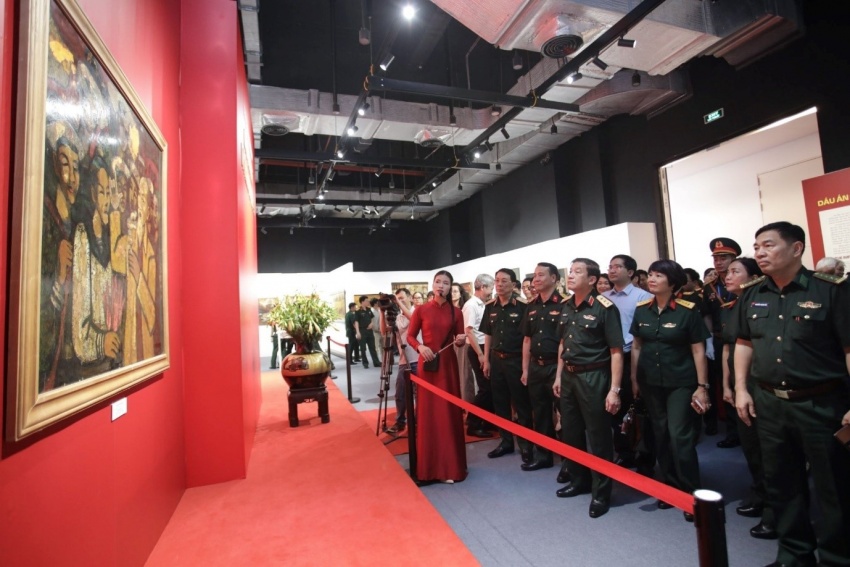 |
| Delegates tour the exhibition space at the Vietnam Military History Museum in Hanoi |
The exhibition “Homeland and the Soldier” is jointly organised by the Vietnam Military History Museum, the Vietnam University of Fine Arts and the University of Arts and Design, to showcase their special art collection.
It brings together artworks by multiple generations of artists, lecturers and students, reflecting themes of homeland, war and post-war transformation. Throughout the talented brushstrokes and fruitful traditional lacquer techniques, Vietnamese heroic soldiers and people, as well as the country’s cultural and natural beauty.
Lacquer painting is both a traditional artistic medium and a form that embodies the vitality of life through the enduring creativity of generations of artists. Through its distinctive visual language, lacquer artworks expresses cultural traditions, a deep love for the homeland and a profound sense of national pride throughout Vietnam’s nation-building and national defence.
The initiative reflects efforts to preserve lacquer painting as a distinctive Vietnamese art form and reaffirm its relevance within contemporary Vietnamese fine arts, particularly in the context of ongoing cultural preservation and historical education.
Speaking at the opening ceremony, Colonel Le Vu Huy, director of the Vietnam Military History Museum said lacquer painting carried a deep historical and cultural significance in Vietnam.
He noted that lacquer art had evolved over thousands of years, from early archaeological traces dating back to ancient times, through its development in traditional craft villages under feudal dynasties, and into modern Vietnamese fine art.
From natural lacquer resin extracted from lacquer trees, combined with materials such as gold, silver, eggshell and mother-of-pearl, Vietnamese artists have developed a highly specialised technique that requires patience, multiple layers of application and careful polishing. Over time, this has formed a distinct visual language closely associated with national identity and artistic heritage.
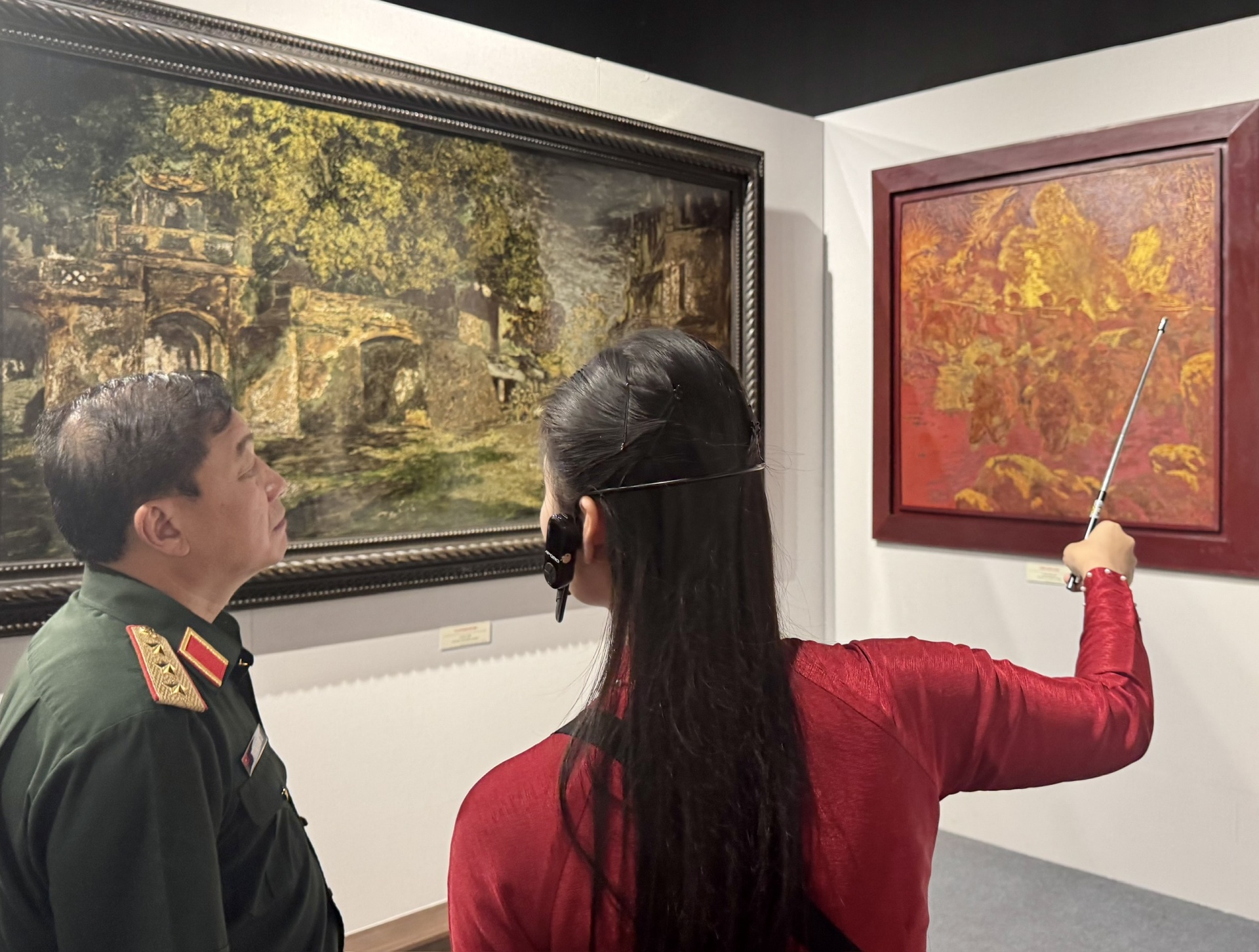 |
| Colonel Le Vu Huy, director of the Vietnam Military History Museum, reviews lacquer artworks on display at the exhibition “Homeland and the Soldier” |
“Lacquer painting is not only a traditional art medium but also a symbol of Vietnamese spirit, resilience and identity. Through its visual language, it expresses cultural traditions, a deep love for the homeland and a strong sense of national pride. Lacquer painting creates a typical and unique characteristic for Vietnam fine arts in the world. The artworks applied in traditional lacquer techniques capture regional diversity across rural plains, river deltas and mountainous areas, reflecting both natural scenery and lived cultural experiences,” said artist Pham Hoang Van.
The exhibition is structured into three thematic sections, forming a narrative linking cultural heritage, wartime history and contemporary life.
The first section “Homeland Imprints” highlights Vietnam’s landscapes, cultural traditions and everyday life.
The second section “The Soldier” depicts the image of the “Uncle Ho’s soldiers” and civil–military relations during Vietnam’s resistance wars. Works by multiple generations of artists, including figures from the Indochina Fine Arts tradition such as Le Quoc Loc and Nguyen Sy Ngoc, portray key historical events and wartime experiences through lacquer painting. Younger artist generation alike Pham Hoang Van with Canon March also reflects the human dimension of conflict, including solidarity, sacrifice and resilience.
The final section “Colours of Peace” reflects Vietnam’s post-war development, highlighting production activities, infrastructure expansion and social change as the country moves towards modernisation. The works present a society in transition, from reconstruction and recovery to long-term development, capturing both continuity and transformation in everyday life.
According to organisers, the three-part structure creates a coherent visual narrative linking historical memory with contemporary artistic expression, allowing visitors to follow Vietnam’s historical trajectory through the evolution of lacquer painting across different periods.
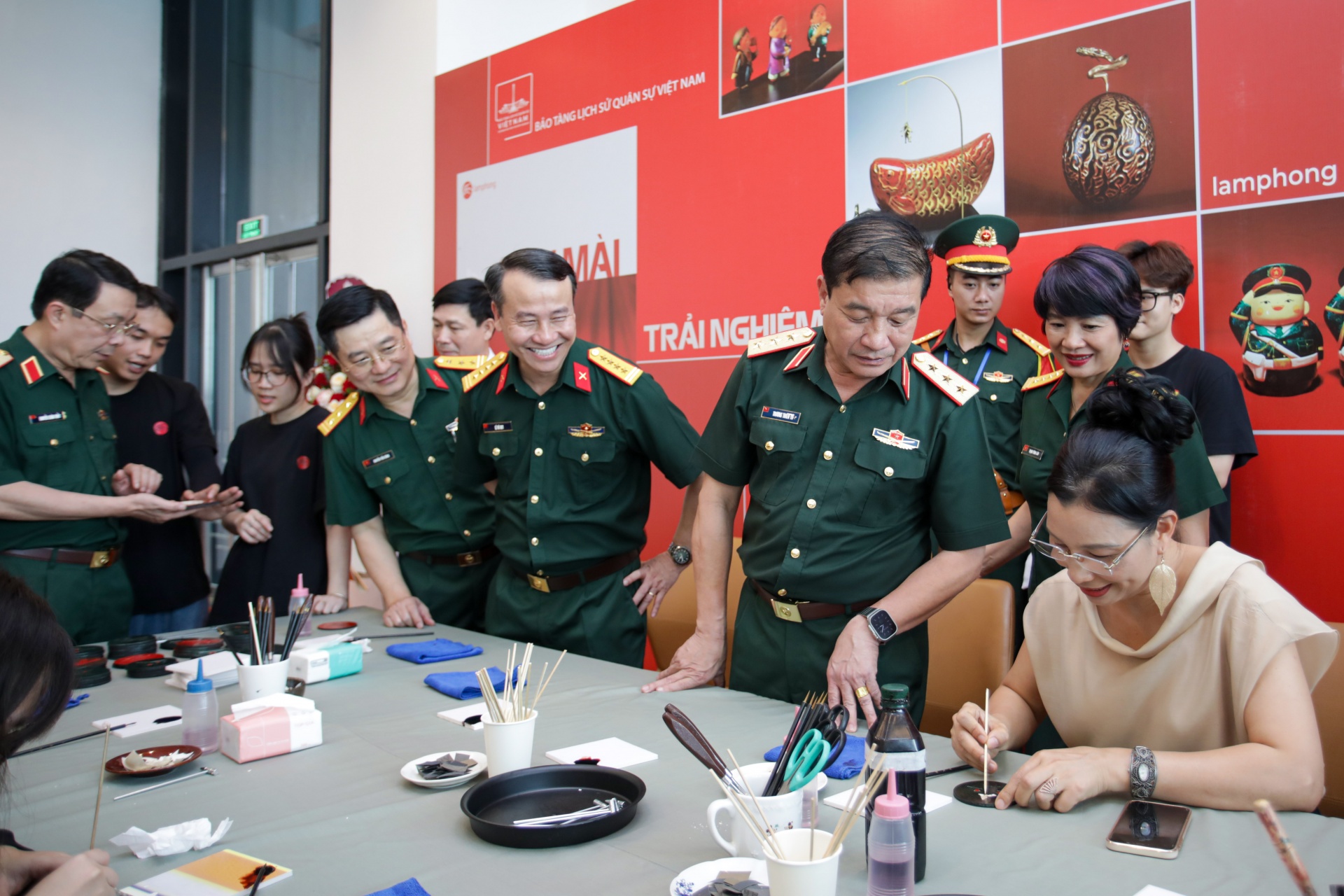 |
| A lacquer-made workshop is opened for visitors to experience typical lacquer crafting techniques during the exhibition lasting until the end of May |
Beyond its artistic value, the exhibition also serves as a cultural and educational platform aimed at strengthening public understanding of national history through visual art. It is designed not only as a display of artworks but also as an interpretive space where historical narratives are communicated through artistic expression, particularly to younger audiences.
The Vietnam Military History Museum is a key cultural and historical institution under the Vietnam People’s Army. It is responsible for collecting, preserving and displaying military historical artefacts, documents and serves as a centre for education on revolutionary and patriotic traditions
Established as one of Vietnam’s leading military museums, the institution plays an important role in preserving national historical memory, particularly related to the country’s wars of resistance and defence. Through exhibitions, archives and educational programmes, the museum connects historical heritage with public engagement, ensuring that military history remains accessible within contemporary cultural discourse.
What the stars mean:
★ Poor ★ ★ Promising ★★★ Good ★★★★ Very good ★★★★★ Exceptional
 Tag:
Tag:
Related Contents
Latest News

More News
- Sedona SkyRun concludes latest race above Ho Chi Minh City (August 11, 2026 | 08:00)
- What propelled East West Barbershop into world's Top 10 grooming brands? (August 06, 2026 | 09:22)
- Livelihood Transition Training Conference contributes to rabies prevention and food safety development (July 24, 2026 | 17:14)
- Muong Thanh group launches 2026 mooncake collection (July 24, 2026 | 10:52)
- Pan Pacific launches 2026 mooncake collection (July 24, 2026 | 10:51)
- Vietnamese women step up as drivers of national development (July 15, 2026 | 11:54)
- Italy marks anniversary by celebrating women's eight decades of progress (June 23, 2026 | 17:19)
- Innovation expands reach of cultural identity in Hue (June 17, 2026 | 15:57)
- Fusion marks Global Wellness Day with spa promotions across Vietnam (June 06, 2026 | 14:11)
- Fortune names Citi CEO Jane Fraser the Most Powerful Woman in Business for 2026 (June 02, 2026 | 18:42)







 Mobile Version