
Vietnam climbs Global Innovation Index

The World Intellectual Property Organisation (WIPO) released its Global Innovation Index 2026 report in Geneva. The results showed that Vietnam's GII performance continued to improve, meeting the target set by the government under Resolution No.02/NQ-CP in 2026.
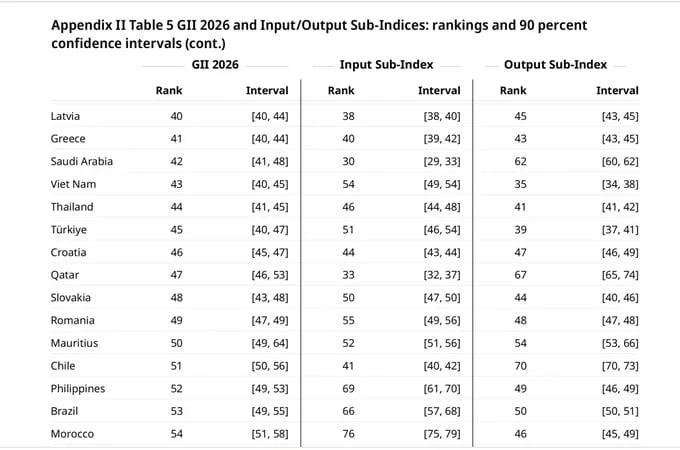 |
| Vietnam improve in Global Innovation Index. Photo: GII 2026 |
Since 2016, the country's ranking has risen from 59th to 43rd, an improvement of 16 places. Notably, Vietnam's innovation output ranking climbed two places, from 37th to 35th. This was one of the factors contributing to the country's one-place improvement in the overall ranking this year.
Vietnam remained the second-ranked lower-middle-income economy, behind India, which ranked 38th. Among upper-middle-income economies, China ranked 10th and Malaysia 34th, while most economies ranked above Vietnam were high-income economies.
Within ASEAN, Vietnam retained its third position, behind Singapore and Malaysia, and ahead of Thailand, meeting the target set under Resolution No.01/NQ-CP in 2026.
WIPO also identified Vietnam as one of the seven middle-income economies that have improved their rankings most rapidly since 2013, alongside China, India, Türkiye, the Philippines, Morocco, and Indonesia.
Vietnam also remained among the three economies with innovation performance that significantly outpaces their level of development, together with China and India. For 16 consecutive years, Vietnam's innovation performance has been assessed as exceeding what would be expected based on its level of development, indicating its ability to translate available inputs into innovation outputs.
In the GII 2026, Vietnam retained the world's top position in two indicators: high-tech exports as a share of total trade and creative goods exports as a share of total trade.
Three other indicators placed Vietnam among the world's top 10: high-tech imports as a share of total trade, ranked third; the number of mobile applications developed and used, ranked fifth; and labour productivity growth, ranked sixth.
Several other indicators also recorded relatively strong rankings. Business-funded research and development (R&D) expenditure as a share of total R&D expenditure ranked 13th; domestic credit to the private sector as a percentage of GDP ranked 14th; the weighted average tariff rate ranked 15th; while gross capital formation and domestic production diversification both ranked 19th.
Minister of Science and Technology Vu Hai Quan said the improvement in Vietnam's innovation output ranking was a notable result, partly reflecting the implementation of Politburo Resolution No.57-NQ/TW over the past year.
"Investment in sci-tech and digital transformation has increased significantly, while the policy and legal framework has continued to be strengthened. Greater participation by the government, businesses, research institutions, and universities is also helping to develop Vietnam's innovation ecosystem," he said.
According to the Ministry of Science and Technology (MoST), the GII 2026 results came against a backdrop of considerable international volatility, with strategic competition, geopolitical conflicts, protectionist trends, and economic fragmentation affecting trade, investment, and technology flows.
At the same time, rapid advances in AI, big data, digital technologies, and green technologies are creating new opportunities while increasing the need to strengthen technological capabilities, innovation capacity, and productivity.
Domestically, implementation of Resolution 57 is shifting from policy development and refinement towards execution, with science, technology, and innovation gradually becoming important drivers of economic growth.
Vietnam's Strategy for Science, Technology and Innovation Development to 2030 targets a GII ranking among the world's top 40 economies by 2030. Looking further ahead, Resolution 57 sets a goal for Vietnam to rank among the world's top 30 economies for innovation by 2045.
These are challenging targets, given that most economies currently ranked above Vietnam are developed, high-income economies with significant positions in global value chains.
According to the MoST, Vietnam would need to continue improving the quality of its human resources, particularly highly skilled personnel for strategic technology sectors, while increasing international scientific publications and the number of patents.
Businesses, in particular, need to play a greater role in R&D and innovation by increasing financial and human-resource investment and incorporating technology and digital transformation into production and business activities to improve product quality, increase value creation, and raise labour productivity.
Vietnam also has to continue refining its institutional framework based on practical requirements, increase investment in R&D, and attract major foreign corporations to establish R&D centres and expand investment in high-tech and strategic technology sectors.
Strengthening the capabilities of research institutions and universities, boosting university–research institute–business links, mobilising capital for innovative startups, developing innovation clusters and networks, and helping businesses adopt, absorb and master new technologies are also key priorities.
The GII 2026 results therefore point to a task that goes beyond improving Vietnam's ranking. More importantly, the country needs to strengthen the quality and effectiveness of its innovation ecosystem and turn investment resources into technologies, products and tangible improvements in the economy's competitiveness.
 | Technology assessment in the context of innovation and green transformation Vietnam's new vision on strategic foreign direct investment means that the work of Vinacontrol Group in terms of technology assessment is deemed more vital than ever. |
 | Vietnam seeks stronger strategic autonomy and new growth drivers through AI and innovation A Vietnamese delegation led by Deputy Prime Minister Nguyen Van Thang successfully concluded the Vietnam Leadership Programme (VLP) 2026 after three days of activities at Columbia University in New York, the United States, on August 26. |
 | 11 innovations showcased plastic waste management solutions in Vietnam 11 Vietnamese innovations showcased scalable solutions to tackle plastic pollution at InnoEx 2026, demonstrating how innovation can turn environmental challenges into opportunities. |
What the stars mean:
★ Poor ★ ★ Promising ★★★ Good ★★★★ Very good ★★★★★ Exceptional
 Tag:
Tag:Related Contents









Latest News





More News
- Preparing professionals for a new business environment (October 19, 2026 | 09:13)
- KN Holdings honoured for ESG efforts in Vietnam (October 18, 2026 | 11:00)
- APEA 2026 Vietnam honours 65 outstanding leaders and enterprises (October 17, 2026 | 10:00)
- MEXC highlights AI-driven trading and broader market access at TOKEN2049 (October 17, 2026 | 09:00)
- EuroCham confidence index holds at 78.3 despite operational hurdles (October 16, 2026 | 17:27)
- Shrimp and rice firms face rising standards in export markets (October 16, 2026 | 09:00)
- SCG and Prime Group add value to the ecosystem (October 15, 2026 | 15:55)
- Project readiness key to unlocking green finance (October 15, 2026 | 12:35)
- Sovereign AI and human oversight key to secure digital government (October 15, 2026 | 12:32)
- MEXC Ventures partners with Corelia Academy: Bringing digital asset education closer to Vietnamese students (October 15, 2026 | 09:00)










 Mobile Version