
Summit highlights Ho Chi Minh City's digital prominence

 |
| Nguyen Ngoc Nam, director of Financial Services Consulting at KPMG Vietnam, at the event |
Speaking at the summit on June 16, KPMG Vietnam director Nguyen Ngoc Nam said that while nearly 40 per cent of organisations are scaling up or accelerating AI adoption, only 8 per cent report achieving a clear return on investment.
“This gap suggests that AI does not automatically create value. Successful AI adoption requires a strong operational foundation, high-quality data, effective performance measurement, and an appropriate governance framework,” Nam said.
According to Nam, this is particularly relevant for Ho Chi Minh City, where enterprises are embracing new technologies at a rapid pace, while expectations regarding investment efficiency, data security, and system resilience are also rising.
“As AI adoption accelerates, the market does not simply need more infrastructure. It needs infrastructure capable of running AI safely, with strong governance and the ability to measure and demonstrate tangible business value,” he added.
If data centres represent the physical backbone of the digital economy, cloud computing is the infrastructure layer that enables enterprises to scale flexibly in the AI era.
Today, cloud computing is no longer merely an IT infrastructure solution. It has evolved into a strategic platform that allows businesses to deploy AI applications more efficiently while meeting increasingly stringent requirements for data management, cybersecurity, and regulatory compliance.
As enterprises accelerate their digital transformation journeys, cloud infrastructure is becoming an essential enabler of innovation, providing the agility, scalability, and resilience needed to support AI-driven growth.
According to the 'Cloud computing market size and share analysis – Growth trends and forecast (2026-2031)' released by Mordor Intelligence in January, Global spending on cloud computing is forecast to grow at a compound annual growth rate (CAGR) of 20.65 per cent during the 2026–2031 period. By 2031, the market is expected to be more than 2.5 times larger than its current size.
In Vietnam, according to Ken Research 2025, the cloud computing market is projected to reach $1.5 billion by 2033, expanding at an annual CAGR of 30 per cent.
“Ho Chi Minh City alone accounted for around 40 per cent of Vietnam’s cloud computing market in 2025, the largest share nationwide,” Nam said. “The main growth drivers are industries with stringent requirements for data processing and system continuity, such as banking, financial services and insurance, healthcare, and other data-intensive sectors,” Nam added.
Against this backdrop, Ho Chi Minh City's digital infrastructure strategy should go beyond merely expanding data centre capacity or increasing cloud computing capabilities.
“Businesses need an AI-ready infrastructure platform that is flexible to deploy, capable of ensuring data security, and resilient against increasingly sophisticated cybersecurity threats,” Nam said.
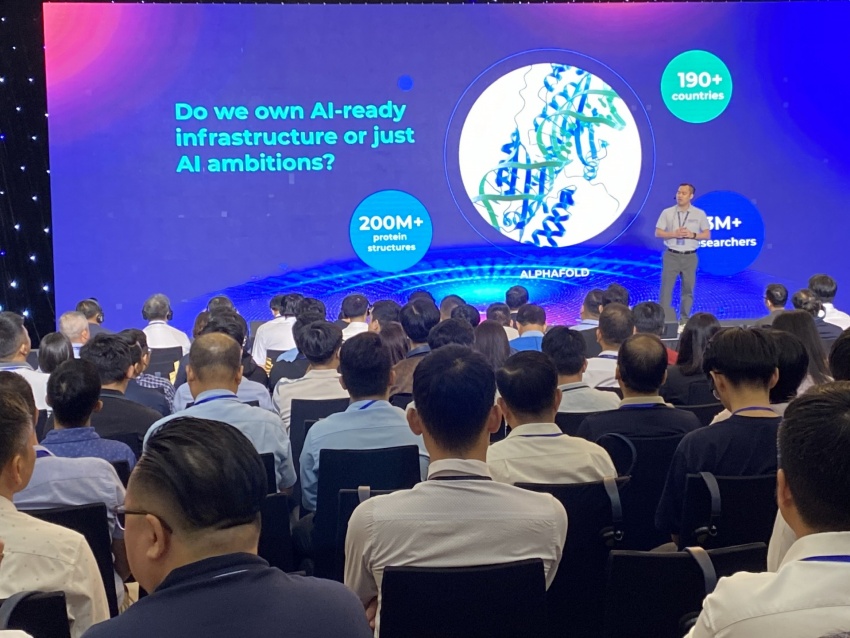 |
| Tran Van Bang, deputy CEO of Viettel IDC |
Tran Van Bang, deputy CEO of Viettel IDC, explained that in the AI era, competitive advantage no longer comes solely from algorithms or AI models, but increasingly from the strength of the underlying infrastructure.
“Data centres, cloud computing, cybersecurity, and operational capabilities are the key factors determining whether AI can be deployed effectively at scale,” Bang said.
"Without an infrastructure foundation that is robust, secure, and flexible, it is extremely difficult for businesses to translate AI investments into tangible business outcomes. This is also the strategic direction that Viettel IDC is pursuing," Bang added.
According to Bang, competition in the AI era is no longer confined to the application layer or the sophistication of AI models. Instead, it is increasingly being shaped by the strength and resilience of the digital infrastructure that supports them.
“As AI adoption accelerates, organisations that invest early in AI-ready infrastructure will be better positioned to innovate, scale their operations, and capture new growth opportunities in the digital economy,” he added.
According to a report released by Gartner in January, global AI spending is projected to reach $2.52 trillion in 2026, up 44 per cent from the previous year, and is expected to rise further to $3.3 trillion by 2027. AI infrastructure accounted for as much as 55 per cent of total AI spending in 2025, making it the largest investment segment across the AI ecosystem.
Worldwide, there are currently around 11,000 data centres with a combined power demand exceeding 120 GW. AI data centres, while representing less than 1 per cent of the total number of facilities and having emerged only in recent years, already account for approximately 25 per cent of the electricity consumed across the global data centre industry.
According to the International Energy Agency, electricity consumption by data centres worldwide could triple over the next decade, largely driven by AI-related workloads.
This signals a major shift for industry: the primary challenge is no longer merely scaling up computing power, but ensuring adequate energy supply, maximizing efficiency, and achieving sustainable operations.
According to Bang, the next phase of data centre development will be shaped by three major imperatives: scaling up infrastructure capacity, enhancing operational efficiency, and complying with stringent safety and sustainability standards. These elements provide the foundation for businesses to deploy AI, cloud, big data and other mission-critical workloads with greater stability and security.
In this context, Ho Chi Minh City's digital infrastructure strategy is no longer limited to expanding data centre capacity or boosting cloud capabilities. Instead, enterprises increasingly need AI-ready infrastructure that offers deployment flexibility, robust data protection and resilience against the growing complexity of cyber threats.
 | Vietnam posts second-highest AI adoption in Southeast Asia Vietnam has the second-highest AI adoption rate in Southeast Asia at 26.5 per cent, according to a recent Microsoft report. |
 | Data and governance key hurdles to AI scaling for Vietnamese firms Governance deficiencies, fragmented data systems, and a lack of clear accountability metrics are preventing Vietnamese businesses from successfully scaling AI technology. |
 | Beyond AI: What a world top-5 school teaches for the future While technology continues to transform how knowledge is accessed and applied, some of the most respected educational institutions argue that the most valuable future skills remain ‘deeply human’. At the forefront is King’s College School Wimbledon, where nearly 200 years of excellence meet forward-looking innovation. |
What the stars mean:
★ Poor ★ ★ Promising ★★★ Good ★★★★ Very good ★★★★★ Exceptional
 Tag:
Tag:Related Contents





Latest News






More News
- KN Holdings honoured for ESG efforts in Vietnam (October 18, 2026 | 11:00)
- APEA 2026 Vietnam honours 65 outstanding leaders and enterprises (October 17, 2026 | 10:00)
- MEXC highlights AI-driven trading and broader market access at TOKEN2049 (October 17, 2026 | 09:00)
- EuroCham confidence index holds at 78.3 despite operational hurdles (October 16, 2026 | 17:27)
- Shrimp and rice firms face rising standards in export markets (October 16, 2026 | 09:00)
- SCG and Prime Group add value to the ecosystem (October 15, 2026 | 15:55)
- Project readiness key to unlocking green finance (October 15, 2026 | 12:35)
- Sovereign AI and human oversight key to secure digital government (October 15, 2026 | 12:32)
- MEXC Ventures partners with Corelia Academy: Bringing digital asset education closer to Vietnamese students (October 15, 2026 | 09:00)
- Global design expertise meets a more sophisticated Vietnam market (October 15, 2026 | 09:00)









 Mobile Version