

DPM pushes for urgent approval of metro extension to Long Thanh International Airport

 |
| Source: VGP |
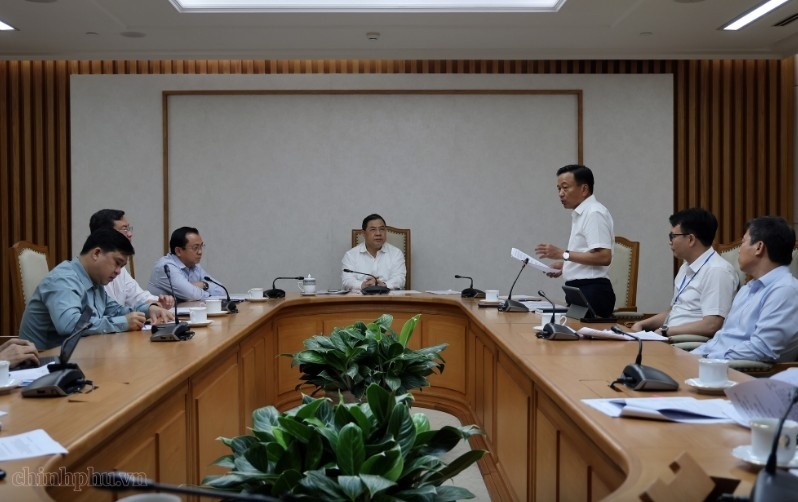
During the meeting on July 30, officials discussed plans to develop the extension as an urgent infrastructure project to improve connectivity between the city and the airport in Dong Nai province.
According to Vice Chairman of Dong Nai People's Committee Ho Van Ha, there are currently three planned railway lines connecting to Long Thanh: the North-South high-speed railway, the Thu Thiem–Long Thanh railway, and the extension of the Ben Thanh–Suoi Tien metro line to the Dong Nai City Administrative Centre and Long Thanh International Airport.
"With a large population, increasing traffic volume between Dong Nai and Ho Chi Minh City, and the operation of Long Thanh International Airport, there will be significant demand for transport connections between the airport and surrounding areas," Ha said. "Extending the Ben Thanh–Suoi Tien metro line from Ho Chi Minh City to Dong Nai – a total length of approximately 44.5 km, of which about 2.9 km passes through Ho Chi Minh City – will provide an additional connection option, complementing other transport routes and aligning with the global trend of urban rail development."
The project is considered vital to enhancing transportation connectivity between the two cities and other areas within the expanded urban region. The people's councils of Dong Nai and Ho Chi Minh City have agreed that this project involves both localities, assigning Dong Nai city as the managing agency for implementation.
The project is expected to be implemented under a public-private partnership (PPP) model, specifically a build-transfer contract. Dong Nai planned urban development sites along the route using the transit-oriented development model and prepared land funds to mobilise resources to implement the project. Dong Nai separated the land clearance project into an independent project and is implementing it along the entire route, with basic completion expected before December 31.
At the meeting, representatives of ministries and agencies agreed to classify the project as urgent under the Law on Construction, and proposed reporting to the government for consideration within its authority to provide a legal basis for implementation.
They also requested that during implementation, dossiers and procedures be reviewed and refined to ensure compliance, and that the functions and tasks of relevant agencies be clearly defined to avoid overlap. On investment preparation, project appraisal, and implementation under the PPP method, ministries will coordinate, guide, and support localities according to their assigned functions and tasks.
 | Ho Chi Minh City to finance Metro Line 4 with public-private partnership Ho Chi Minh City is considering a proposal from Sovico Group to invest in Metro Line 4 using a build-transfer contract with payment via land funds combined with Transit-Oriented Development. |
 | Chinese contractor to formulate feasibility study for Metro Line 4 A consortium comprising China’s Guangzhou Metro Design & Research Institute Co., Ltd., ARUP Vietnam, and TEDI SOUTH has been licensed to carry out the feasibility study for the nearly $6 billion Metro Line 4 in Ho Chi Minh City. |
 | Ho Chi Minh City to start construction on four urban railway lines Ho Chi Minh City People’s Committee is accelerating the procedures to start construction on four urban railway lines from now until the end of 2026, with the goal of completion by the end of 2030. |
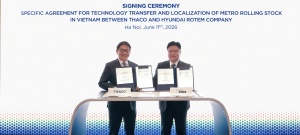 | THACO, Huyndai Rotem to advance railway localisation On June 11, THACO and South Korea’s Huyndai Rotem signed a specific agreement for technology transfer and localisation of metro rolling stock in Vietnam. |
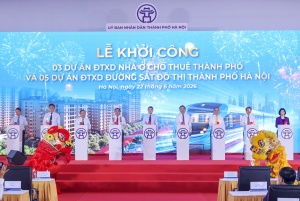 | Hanoi breaks ground on three rental housing, five urban railway projects Hanoi People's Committee has broken ground on three rental housing projects and five urban railway projects, with Prime Minister Le Minh Hung in attendance. |
What the stars mean:
★ Poor ★ ★ Promising ★★★ Good ★★★★ Very good ★★★★★ Exceptional
 Tag:
Tag:Related Contents



Latest News

More News
- Molex opens its expanded manufacturing facility in Hung Yen (September 17, 2026 | 15:57)
- SACE announces $200 million financing for VinFast Vietnam (September 17, 2026 | 15:52)
- World Bank Group supports Vietnam's trade connectivity and coastal livelihoods (September 16, 2026 | 18:24)
- Beacon Fund invests in Vipep to strengthen Vietnam's agricultural value chain (September 15, 2026 | 16:11)
- Electronics FIEs asked to expand Vietnamese supplier networks (September 15, 2026 | 15:50)
- Hung Yen accelerates infrastructure development (September 14, 2026 | 15:36)
- New decree aims to modernise contractor selection procedures (September 14, 2026 | 14:46)
- AEON continues Vietnam expansion with two new malls (September 13, 2026 | 10:21)
- Vietnam turns to specialised chips for its semiconductor industry (September 11, 2026 | 17:43)
- AEON accelerates expansion with 10th shopping centre in Vietnam (September 11, 2026 | 13:53)







 Mobile Version