
Q3 earnings surge masks widening divide across financial and non-financial sectors

According to a Saigon-Hanoi Securities (SHS) report compiling Q3/2026 business results based on data from 856 listed firms representing 93.4 per cent of total market capitalisation that had announced their earnings, aggregate after-tax profit reached approximately $9.05 billion, with 754 companies reporting profits. This represented a 45 per cent increase on-year.
 |
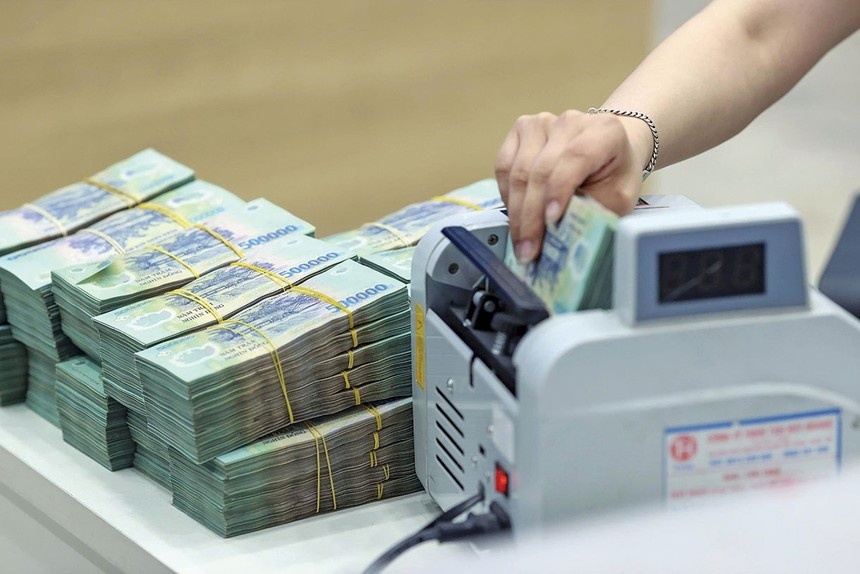
| Q3 earnings surge masks widening divide across listed firms. Photo: baodautu.vn |
However, behind this strong growth lies considerable divergence. Within the financial sector, banks and securities firms recorded contrasting performances, limiting the overall profit growth of the financial sector to 9.9 per cent, well below the 82.8 per cent increase in the non-financial sector.
Banks continued to lead in terms of profit scale, generating nearly $3.23 billion in Q3, up 21.8 per cent on-year, and remaining one of the key drivers of market-wide earnings growth.
The improvement in banking was also reflected in the breadth of earnings performance. Of the 26 banks surveyed, 20 recorded profit growth while six saw declines. The three major banks BIDV, VietinBank and MB alone accounted for 49.8 per cent of the banking industry's profit increase.
Specifically, MB's Q3 after-tax profit reached nearly $330.1 million, up 42.3 per cent. BIDV reported profit of more than $338.9 million, an increase of 39.2 per cent, while VietinBank posted nearly $434.8 million, up 27.7 per cent.
Nevertheless, the banking sector's performance was not uniformly positive. Southern lender Sacombank reported after-tax profit of nearly $53.9 million, down 53.6 per cent on-year.
In contrast to banks, the financial services sector, which the report uses to analyse securities firms, recorded only approximately $315.9 million in after-tax profit, down 45 per cent on-year. This represented a decline of around $260 million in profit.
The downturn among securities firms was more widespread than that among banks. Of the 45 financial services companies with comparable data, as many as 35 reported lower profits on-year, while only 10 recorded growth. In Q3, 36 companies were profitable and 10 reported losses.
VIX Securities, VPBankS and VNDirect were the three largest contributors to the decline, together accounting for 63.5 per cent of the financial services sector's profit contraction.
Specifically, VIX's after-tax profit fell to nearly $7 million, down 92.9 per cent on-year. VPBankS reported Q3 profit of nearly $26.8 million, down 64.6 per cent, while VNDirect posted nearly $13.2 million, a decline of 64.5 per cent.
The figures show that the divergence between banks and securities firms extends beyond their respective growth rates.
While most banks improved their earnings and all profitable institutions in the banking statistics reported positive results, the majority of financial services companies experienced declining profits, with a number also reporting losses.
Across the broader market, profit growth of 45.1 per cent stood out as a major bright spot in the Q3 earnings season. However, excluding tickers belonging to leading conglomerate Vingroup ecosystem, profit growth fell to just 21.3 per cent, indicating that earnings were rising rapidly but remained concentrated among a handful of companies.
Residential real estate was the clearest example of this concentration. The sector's aggregate after-tax profit reached approximately $2.08 billion, up 325.7 per cent on-year, making it the second-largest contributor by profit scale after banking.
However, excluding Vingroup tickers, the sector's growth rate fell to just 37.6 per cent. Vingroup reported after-tax profit of nearly $910.4 million, up 652.3 per cent, while Vinhome posted approximately $920.8 million, an increase of 419 per cent.
The breadth of growth in the sector also fell short of its aggregate profit increase. Of the 60 residential real estate companies surveyed, only 25 recorded on-year growth, while 35 reported declines.
Sunshine, Ba Ria-Vung Tau House Development JSC and Khang Dien were the three largest contributors to the decline. In Q3, the residential real estate sector had 49 profitable companies and 12 loss-making ones.
Beyond real estate and banking, oil and gas, basic resources and retail were among the sectors that contributed positively to the Q3 earnings season.
The oil and gas sector recorded after-tax profit of approximately $421.1 million, up 413.8 per cent on-year. However, Petrovietnam Refining and Petrochemical Corporation alone accounted for 95.1 per cent of the sector's profit increase.
Basic resources reported profit of nearly $499.8 million, an increase of 158.3 per cent. Hoa Phat Group (HPG), Masan High-Tech Materials and VNSteel together contributed 96.7 per cent of the sector's profit growth. HPG alone posted after-tax profit of approximately $330.6 million, up 106 per cent, representing an increase of more than $170.1 million.
The retail sector saw a relatively broad-based improvement, with 13 of the 17 companies recording positive on-year profit growth.
Aggregate after-tax profit for the sector reached nearly $301.4 million, up 94.5 per cent. Nevertheless, the added value was still concentrated primarily in major retailers Mobile World, Dien May Xanh and FPT Retail, which together accounted for 94.9 per cent of the increase.
According to SHS, the companies that had announced financial statements covered approximately 93.4 per cent of total market capitalisation.
A total of 754 companies reported profits, accounting for 86.6 per cent of those that had released their results. However, only 52.7 per cent of companies recorded on-year profit growth, equivalent to 453 of the nearly 860 companies surveyed.
 | MB eyes 30 million customers by 2024 following strong Q3 earnings Military Commercial Joint Stock Bank (MB) has just unveiled a robust performance for Q3 2023, maintaining a positive growth trajectory. The bank's focus on operational cost management and a push towards digital transformation places it at the forefront of Vietnam's banking sector's digitalisation race. |
 | Fed rate hike unlikely to disrupt Vietnam's stock market The US Federal Reserve’s latest 25-basis-point rate hike is unlikely to cause significant short-term disruption to Vietnam’s stock market, with investors instead watching the USD, treasury yields, and the central bank’s next policy signals. |
 | Stock market reforms target greater flexibility and efficiency Vietnam is studying stock market trading reforms, including longer trading hours and wider price bands, while preparing market infrastructure upgrades to improve efficiency without compromising safety and stability. |
 | Transparency and disclosure key to sustaining Vietnam's market upgrade Stronger disclosure standards, greater corporate transparency, and proactive investor engagement are essential to attracting long-term capital and sustaining investor confidence following Vietnam's stock market upgrade. |
What the stars mean:
★ Poor ★ ★ Promising ★★★ Good ★★★★ Very good ★★★★★ Exceptional
 Tag:
Related Contents







Latest News
More News
- Vietnam and AIIB discuss expanding financial cooperation (November 05, 2026 | 17:11)
- Banks face rising bad debts amid push for debt market development (November 03, 2026 | 18:07)
- Fintech growth puts financial stability and resilience in focus (November 03, 2026 | 15:52)
- Real estate and retail drive Q3 profit surge (November 03, 2026 | 14:06)
- Techcombank announces core banking upgrade to enhance customer experience (November 02, 2026 | 18:04)
- Banks unlock foreign ownership headroom to attract strategic investors (November 02, 2026 | 17:07)
- VBSP loans help Bat Trang farmers expand high-value agriculture (November 02, 2026 | 13:48)
- SeABank unveils Sustainable Finance Framework (October 30, 2026 | 18:30)
- Implementation key to Vietnam’s post-upgrade capital inflows (October 30, 2026 | 18:26)
- Experts outline ways to sustain interest rate cuts (October 29, 2026 | 17:10)



Latest News






 Mobile Version