
PwC interesting findings of FIFA World Cup


World Cup home advantage boost for Brazil, but England face battle in ‘Group of Death’, according to a PwC recent report.
PwC economist Dan Broadfield said: “In previous analyses of the Olympic Games, we found a strong link between medal totals and the size of the economy. But no such relationship has been found for the World Cup. Instead, key factors include the number of players available to each country, the national interest in football, long-term footballing tradition, and recent form.”
Strength of teams
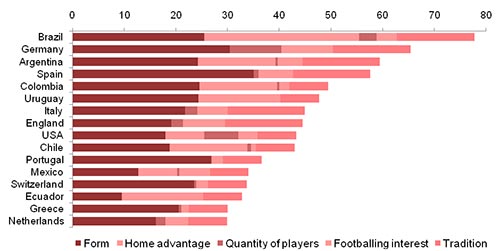
The result of analysing all the key variables is a ‘PwC World Cup Index’ (Figure 1) – a qualitative assessment of each country’s relative strength. This clearly indicates that Brazil is a favourite this year, due to footballing tradition and home advantage; but Germany, Argentina and Spain will push them hard. Meanwhile, although England rank in the top eight on the index, they face a battle to progress from their group – given the slightly higher ranking of their direct rivals Italy and Uruguay.
Figure 1: PwC’s estimated relative strength of leading teams in the 2014 World Cup
The ‘host factor’
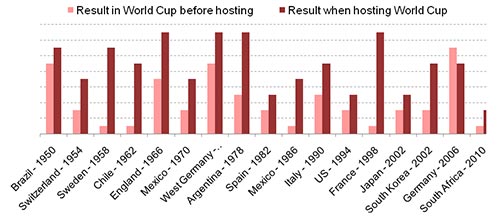
Modelling shows that, on average, host countries can expect to progress a further two rounds than if they were not hosting (see Figure 2). There is also a clear ‘home region’ effect, with strong crowd support and familiar climatic conditions giving a potential boost this year to all the South American teams. An interesting statistic: a European country has never won a World Cup hosted in the Americas, while only once has a Latin American country won a World Cup in Europe – Brazil in Sweden in 1958.
Figure 2: Host country performance at the World Cup
Group of Death
Opinion is divided on which is the ‘Group of Death’ for the 2014 World Cup, with Groups D and G being the two toughest according to combined PwC index scores (see Figure 3 below).
Figure 3: The estimated strength of each 2014 World Cup group according to PwC index

John Hawksworth, UK chief economist at PwC, commented: “Group D has the highest total combined score on our index and is therefore deemed to be the ‘Group of Death’. This reflects the strong collective footballing tradition of Uruguay, England and Italy – three countries in the top 10 of the all-time World Cup table that between them have won seven of the previous 19 World Cups. It will be tough for England to qualify from this group but, if they do, they should have a decent chance to at least reach the quarter finals.”
Over and underachievers
The PwC paper establishes several variables which explain, to a significant extent, the differences in World Cup performance across countries. These are the number of registered football players, attendance at top division club matches, number of bids to host the World Cup, and whether the country is from Europe or South America.
PwC model estimates of each country’s total World Cup points (see note 1 for definition) compared to their actual points is shown in Figure 4 below, which indicates whether each country has under or overachieved relative to model estimates.
Figure 4: Model estimates vs actual historic World Cup performance
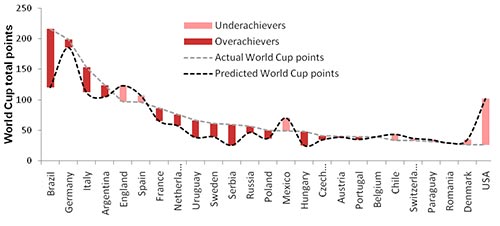
PwC has used historic data on the 56 countries who have played at least six World Cup games. Historical World Cup performance was measured using FIFA’s all-time rankings table, which awards three points for a win, one point for a draw and zero points for a loss for every World Cup game played.
These factors were then combined in a new PwC World Cup index as an indicator of relative prospects for the 2014 World Cup (see Figure 1).
The analysis found that economic variables such as GDP per capita and population were statistically insignificant after controlling for football-specific factors.
What the stars mean:
★ Poor ★ ★ Promising ★★★ Good ★★★★ Very good ★★★★★ Exceptional
Latest News



More News
- Vietjet launches mega year-end ticket promotion (December 10, 2025 | 11:33)
- Vietjet launches daily Manila flights to celebrate year-end festive peak season (December 05, 2025 | 13:47)
- Phu Tho emerges as northern Vietnam’s new tourism hub (December 01, 2025 | 17:00)
- Vietjet completes Airbus A320/A321 updates ahead of deadline (December 01, 2025 | 09:49)
- Vietjet resumes Con Dao flights from early December (November 28, 2025 | 15:24)
- Free tickets, Lunar New Year promotions on offer at Vietjet Mega Livestream (November 26, 2025 | 15:32)
- UNIQLO unveils upgraded heat-retention wear at Hanoi event (October 26, 2025 | 10:00)
- Vietnam named among world’s top four culinary destinations (October 24, 2025 | 17:09)
- Vietnam and Denmark strengthen dialogue on sustainable fashion (October 20, 2025 | 09:11)
- Fusion rolls out special initiatives to celebrate Vietnamese Women’s Day (October 17, 2025 | 20:00)







 Mobile Version