
Human skills key to thriving with AI

At a Deakin University's seminar on July 2, experts argued that while AI is transforming how work is done, the key to remaining relevant lies not in competing with machines, but in strengthening distinctly human capabilities.
Prof. Tran The Truyen, head of AI, Health and Science at the Deakin Applied AI Initiative, argued that the greatest risk posed by AI today is that users may mistake AI-generated responses for factual truth.
"One characteristic of today's generative AI models is that they can produce highly fluent and persuasive responses, but that does not necessarily mean the information is accurate. This phenomenon is known as hallucination, where the system generates information that is entirely fabricated yet presents it as though it were factual," stated Truyen.
"This is currently the biggest risk. We are increasingly relying on AI tools, yet it is becoming difficult to distinguish between what is true and what is false. More dangerously, people can easily develop the illusion that AI is always right," he added. "AI speaks with great confidence, but confidence does not equate to accuracy. Today's technology cannot guarantee absolute correctness, and AI itself does not truly understand what it is generating."
According to Truyen, this risk is particularly serious in sectors that require absolute accuracy, including healthcare, finance, security and defence.
Asked whether AI could one day become as dangerous as nuclear weapons, Truyen argued that the two technologies are fundamentally different. One is a technology that humans understand thoroughly but which possesses immense destructive power; the other is a technology that humans themselves still do not fully understand, yet are deploying at an increasingly massive scale.
According to him, nuclear weapons were developed on the foundation of profound scientific knowledge. Humanity fully understands how they work, but their destructive capacity makes strict control essential.
"Modern AI is different. Today's large language models contain hundreds of billions, or even trillions, of parameters, making it extremely difficult even for the engineers who built them to fully explain why the model produces a particular answer," he explained. "The danger of AI does not lie in physical destruction, as with nuclear weapons, but in the fact that we still do not fully understand how it operates while already deploying it at enormous scale."
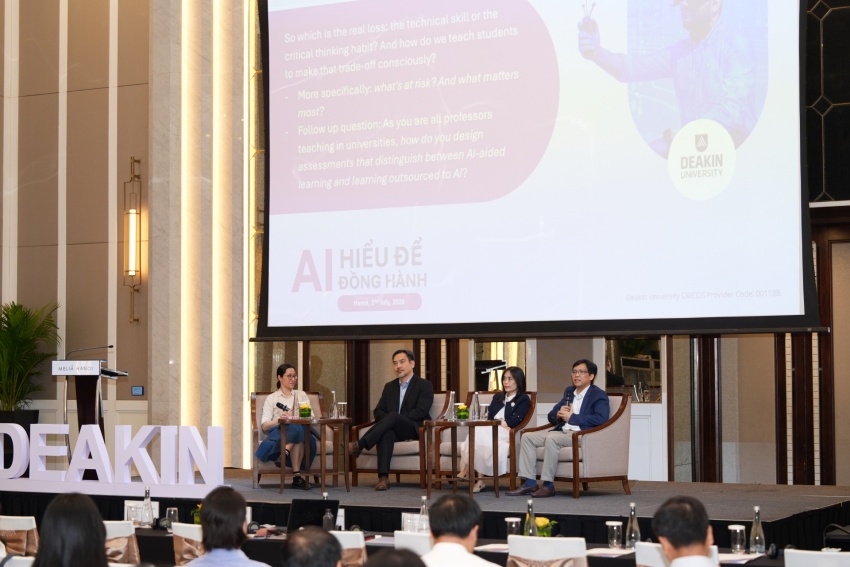 |
| Photo: Deakin University |
Echoing that view, Huynh Thi Thanh Binh, vice dean of the School of Information and Communication Technology, Hanoi University of Science and Technology, said that from both a teaching and research perspective, the central question is no longer what AI is capable of doing, but how it can better support human beings.
According to her, AI will undoubtedly continue to play an increasingly important role in education, research, manufacturing and everyday life. However, greater support from AI does not mean that it can completely replace humans.
"If AI is used to analyse data for decisions involving social benefits, public policies or citizens' entitlements, then any bias or inaccuracy in the input data will inevitably lead to flawed outcomes. The question then becomes: who should be held accountable for those decisions?" said Binh. "AI is highly capable of analysing and synthesising data, but inaccurate inputs will inevitably produce inaccurate outputs. Determining accountability in such cases is an issue we must pay particular attention to. Despite the tremendous benefits AI brings to both work and daily life, we must continue to verify information and use AI selectively rather than assuming every AI-generated output is correct."
According to Vu Tat Thanh, Computer Systems and Network Engineering Specialist Group under the Faculty of Information Technology, Hanoi University of Civil Engineering, the dangers of nuclear weapons have already been proven throughout history, whereas many of AI's negative consequences may only emerge after prolonged use.
“When these technologies first appeared, society largely focused on their benefits. However, after two or three decades of widespread adoption, many countries introduced regulations restricting children's access to smartphones and social media in schools due to concerns over their impact on mental health and youth development,” he cited smartphones and social media as examples.
In his view, AI could follow a similar trajectory. While the technology currently offers enormous benefits, society still needs time to fully understand the long-term consequences that may emerge.
"Many technologies initially deliver tremendous benefits, but only years later do we fully recognise their unintended negative impacts. AI should be approached in the same way: embrace its benefits while remaining cautious about its long-term risks," he said.
Tran Nam Tu, deputy director at the Department of Science, Technology and Information under the Ministry of Education and Training (MoET), pointed out two parallel missions of education in the Al era.
“Al must become a driver for educational transformation, helping improve teaching and learning quality, personalise learning, support teachers, modernise educational governance and expand access to quality education for all citizens,” stated Tu. “Education must become the foundation for developing national Al capacity by training high-quality workers, building strong research groups, promoting innovation and developing competitive Vietnamese-made Al technologies.”
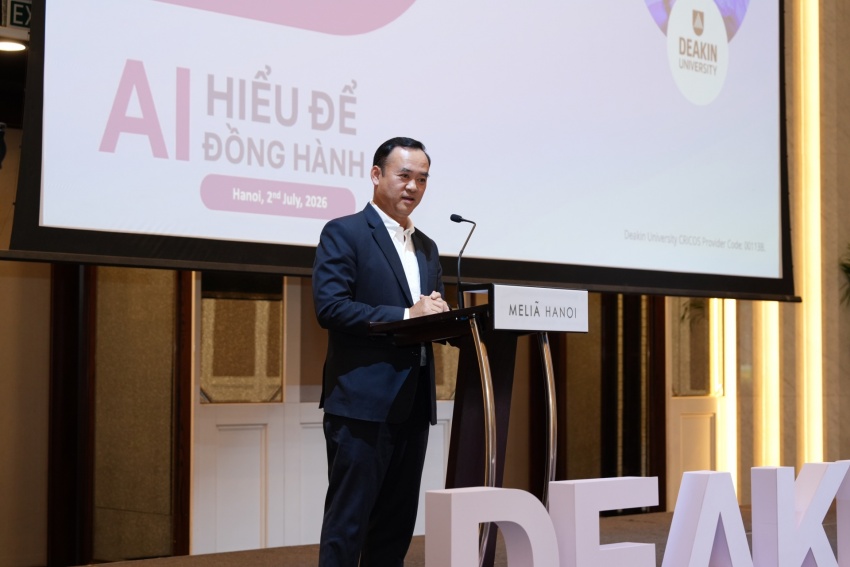 |
| Tran Nam Tu, deputy director at the Department of Science, Technology and Information under the Ministry of Education and Training. Photo: Deakin University |
To realise this vision, Tu suggested that Vietnam focusing on several strategic priorities.
“We are building a national smart education ecosystem, in which educational data, digital learning resources, AI tools, assessment systems and governance platforms are connected into an open, secure and shareable infrastructure,” he said. “Our goal is not to develop a single software application, but to create an integrated digital foundation that can foster innovation across the entire education system.”
Second proposed priority by the MoET is to develop teachers for the Al era.
“We believe that AI will not replace teachers. On the contrary, Al should serve as a supportive tool that helps teachers reduce repetitive tasks and spend more time on creativity, inspiration, critical thinking and the holistic development of learners. The core value of education will remain human-centred,” stated Tu.
“Our third priority is to train high-quality Al human resources. Vietnam is expanding education and training in AI, data science, semiconductors and other strategic technologies,” added Tu. “We are promoting interdisciplinary education by integrating Al into healthcare, agriculture, education, smart manufacturing and public governance. Our goal is to equip all learners with digital and Al literacy, while also developing a pool of experts capable of researching, developing and mastering advanced Al technologies.”
 | AI-ready workforce key to Vietnam's next decade, analysts say As investors assess Vietnam's prospects over the next decade, the decisive question is no longer where to build factories, logistics hubs, or financial platforms, but whether the country can develop the adaptable workforce needed for an AI-driven economy, according to an analysis by Prof. Dr. Andreas Stoffers of FOM University of Applied Sciences and Quynh Nguyen, consultant at Hoa Sen University. |
 | Vietnam posts second-highest AI adoption in Southeast Asia Vietnam has the second-highest AI adoption rate in Southeast Asia at 26.5 per cent, according to a recent Microsoft report. |
What the stars mean:
★ Poor ★ ★ Promising ★★★ Good ★★★★ Very good ★★★★★ Exceptional
 Tag:
Tag:
Latest News





More News
- AEON Vietnam steps up recruitment (October 23, 2026 | 18:16)
- Vietstar partners with Indiana University on AI-era leadership (October 23, 2026 | 12:44)
- Hanoi conference to explore AI, resilience, and integration (October 23, 2026 | 10:19)
- BPC Roundtable Conference 2026 to open in Ho Chi Minh City (October 21, 2026 | 14:46)
- AMATA congratulates Kao Vietnam on 30 years (October 21, 2026 | 14:17)
- Deputy Minister of Finance meets Gujarat delegation in Hanoi (October 21, 2026 | 12:11)
- Vietnam and US discuss financial cooperation and preparations for APEC 2027 (October 21, 2026 | 12:07)
- Vietnam and Denmark sign MoUs to strengthen bilateral ties (October 21, 2026 | 08:00)
- Vietnam and Liechtenstein sign double taxation avoidance agreement (October 19, 2026 | 18:08)
- Creative Young Entrepreneur 2026 showcases five young businesses (October 19, 2026 | 17:59)










 Mobile Version