
Green finance challenge shifts from capital to project quality

On June 5, the Vietnam Green Building Council (VGBC) hosted the workshop 'Mobilising Green Finance for Sustainable Buildings: Bridging ESG Reporting and Access to Capital in Vietnam', bringing together financial institutions, developers, policymakers, and sustainability experts to tackle a critical challenge in Vietnam’s green transition.
As the country moves towards its net-zero emissions target by 2050, Vietnam is estimated to require around US$20 billion in green investment annually. Yet despite offering tangible collateral and measurable environmental performance, green buildings still account for only a small share of the nation’s green credit portfolio.
The key question raised at the event was no longer whether green capital is available, but how to make more projects investment-ready and capable of absorbing the growing pool of sustainable finance.
From the perspective of a financial institution directly deploying capital, Richard Barnsley, director, head of Global Network Banking for HSBC Vietnam, explained that there is no shortage of green capital globally or in Vietnam.
“What is lacking are projects that meet the stringent eligibility criteria required by banks. To enhance their capacity to absorb large-scale capital flows, businesses cannot wait until a project is completed before attempting to label it as green,” said Barnsley.
“Instead, sustainability and ESG considerations must be embedded throughout the project from the earliest stages of concept development and design. This is the golden key that enables projects to pass the rigorous due diligence and assessment processes of international financial institutions,” he added.
 |
| Richard Barnsley, director, head of Global Network Banking for HSBC Vietnam |
Providing a broader point of view, Ta Duc Binh, specialist at the Institute of Strategy and Policy on Agriculture and Environment, Ministry of Agriculture and Environment, said Vietnam has made significant progress in establishing the legal framework for green finance and the carbon market.
In particular, he noted that Decision No.21/2025/QD-TTg on the Green Taxonomy is regarded as a landmark policy, helping standardise the criteria for identifying and classifying green projects.
“Compared with other ASEAN+3 countries, Vietnam can take pride in being one of the pioneers in completing this critical component of the green finance ecosystem,” Binh said. “However, to accelerate capital mobilisation and allocation, the market still needs to address remaining gaps, including standards for green bond issuance, the development of transition finance mechanisms, and the establishment of an integrated data system to support investment appraisal and due diligence.”
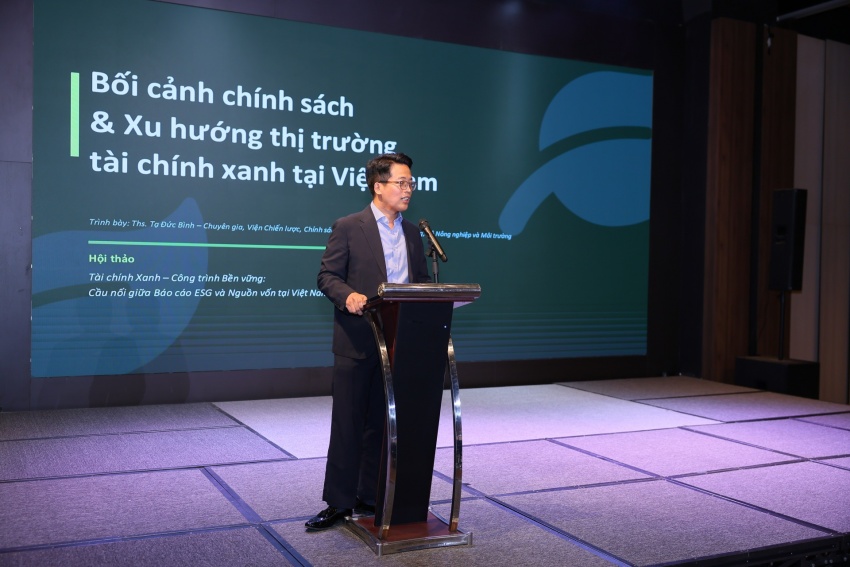 |
| Ta Duc Binh, specialist at the Institute of Strategy and Policy on Agriculture and Environment, Ministry of Agriculture and Environment |
Phan Thu Hang, chairwoman of the board of VGBC, believes that green building certification systems can serve as independent verification tools, enabling businesses to demonstrate the environmental performance and sustainability credentials of their projects.
Citing research findings, Hang noted that green buildings can reduce energy consumption by between 25-60 per cent and cut water usage by 40-50 per cent compared with conventional buildings.
“In addition to their environmental benefits, green buildings help lower operating costs and typically achieve investment payback periods of only two to five years, thereby increasing their attractiveness to financial institutions and long-term investors,” she said. “Strengthening the linkage between green building certifications, ESG reporting, green taxonomies, and sustainable finance mechanisms will help standardise assessment criteria, enhance project transparency, and narrow the information gap between businesses and financial institutions.”
 | Small business ESG strategies unlocked A true sustainability ecosystem requires global endorsement, genuine green financing, and technology solutions to lower the cost of implementation for businesses. |
 | ESG must be translated into tangible action Environmental, social and governance (ESG) is a long-term journey that requires businesses to start early, take concrete actions, and continuously improve over time, rather than waiting for a perfect starting point. |
 | HSBC provides sustainability-linked trade facilities to Bach Hoa Xanh HSBC Bank has provided short-term sustainability-linked trade facilities to Bach Hoa Xanh, one of Vietnam's leading grocery chains owned by Mobile World Group. |
What the stars mean:
★ Poor ★ ★ Promising ★★★ Good ★★★★ Very good ★★★★★ Exceptional
 Tag:
Tag:
Related Contents
Latest News


More News
- Consultation workshop refines Vietnam's clean hydrogen strategy (October 04, 2026 | 08:00)
- JBIC considers new financing options for Vietnam’s energy projects (October 03, 2026 | 08:00)
- Vestas to supply 16 turbines for two new Vietnam wind farms (October 01, 2026 | 07:00)
- Inter-sectoral cooperation on Montreal protocol (September 30, 2026 | 17:20)
- EV battery recycling rate proposed at 8 per cent from 2029 (September 29, 2026 | 16:00)
- Bankability remains hurdle for Vietnam's JETP projects (September 29, 2026 | 12:08)
- Binh Minh Plastics extends clean water project to border communities (September 29, 2026 | 10:57)
- Coca-Cola Vietnam expands packaging collection programme (September 25, 2026 | 08:15)
- Pacifico Energy secures sea survey licence for offshore wind project in Lam Dong (September 24, 2026 | 18:02)
- Vietnam secures $221 million in UN development programmes for 2027-2031 (September 23, 2026 | 17:39)







 Mobile Version