
Government proposes land law amendment to speed up project timelines

 |
| Photo: Le Toan |
According to a report by BMI, a unit of Fitch Solutions, published on September 21, the centrepiece of the proposed amendment – proposed on August 19 – consists of allowing land acquisition and construction to start before compensation plans are approved, and resettlement arrangements are carried out for residents affected. The proposed amendment is part of a broader effort to reform the current 2024 Land Law and is being debated by lawmakers, with its approval by the National Assembly expected in October.
This follows the resolution issued by the Communist Party’s Central Committee in July, setting out the political direction for overhauling how land is managed, priced, and compensated, replacing an earlier resolution that had guided policy for the previous four years.
This resolution functions as a policy framework rather than as law, urging the government to urgently translate its principles into amended legislation. The amendment to the Land Law proposed in August, at the legislative level, would make these changes binding, once they are approved in the National Assembly.
The wider land law reform policy framework, which sets the direction of regulatory changes in the sector in the long term, also focuses on addressing other issues such as allowing for the acquisition of unresolved parcels of land when the majority of landowners and developers in a project area have already agreed to terms, instead of waiting for unanimous agreement.
It also urges resolutions for the clarification of criteria for when land can be seized, as well as data-driven methods for setting land prices. For this reason, the long-term targets of the reform include making a digital land database with full implementation of the modernised land reform targeted for 2030, which, if passed, would only have an effect towards the end of the forecast period between 2026 and 2035.
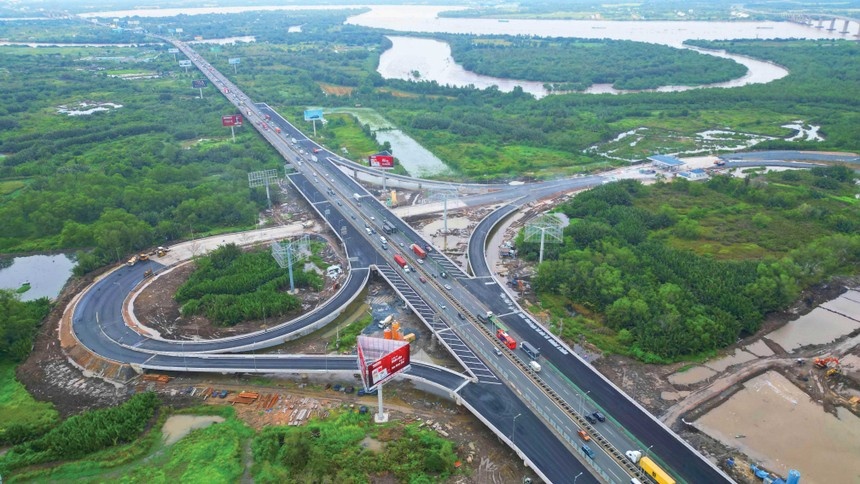
In addressing land acquisition issues, which BMI has previously highlighted as one of the biggest impediments currently to infrastructure development and building construction in the market, the research firm anticipates the reform will bode well for project development within Vietnam’s infrastructure and building construction sectors.
Land acquisition-based delays are currently affecting other infrastructure projects including the $7.5 billion Gia Binh International Airport in Bac Ninh province, which reportedly pushed back the handover of resettlement land for affected residents a fourth time in July.
The recently approved $29 billion Red River Land Boulevard project in Hanoi has also been reportedly experiencing delays stemming from resettlement disputes between residents and developers. The mega-project was approved in May, with its scheduled completion date in 2038.
Land acquisition issues have also been posing downside risks to timely construction of building construction projects in Vietnam. This is the case of the $4.2 billion North Hanoi Smart City project, for which the initial completion date was 2028, but with construction starting only in August last year.
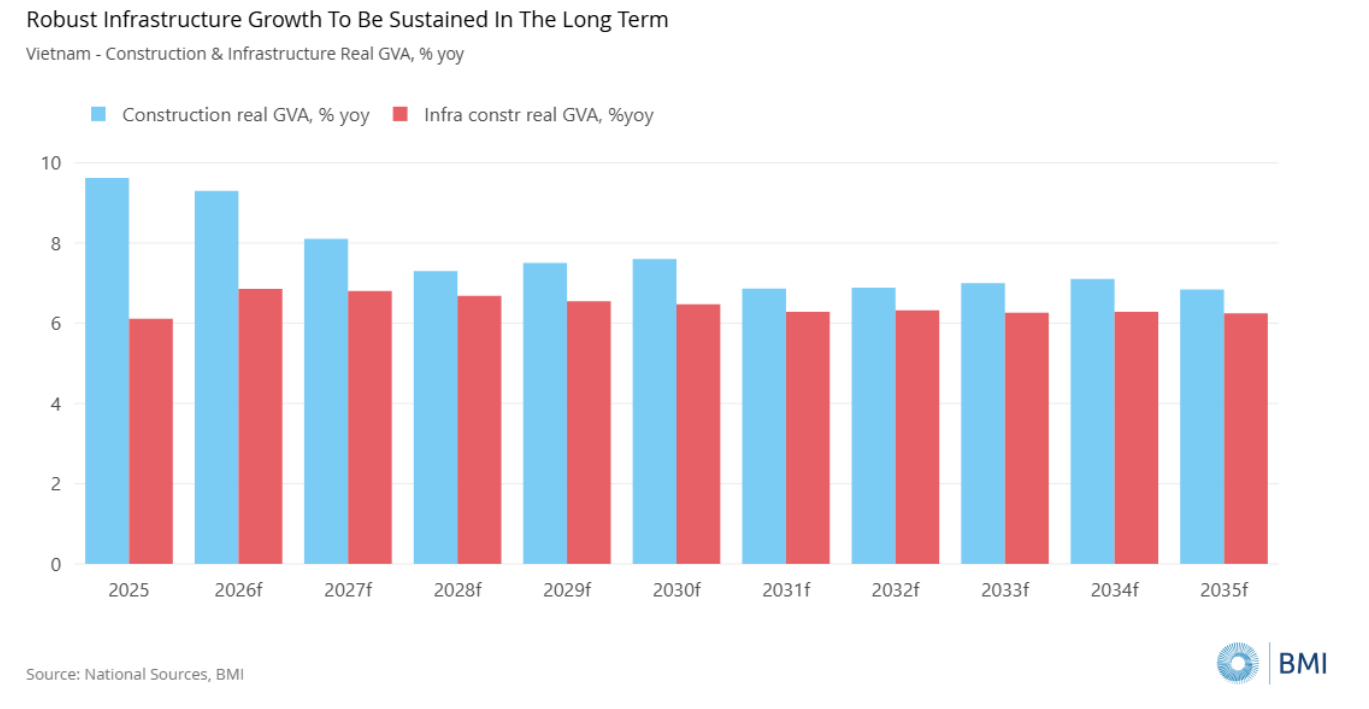
The implementation of the new land reform will therefore bode well for the advance of infrastructure and building projects in Vietnam. BMI currently forecasts Vietnam’s construction real GVA to expand by 9.3 per cent in 2026 and by an average of 7.4 per cent annually between 2026 and 2035, as one of the fastest growing markets in the region. That said, BMI highlights that risks to BMI's forecast are skewed to the downside due to the oil shortages and higher construction material prices triggered by the US-Iran conflict.
 |
| Photo courtesy of BMI |
Given the amendment is still subject to National Assembly approval, BMI anticipates that the effects of the proposed amendment will largely start to materialise towards the medium term.
In October 2026, the National Assembly is expected to approve the amendment, though translation of these legislative changes into quicker land acquisition processes and shortened project timelines will likely take considerably longer, and only take effect towards the end of theforecast period. Vietnam's land framework was already overhauled significantly in August 2024, suggesting that further amendments could take years to be consolidated into a coherent legal structure.
As such, while the amendment will be a structural improvement for project development in the medium to long term, near-term relief for the construction sector's most pressing land-related bottlenecks will remain limited, and infrastructure projects currently experiencing land acquisition issues are unlikely to benefit from this resolution by the time it is passed.
 | Land law overhaul transforms land acquisition Senior partner Duyen Ha Vo and senior associate Tram Dang of VILAF explore the potential implications of upcoming changes on land acquisitions of developers engaged in real estate, energy, and infrastructure projects. |
 | Government to propose Land Law draft easing land recovery procedures The government is set to present a draft resolution to simplify procedures under the Land Law, aiming to ease implementation challenges. |
 | MAE proposes Land Law amendments to support growth targets The Ministry of Agriculture and Environment has submitted a proposal to add amendments to the Land Law to the 2026 legislative programme. |
What the stars mean:
★ Poor ★ ★ Promising ★★★ Good ★★★★ Very good ★★★★★ Exceptional
 Tag:
Tag:Related Contents






Latest News





More News
- Enterprises honoured as Outstanding Provider of Green Industrial Solutions (October 06, 2026 | 18:03)
- MIK Group launches House of MIK in Ho Chi Minh City (October 03, 2026 | 17:00)
- Vietnam hospitality shifts towards integrated mixed-use developments (October 03, 2026 | 10:00)
- Stavian IP accelerates its modern expansion (October 02, 2026 | 14:00)
- ESG for future-ready industrial success (October 02, 2026 | 09:00)
- Green Future Awards honour five leading industrial park developers (October 01, 2026 | 22:20)
- Green transition leaders honoured at Green Future Awards 2026 (October 01, 2026 | 22:10)
- Six developers honoured as Emerging Green Industrial Property Developers (October 01, 2026 | 22:00)
- Why logistics will define the next phase of growth (October 01, 2026 | 09:00)
- Urban Development Law takes effect on October 1 (September 30, 2026 | 17:49)










 Mobile Version