
Real estate market shifts focus to usability and quality of life

These issues were discussed at a seminar on the real estate sector's shift from short-term potential to lasting value, held during Nam Long Experience 2026 – the Real Value Real Estate Exhibition in Ho Chi Minh City from September 18-20.
According to Duong Thuy Dung, executive director of CBRE Vietnam, the real estate market is entering a phase in which growth is no longer driven solely by expectations of short-term price appreciation, but increasingly by factors that create value and support long-term utilisation.
“This shift is driven by increasingly limited land availability in central areas and high development costs, while also reflecting ongoing infrastructure investment and the expansion of the urban area. Ring Road 3, Ring Road 4, the Ben Luc-Long Thanh Expressway and the metro network are gradually improving connectivity between the urban core and surrounding areas,” Dung said.
According to CBRE data, as of July, the former Ho Chi Minh City accounted for around 73 per cent of total housing supply, including apartments and low-rise housing, while the former Binh Duong accounted for 19 per cent, the former Dong Nai 5 per cent, and the former Long An 4 per cent.
“However, newly launched supply shows a clearer trend of expansion beyond the urban core,” Dung said.
For low-rise housing, the former Ho Chi Minh City previously accounted for around 40-70 per cent of new supply, but this share fell to approximately 20-40 per cent from 2024 onwards.
A similar shift has occurred in the apartment segment. Before 2024, the former Ho Chi Minh City accounted for 60-85 per cent of newly launched apartment supply across the region. Since 2024, however, its share has declined to around 20-50 per cent, with new supply increasingly distributed across the former Binh Duong, Dong Nai and Long An.
At the same time, continued increases in house prices in central areas are prompting homebuyers to widen their search.
According to CBRE, between 2021 and 2026, primary apartment prices in Ho Chi Minh City increased by an average of around 14 per cent per year, while secondary-market prices rose by approximately 12 per cent annually.
For the 2026-2028 period, CBRE forecasts annual growth of around 11 per cent for primary prices and 5-6 per cent for secondary prices. This is making housing affordability an increasingly pressing issue, particularly for owner-occupiers.
According to a survey by batdongsan.com.vn released in August, one of the clearest shifts among property buyers is a move away from the belief that they must live in the city centre.
Specifically, 69 per cent of respondents said they would consider suburban areas or emerging locations when searching for property over the next three to five years.
Dong Quang Canh, senior business manager at batdongsan.com.vn, said that suburban areas are not being chosen simply because they are cheaper.
“Buyers are willing to live further from the city centre in exchange for more living space, more affordable prices, and future infrastructure connectivity. Unlike previous cycles, the competitive advantage of suburban areas today lies in the expectation that they still have ‘room for development’ and a sufficiently clear future,” Canh said.
The survey also found that consumers view the next six months as a more suitable period for buying and investing than selling. Their preferences are strongly tilted towards safer products with clear legal status, infrastructure, and established communities.
Notably, 72 per cent of owner-occupier buyers chose areas with new infrastructure and good connectivity.
In Ho Chi Minh City, interest is increasingly concentrated in areas benefiting from metro development, administrative mergers and emerging growth centres. Meanwhile, Hanoi investors are paying greater attention to areas associated with ring roads, inter-regional infrastructure and the expansion of urban areas.
These figures indicate the shift is not taking place solely on the side of developers. Homebuyers are also expanding their search radius to balance four factors: price, living space, connectivity, and quality of life.
As a result, the concept of suburban areas is also evolving. As transport connections improve, being geographically distant from the city centre does not necessarily mean being difficult to access. Conversely, areas with abundant land but inadequate infrastructure, services, and employment opportunities may not yet have the conditions to emerge as new growth poles.
Therefore, the shift in housing supply is not simply about moving further away from the city centre. The key question is where new supply will emerge, and whether it will be supported by infrastructure, employment, services, and genuine housing demand.
For a long time, location has been considered one of the most important factors determining property values. The closer a property is to the city centre, the more highly it tends to be valued. However, as cities expand and inter-regional infrastructure develops, the concept of 'location' is also changing.
According to experts, buyers are now paying greater attention to practical use value and property’s ability to meet their families’ needs over the long term. A home is no longer assessed solely by its distance from the city centre, but also by access to schools, healthcare, retail, parks, workplaces and community spaces.
This is also the basis for integrated and mixed-use urban development models. Under such models, essential needs such as education, healthcare, shopping, work, and leisure can be met within a relatively short travel distance.
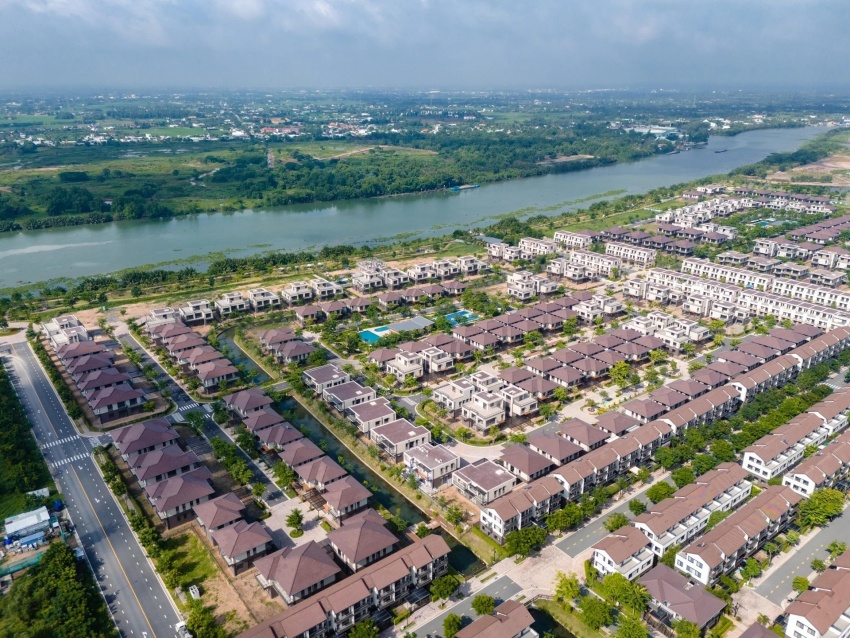 |
| Photo: Nam Long Group |
 | Untangling bottlenecks in Vietnam’s property market The panel “Untangling Bottlenecks, Unlocking Resources” at VIR’s real estate seminar discussed some of the market’s most pressing issues, including the mismatch between supply and demand, homebuyer confidence and investor sentiment. |
 | Cash flows shift as property market repositions Vietnam's real estate market is moving beyond a growth phase driven largely by expectations and entering a more sustainable cycle centred on genuine housing demand and long-term asset value. |
What the stars mean:
★ Poor ★ ★ Promising ★★★ Good ★★★★ Very good ★★★★★ Exceptional
 Tag:
Tag:Related Contents




Latest News

More News
- MIK Group launches House of MIK in Ho Chi Minh City (October 03, 2026 | 17:00)
- Vietnam hospitality shifts towards integrated mixed-use developments (October 03, 2026 | 10:00)
- Stavian IP accelerates its modern expansion (October 02, 2026 | 14:00)
- ESG for future-ready industrial success (October 02, 2026 | 09:00)
- Green Future Awards honour five leading industrial park developers (October 01, 2026 | 22:20)
- Green transition leaders honoured at Green Future Awards 2026 (October 01, 2026 | 22:10)
- Six developers honoured as Emerging Green Industrial Property Developers (October 01, 2026 | 22:00)
- Why logistics will define the next phase of growth (October 01, 2026 | 09:00)
- Urban Development Law takes effect on October 1 (September 30, 2026 | 17:49)
- Phu My Hung to demolish Lawrence S. Ting Building for new development (September 30, 2026 | 17:43)



Latest News





 Mobile Version