
Canon commemorates 25 year launch of flagship-model EOS-1 series SLR cameras

“We have come a long way with our consumers in the journey of professional photography, and look forward to many more years of equipping them with the best tools that enable them to achieve nothing short of the world’s most stunning images. The EOS-1 series is a testament of Canon’s continued commitment to that,” said Nick Yoshida, general director of Canon Marketing Vietnam.
Through the introduction of its powerful flagship-model EOS-1 series, incorporating cutting-edge technologies, and the expansion of these technologies and the functions they make possible, even to entry-level models, Canon continues aiming to enhance the value of its product lineup.
In 1987, Canon launched EOS, the world’s first AF (autofocus) single-lens reflex camera to employ a fully electronic mount system, using electrical signals to control such functions as autofocusing and aperture adjustment.
Two years later, in 1989, the company introduced the top-of-the-line professional-model EOS-1, the camera marked the inaugural model of Canon’s EOS-1 series.
Based on the EOS concept of delivering automated performance in accordance with the will of the user, the EOS-1 featured cutting-edge technologies, class-leading levels of performance, high durability, robustness and reliability.
In 1994, as a growing number of professional photographers were making use of the autofocusing capabilities offered by cameras, Canon launched the EOS-1N, featuring an increased number of focusing points and increased predictive focusing when tracking moving subjects.
Additionally, in 2000, the company introduced the EOS-1V, equipped with 45-point high-density area AF, which contributed to high-speed predictive AF of up to nine frames per second.
In this way, Canon has consistently launched flagship-model SLR cameras designed to satisfy the demands of professionals in step with the changing times.
Upon entering the digital era, Canon launched its first flagship-model professional digital SLR camera—the EOS-1D—in 2001, followed in 2002 by the EOS-1Ds, equipped with a full-frame 35mm sensor.
Since then, the company has reinforced its product lineup through efforts targeting enhanced image quality and continuous shooting performance.
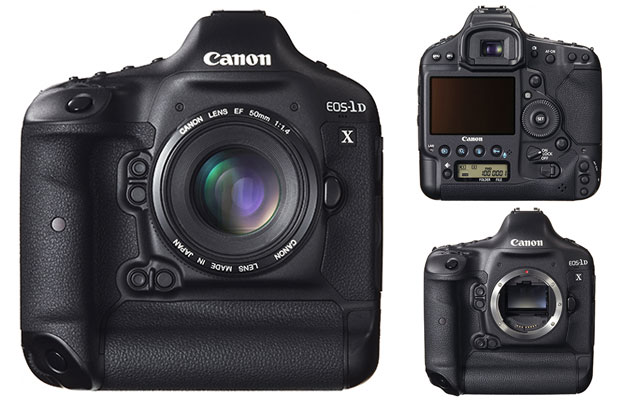
In June 2012, Canon unveiled the EOS-1D X, its latest flagship pro-model digital SLR camera, marking the EOS-1 series’ 13th model since the launch of the original EOS-1.
The 1D X has garnered strong acclaim from professionals working in a wide range of fields, from photojournalism and sports coverage to commercial and nature photography.
Additionally, in February 2014, Canon marked an important milestone in camera production when the company’s total output of digital cameras and EOS series of interchangeable-lens cameras surpassed 70 million units.
Additionally, production of Canon’s EF lens is on track to reach 100 million units in the first half of this year.
In early April 2014, Canon announced further milestones in its camera-manufacturing sector, as the company’s total production of digital cameras and SLR cameras exceeded 250 million units on the 31st of January 2014.
This production output has contributed significantly to Canon maintaining its leading position in the SLR camera market share for the last 11 years.
In addition to its robust camera lineup, Canon contributes to developing the culture of photographic and video imaging though its efforts to fulfill the diverse needs of users.
Canon is a global leader in photographic and digital imaging solutions with a global network of close to 300 companies and employs close to 200,000 people worldwide.
It is dedicated to the advancement in technology and innovation, and is consistently one of the top few companies to earn the most number of patents over the last 20 years.
As a Fortune Global 500 company, Canon is guided by its kyosei philosophy that focuses on living and working together for the common good.
What the stars mean:
★ Poor ★ ★ Promising ★★★ Good ★★★★ Very good ★★★★★ Exceptional
Latest News





More News
- Vietnamese e-commerce beauty spending tops $3 billion in 2025 (March 26, 2026 | 13:57)
- Nghi Son Refinery secures alternative crude amid Middle East disruptions (March 26, 2026 | 09:39)
- New regulatory approach to boost transparency for businesses (March 25, 2026 | 20:00)
- Vietnam Airlines Seeks to Lease 12 Widebody Jets for 2028 Delivery (March 25, 2026 | 15:25)
- MoF moves to cut fuel tax amid global oil volatility (March 25, 2026 | 10:28)
- ACV and Vingroup tie up to advance green transition and airport development (March 24, 2026 | 20:22)
- Caution and stability drive Vietnam’s workforce trends (March 23, 2026 | 14:28)
- Kim Long Motor exports first buses to Thailand in regional push (March 23, 2026 | 12:46)
- Sun Group partners with CAI to manage Phu Quoc Airport (March 23, 2026 | 12:43)
- Robotic surgery advances women's health at FV Hospital (March 20, 2026 | 17:00)









 Mobile Version