
New regulatory approach to boost transparency for businesses

On March 25, the Commission for Standards, Metrology and Quality of Vietnam (STAMEQ), under the Ministry of Science and Technology, in collaboration with Regional Trade for Development (RT4D), hosted a regional workshop in Hanoi aimed at improving technical regulations through the application of Good Regulatory Practices (GRP) and Regulatory Impact Assessment (RIA).
The move aligns with commitments under the Regional Comprehensive Economic Partnership (RCEP) to improve technical standards and better support businesses.
The workshop forms part of a project supported by RT4D under its RCEP Implementation Support Programme, which seeks to strengthen the capacity of Vietnamese officials in applying GRP and RIA in the development of technical regulations and conformity assessment procedures, in line with the country’s commitments under the Regional Comprehensive Economic Partnership.
Speaking ahead of the event, Dr. Tran Hau Ngoc, vice chairman of STAMEQ, said the adoption of GRP and RIA should be viewed as more than a technical adjustment, describing it as a critical step in improving the overall quality of Vietnam’s regulatory system.
“As the national focal point for standards and technical regulations, as well as the implementation of the World Trade Organization's Agreement on Technical Barriers to Trade, STAMEQ is spearheading efforts to develop technical regulations that are evidence-based, informed by comprehensive impact assessment, and aligned with international practices,” stated Ngoc.
He added that these efforts are expected to enhance transparency and regulatory effectiveness, while also facilitating trade, improving business competitiveness, and supporting Vietnam’s deeper integration into the global economy.
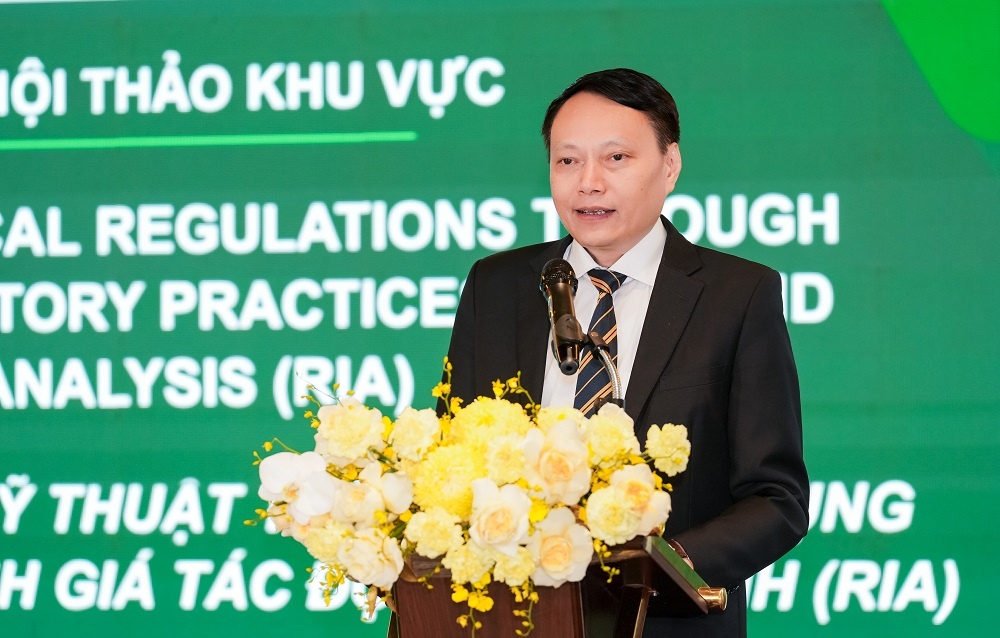 |
| Dr. Tran Hau Ngoc, vice chairman of STAMEQ. Photo: Organiser |
International partners also explained the role of regulatory quality in supporting trade and economic development.
Rebecca Wood, chargé d’affaires at the New Zealand Embassy in Vietnam, noted that improving regulatory practices helps ensure greater transparency and consistency for traders, which in turn supports trade growth, consumer confidence, and more inclusive economic development.
“New Zealand is proud to support practical capacity-building through RT4D. Strengthening GRP and RIA helps regulators make more informed decisions and provides transparency and consistency for traders. This helps grow trade, consumer confidence, and ultimately inclusive economic growth,” she said.
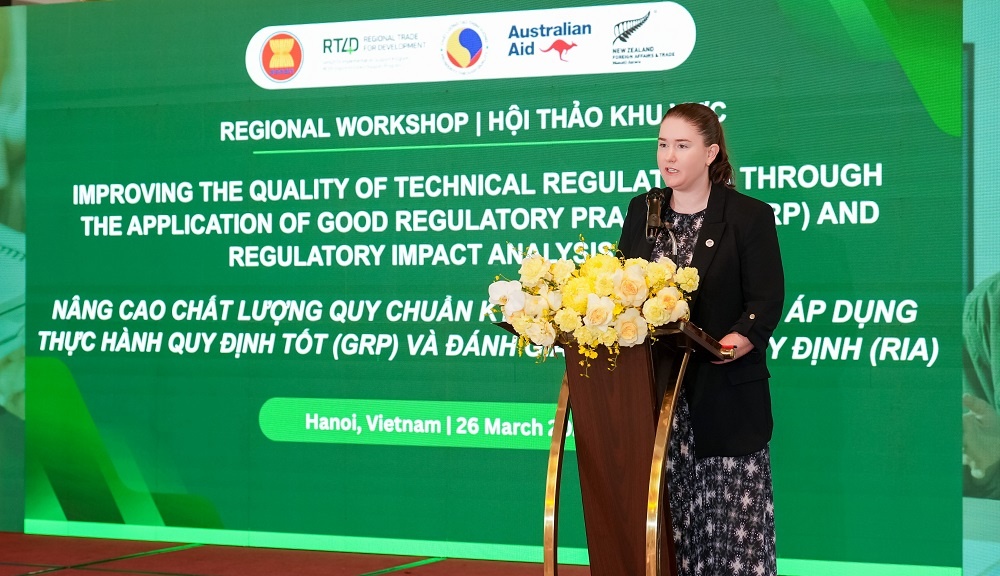 |
| Rebecca Wood, chargé d’affaires at the New Zealand Embassy in Vietnam. Photo: Organiser |
Cecilia Brennan, economic counsellor at the Australian Embassy in Vietnam, noted that enhancing the capacity of both Vietnamese and regional officials to apply GRP and RIA would help ensure that technical regulations are appropriate and aligned with international commitments.
“Australia is pleased to support this project to assist Vietnamese and regional officials to strengthen their capacity to apply GRP and RIA in their work. These practices will help to ensure that technical regulations are fit for purpose, aligned with RCEP commitments and promote a more transparent and predictable regulatory environment for businesses,” said Brennan.
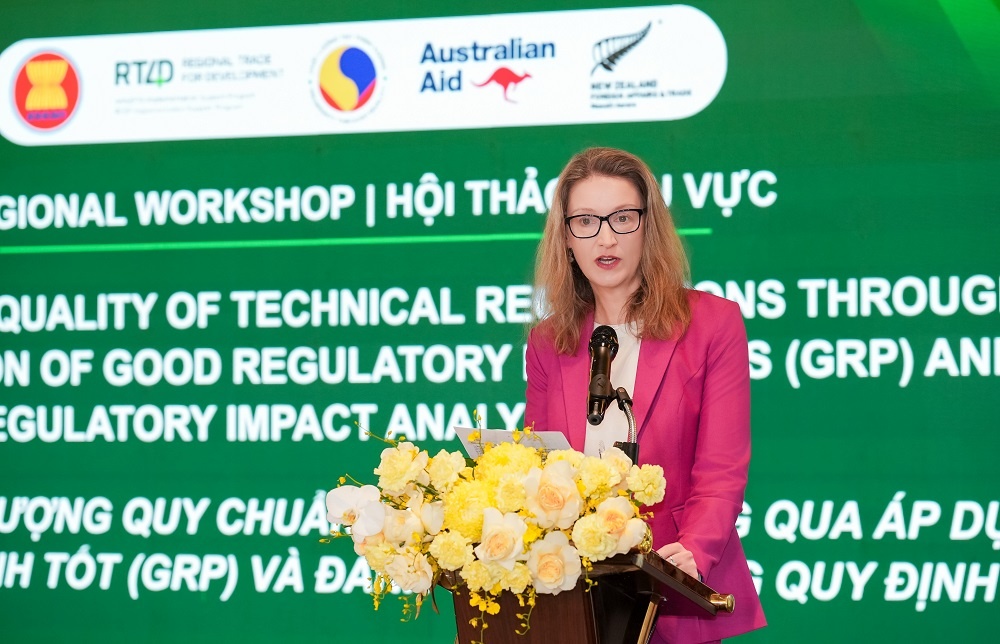 |
| Cecilia Brennan, Economic Counsellor at the Australian Embassy in Vietnam. Photo: Organiser |
The workshop focused on strengthening practical capabilities in applying GRP and RIA, with an emphasis on improving the clarity, effectiveness, and transparency of technical regulations. Participants were introduced to structured approaches to identifying regulatory issues, assessing policy options, and evaluating potential impacts, with the aim of ensuring that regulations are both practical and proportionate.
A representative from the RT4D Facility said the initiative is intended to support better regulatory outcomes by promoting approaches that are evidence-based and trade-friendly.
“Building practical capacity in GRP and RIA helps ensure that technical regulations are well-designed, fit for purpose, and do not create unnecessary barriers to trade,” the representative said, adding that RT4D is working closely with STAMEQ to facilitate knowledge sharing across the region.
Through technical discussions and peer exchange, participants are expected to gain a clearer understanding of how to design regulations that minimise trade disruptions while meeting policy objectives.
The programme also aims to strengthen coordination among regulators and stakeholders by sharing practical tools and experiences, helping identify common challenges and potential solutions to advance regulatory cooperation within the region.
 | Vietnam eases rules for foreign employees: key changes and implications For many years, Vietnam has been a source of international migrant labour, but also a destination for many employees from around the world. |
 | Doing Business in Vietnam report offers roadmap for investors The “Doing Business in Vietnam 2025-2026” report serves as a practical guide, offering investors a comprehensive view of the nation's economic landscape along with the key considerations for market entry and operations. |
 | Vietnam tax and legal changes set to shape foreign investment landscape Nguyen Huong Giang, partner of Tax and Legal Services at PwC Vietnam, notes that upcoming tax reforms are expected to reshape the business environment and influence the attractiveness of Vietnam for foreign investors. |
What the stars mean:
★ Poor ★ ★ Promising ★★★ Good ★★★★ Very good ★★★★★ Exceptional
 Tag:
Tag:
Latest News




More News
- EuroCham confidence index holds at 78.3 despite operational hurdles (October 16, 2026 | 17:27)
- Shrimp and rice firms face rising standards in export markets (October 16, 2026 | 09:00)
- SCG and Prime Group add value to the ecosystem (October 15, 2026 | 15:55)
- Project readiness key to unlocking green finance (October 15, 2026 | 12:35)
- Sovereign AI and human oversight key to secure digital government (October 15, 2026 | 12:32)
- MEXC Ventures partners with Corelia Academy: Bringing digital asset education closer to Vietnamese students (October 15, 2026 | 09:00)
- Global design expertise meets a more sophisticated Vietnam market (October 15, 2026 | 09:00)
- Vietnam growth nears double digits, UOB raises forecast (October 14, 2026 | 17:39)
- Smart factories need skills, finance and trust to scale (October 14, 2026 | 17:33)
- Sanofi-Aventis Vietnam appoints new head of Vaccines and country lead (October 12, 2026 | 17:21)








 Mobile Version