
Real estate pressures could lead to healthier growth cycle

Pham Van Hoanh made the remarks at a seminar organised by VIR in Ho Chi Minh City on May 12. Delivering the opening address, he noted that Vietnam's real estate market has never operated in such a highly volatile environment.
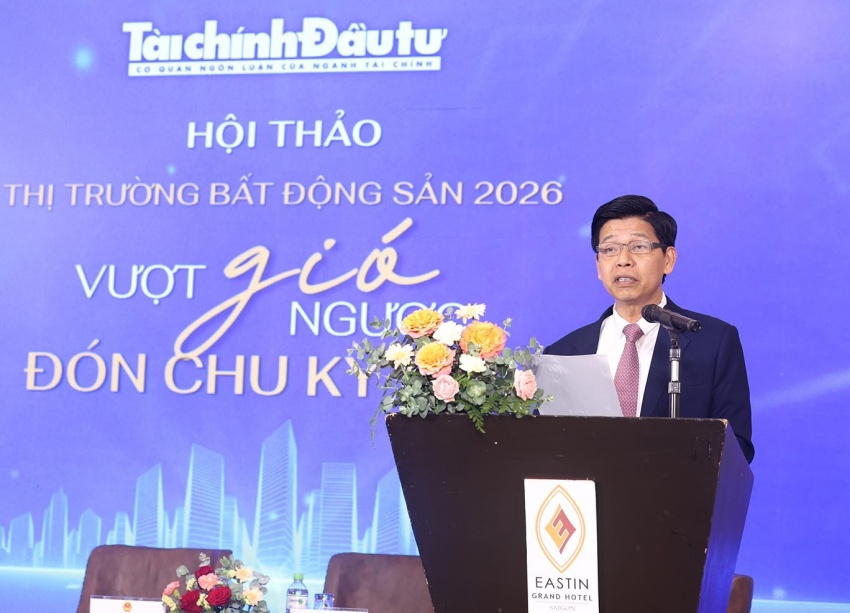 |
| Pham Van Hoanh, VIR editor-in-chief |
"On the global front, prolonged geopolitical tensions, rising protectionism, and persistently high interest rates are placing mounting pressure on capital flows and project development costs," he said.
Meanwhile, rising input material prices and escalating construction costs have affected project implementation schedules, reshaped supply structures, and pushed up market prices.
Domestically, while public investment, infrastructure development, foreign investment and rapid urbanisation continue to provide strong momentum for the real estate sector, the market is also entering a period of deeper screening and restructuring. This is forcing real estate developers to rethink their growth strategies, restructure capital sources, and adapt to increasingly stringent requirements for transparency and sustainable development.
Citing first-quarter 2026 market data, Hoanh said that nationwide, 55 housing projects received investment policy approval with total registered capital exceeding VND629 trillion ($24.2 billion). In parallel, more than 1,300 projects are currently under construction, supplying around 654,000 housing units to the market. A number of projects have also been completed or become eligible for commercial launch.
“This indicates that investment and project development activities are still being maintained, while market supply has not fallen into a state of disruption,” Hoanh noted.
However, behind these positive signals, the market continues to face multiple 'headwinds'. Input costs are continuing to rise amid fluctuations in fuel and raw material prices, while interest rates and capital costs remain elevated. Real estate credit is also being more tightly controlled, pressure from corporate bond maturities during the 2026–2027 period is mounting, and prolonged legal delays at many projects remain unresolved. Together, these factors are exerting considerable pressure on supply, market liquidity, and investor sentiment.
Over the past period, the Party, the National Assembly, and the government have introduced a series of decisive policies aimed at removing obstacles for the real estate market, ranging from improving the legal framework to unlocking capital flows and reforming administrative procedures.
The passage of the 2024 Land Law, the 2023 Housing Law, and the 2023 Law on Real Estate Business, together with Resolution No.171/2024/QH15 and Decree No.75/2025/ND-CP, is expected to address many longstanding legal issues and help revive market supply.
From a financial perspective, the government has also directed the rollout of the VND120 trillion ($4.62 billion) credit package for social housing and steered interest rate management towards supporting market recovery.
The government has recently issued eight resolutions on cutting, decentralising, and simplifying administrative procedures and business conditions, abolishing hundreds of procedures and requirements in a move aimed at significantly reducing compliance time and costs for businesses.
“With such strong policy efforts, Vietnam’s real estate market is gradually overcoming its most difficult period and is expected to enter a new phase characterised by greater transparency and sustainability,” Hoanh added.
The next growth cycle will no longer be driven by overheated expansion or excessive financial leverage, but rather by genuine housing demand, project execution capabilities, market transparency, and the quality of capital flows. This means developers will need to undergo restructuring, investors will have to recalibrate their strategies, and the market itself will be required to operate under stricter discipline.
Every correction phase presents an opportunity to reshape the market in a healthier direction. If delays in capital disbursement are addressed effectively, policies are implemented efficiently, and businesses adapt in a timely manner, today’s headwinds could ultimately become the driving force behind a more transparent, sustainable, and resilient growth cycle for Vietnam’s real estate market in the years ahead.
 | More disciplined growth for real estate and construction After a turbulent early 2020s, Vietnam’s real estate and construction sectors are entering a new growth cycle – one driven by fundamentals rather than speculation. Khushboo Goyal, director and lead for Building, Construction & Real Estate Consulting at KPMG in Vietnam, analyses the trends and challenges shaping these sectors. |
 | Real estate market 2026: Weathering Headwinds, Embracing a New Cycle The seminar "Real estate market 2026: Weathering Headwinds, Embracing a New Cycle" organised by Vietnam Investment Review will commence at 8am on May 12 at Eastin Grand Hotel Saigon. |
What the stars mean:
★ Poor ★ ★ Promising ★★★ Good ★★★★ Very good ★★★★★ Exceptional
 Tag:
Tag:Related Contents




Latest News
More News
- MIK Group launches House of MIK in Ho Chi Minh City (October 03, 2026 | 17:00)
- Vietnam hospitality shifts towards integrated mixed-use developments (October 03, 2026 | 10:00)
- Stavian IP accelerates its modern expansion (October 02, 2026 | 14:00)
- ESG for future-ready industrial success (October 02, 2026 | 09:00)
- Green Future Awards honour five leading industrial park developers (October 01, 2026 | 22:20)
- Green transition leaders honoured at Green Future Awards 2026 (October 01, 2026 | 22:10)
- Six developers honoured as Emerging Green Industrial Property Developers (October 01, 2026 | 22:00)
- Why logistics will define the next phase of growth (October 01, 2026 | 09:00)
- Urban Development Law takes effect on October 1 (September 30, 2026 | 17:49)
- Phu My Hung to demolish Lawrence S. Ting Building for new development (September 30, 2026 | 17:43)



Latest News





 Mobile Version