
Vietnam maintains stable AI outlook in 2026 survey

 |
| Photo: Shutterstock |
Released on May 17 to mark World Telecommunication Day, the index measures how people in 44 countries think about and use AI, covering usage habits, trust, acceptance, and concerns.
In Vietnam, the 2026 survey was carried out by DXL Research & Consulting. A total of 900 urban Vietnamese were surveyed across four major cities between November and December 2025. This is the second year the Index has been published, making it possible to track year-on-year changes.
The score remained stable because two sets of forces were pushing in opposite directions and almost cancelled each other out. More people are using AI every day and trusting what it tells them. At the same time, fewer feel comfortable with AI as part of society, and concern about misinformation, privacy, and job loss has grown sharply.
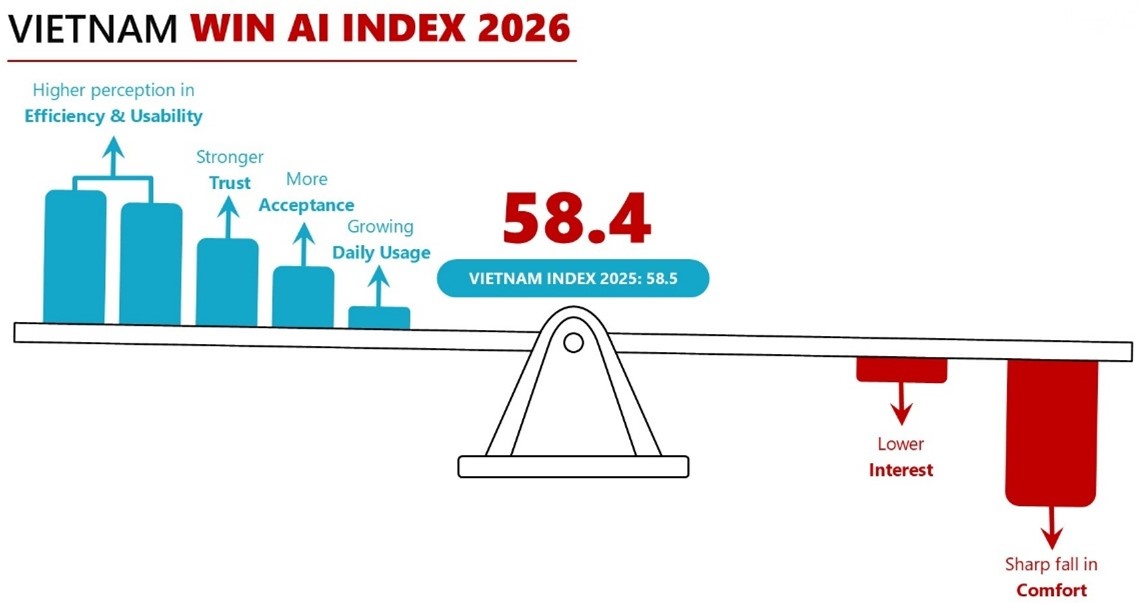 |
Five indicators improved. Vietnamese respondents showed higher perception of AI's efficiency and usability, meaning more people see AI as a practical, effective tool. Trust in AI strengthened. Acceptance of AI grew. And the share of daily users increased. These are all signals of a population that is engaging with AI more seriously than a year ago.
At the same time, two indicators fell. Interest in AI declined, suggesting the initial novelty has worn off for some. And comfort with AI dropped significantly, meaning fewer people feel at ease with the broader role AI is playing in society. These two declines were large enough to pull the overall score down even as the positive indicators rose, leaving the index in almost the same place it was in 2025.
For the first time, the WIN World AI Index places each of the 44 surveyed countries into one of four maturity profiles, based on how widely AI is used and how people feel about it. They include AI leaders, rising performers, cautious adopters, and early stage.
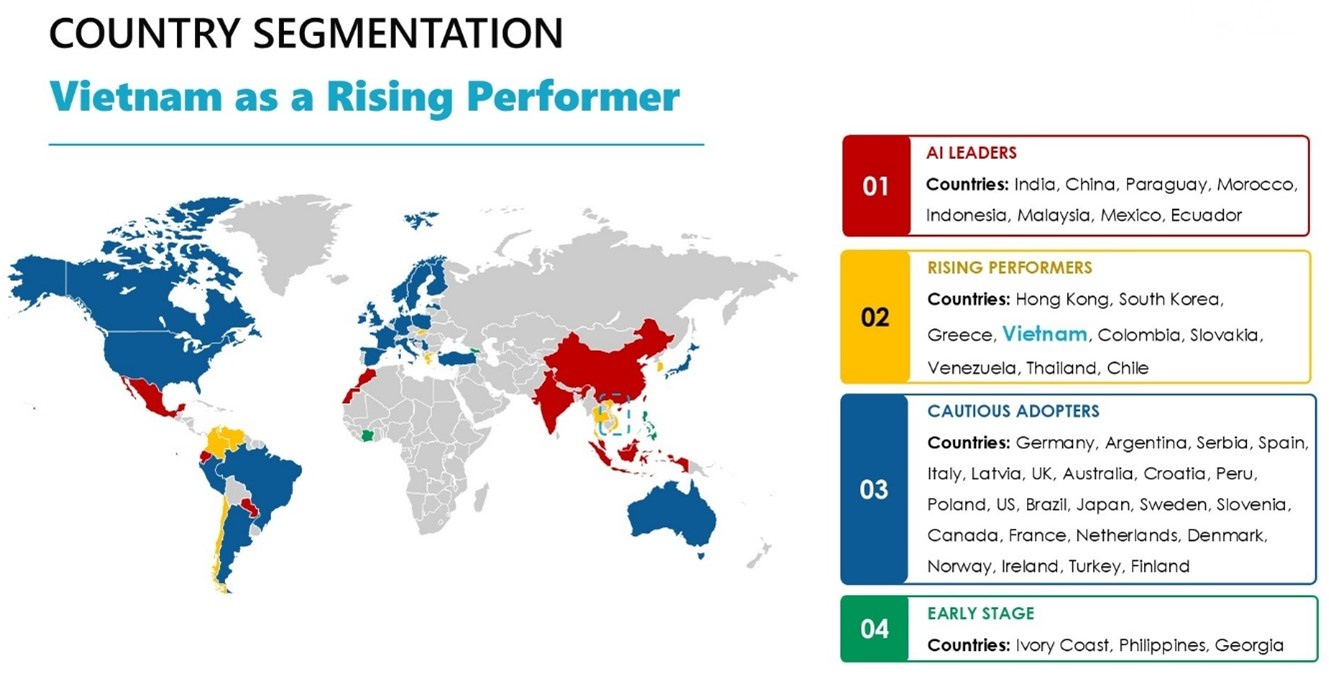 |
Of these four, Vietnam's profile in 2026 is categorised in the Rising Performers group. Vietnam is a market where AI has found a real foothold in daily life, but where public confidence in its broader role in society has yet to follow. People are using AI more and finding it useful. But on the bigger questions like what AI means for jobs, for privacy, for the information people trust, comfort has fallen and concern has grown. Vietnam knows what AI can do. What remains unsettled is what kind of place AI should have.
In 2025, 13 per cent of urban Vietnamese respondents said they used AI tools daily. By 2026, that figure had risen to 19 per cent.
That growth signals a shift in behaviour. More Vietnamese are moving from occasional experimentation to regular, habitual use. It is this group of consistent users that tends to drive how attitudes and norms around AI develop over time.
The gap between how Vietnamese people use AI at home versus at work is one of the biggest findings in this year's data. Personal use stands at 53 per cent. Professional use is at 38 per cent. That 15 per cent pts difference is among the largest of any country in the Index.
Among those who use AI personally, entertainment is by far the main purpose, cited by 76 per cent of respondents. AI-powered content, recommendations, and interactive experiences are driving everyday personal adoption.
In the workplace, the picture is more practical. Research and data analysis is the top use case at 37 per cent, closely followed by productivity and workflow tasks at 36 per cent. When people do use AI at work, they tend to use it for tasks where they can check the results.
Vietnam's most striking result is a split: trust in the accuracy of AI-generated information went up, from 65.6 to 69.4. At the same time, personal comfort with AI went down, from 49.3 to 40.7. That is the biggest single change in Vietnam's Index this year.
These two numbers are not in conflict. Trust in accuracy reflects personal experience: someone asks AI a question and finds the answer useful. Comfort is about how AI is changing society, what it means for jobs and privacy and the reliability of public information. People can trust their own AI interactions and still feel uneasy about where AI is taking things more broadly.
Concern went up across all three risk areas measured by the Index. Each one also has a direct response to Vietnam's new AI law, which was drafted and debated at the same time the public's anxiety was being measured.
68 per cent of respondents said they have high concern about how AI handles personal information, which increases from 52 per cent in 2025. That 16 per cent pts rise makes privacy the biggest worry among the three areas measured.
Concern about AI spreading false information saw the largest increase of any measure in this year's Vietnam results. It jumped from 36 per cent in 2025 to 65 per cent in 2026, a rise of 29 per cent pts in a single year.
In addition, 6 in 10 respondents (61 per cent) expressed high concern about AI causing job losses. That is up from 48 per cent in 2025, a rise of 13 per cent pts.
 | ASEAN unveils digital outlook, AI readiness research New regional reports highlight ASEAN’s digital maturity and readiness for artificial intelligence, marking the next phase of the bloc’s AI skills push. |
 | SK Group to foster AI ecosystem development in Vietnam SK Group has signed agreements to collaborate with Vietnam on building the country's AI industry ecosystem and developing core AI infrastructure. |
 | Vietnam’s financial sector accelerates AI adoption, but security issue remains Financial institutions in Vietnam are accelerating the adoption of AI, but security concerns and legacy technology remain significant barriers to scaling deployment, according to new research from Finastra on February 10. |
What the stars mean:
★ Poor ★ ★ Promising ★★★ Good ★★★★ Very good ★★★★★ Exceptional
 Tag:
Tag:Related Contents





Latest News




More News
- Vietnam’s coffee industry faces value-add challenge (October 23, 2026 | 10:17)
- Ho Chi Minh City offers interest rate support to businesses (October 23, 2026 | 10:03)
- Carlsberg underscores long-term Vietnam commitment at Denmark talks (October 22, 2026 | 16:06)
- Brookland Group makes first investment in Vietnam's Miza Corporation (October 21, 2026 | 12:18)
- Petronas, Petrovietnam to expand energy cooperation (October 21, 2026 | 12:13)
- AI in customer experience: Finding the right level of automation (October 21, 2026 | 09:03)
- Fresh graduates fall short on soft skills, employers say (October 19, 2026 | 13:14)
- Ford innovations continue towards sustainable growth (October 19, 2026 | 09:40)
- Preparing professionals for a new business environment (October 19, 2026 | 09:13)
- KN Holdings honoured for ESG efforts in Vietnam (October 18, 2026 | 11:00)











 Mobile Version