
Securing capital and efficiency for Vietnam’s 2026-2030 growth ambitions

On December 16 in Hanoi, the Central Policy and Strategy Commission and the government co-chaired and directed the Vietnam's Economy in 2025 and Prospects in 2026 Forum (VEPF), under the theme “Vietnam's economy: rapid and sustainable development, green transition in the digital era”. At the thematic session on finance and banking, most contributions focused on solutions to mobilise and use financial resources effectively in support of economic growth during the 2026-2030 period.
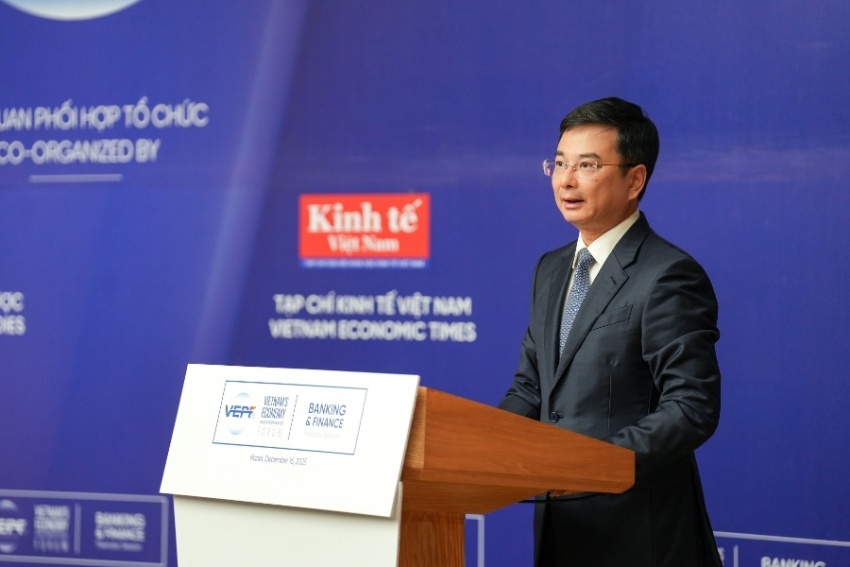 |
| Pham Thanh Ha, deputy governor of the State Bank of Vietnam |
In his opening remarks, Pham Thanh Ha, Deputy Governor of the State Bank of Vietnam, said that the country is facing the need for strong acceleration in its next stage of development. The government has set a target of at least 8 per cent economic growth in 2025 and aims for double-digit growth in the 2026-2030 period. This provides an important foundation for Vietnam to move into the group of upper-middle-income countries by 2030 and towards becoming a high-income country by 2045.
To reach upper-middle-income status by 2030 and high-income status by 2045, the economy must not only sustain high growth rates over a prolonged period, but also ensure stability and sustainability.
In this context, since early 2025 the Party and the state have issued numerous major resolutions, most notably a group of resolutions considered strategic pillars for a new development phase. These include policies on developing science and technology, innovation, and digital transformation; promoting international integration; improving legal and institutional frameworks; and advancing the private sector. These orientations are generating new momentum, mobilising the coordinated participation of the political system, the business community, the public, and the intellectual community.
“One of the issues with decisive significance for the goal of high growth is ensuring sufficient capital for the economy, alongside its effective use to promote a growth model based on science and innovation,” Ha highlighted.
However, Deputy Minister of Finance Do Thanh Trung noted that it is also necessary to candidly recognise that a growth model heavily reliant on capital, low-cost labour, and processing-based exports is gradually reaching its limits.
Moreover, the international environment is changing rapidly, with strategic competition, increasing trade fragmentation, and the emergence of new standards such as the global minimum tax, carbon border adjustment mechanisms, and requirements for green and sustainable development. This context requires Vietnam to grow faster, but also with higher quality and greater sustainability.
From the perspective of fiscal and budgetary management, Trung emphasised that the double-digit growth target for the 2026-2030 period reflects a very high level of political determination by the Party and the state. Achieving this goal requires fundamental changes in action-oriented thinking, as well as in the way resources are mobilised, allocated, and utilised.
"With the principle of internal strength as a long-term strategy and external resources as an important, regular, and breakthrough factor, mobilising sufficient capital is a major task. However, allocating resources to the right priorities and using them effectively and transparently to generate high added value is even more important. Therefore, alongside capital mobilisation, priority must be given to targeted allocation and transparent, efficient use to create greater value," he said.
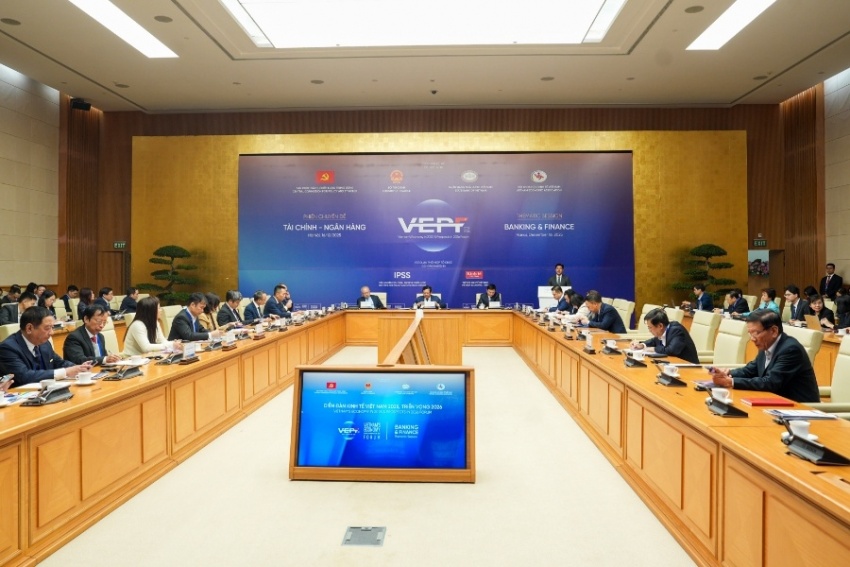 |
He also noted that fiscal policy should continue to play a role in fostering long-term growth, being managed proactively, sustainably, and with clear focus. In this regard, the structure of state budget expenditure should prioritise development investment and the assurance of social security.
At the same time, the capital market needs to be further consolidated and developed to become the main channel for mobilising medium- and long-term resources for the economy, gradually reducing pressure on the banking credit system while enhancing market transparency and safety.
Beyond financial and monetary solutions, improving the operational efficiency of state-owned enterprises and creating a favourable environment for the private sector have been identified as important drivers of growth. The business and investment environment also needs continued improvement so that the private sector can truly become the most important engine of growth and innovation.
In addition, strengthening close coordination between fiscal and monetary policies is considered a key factor in ensuring macroeconomic stability and inflation control, while still supporting high growth amid rising risks.
In particular, institutional reform and the establishment of a transparent and stable legal environment are seen as foundational and decisive solutions to retain financial resources and attract businesses, especially long-term strategic investors, to Vietnam.
“Mobilising and using financial resources effectively to achieve double-digit growth is a shared task of the entire economy, requiring the coordinated involvement of ministries, sectors, local authorities, the business community, and society as a whole,” Trung said.
“The VEPF will serve as a platform to bring together intellectual contributions and share ideas, suggesting practical and feasible solutions that help refine policies and turn aspirations for rapid and sustainable national development into a reality,” he added.
 | VIR workshop highlights capital and policy for sustainable development Sustainable development, once framed largely as a long-term aspiration, demands strong policy commitments along with a fundamental rethinking of how capital is mobilized and allocated to support green and inclusive growth. |
 | Vietnam's green transition demands collective financial action As Vietnam accelerates its green transition, mobilizing diverse, long-term financial resources beyond the banking system has become a decisive factor in delivering sustainable and inclusive growth. |
 | Vietnam still has room to mobilize capital for sustainable growth As Vietnam pursues increasingly ambitious growth targets, resources for sustainable development should be understood within the broader context of the economy's financing needs, rather than confined solely to green projects. |
What the stars mean:
★ Poor ★ ★ Promising ★★★ Good ★★★★ Very good ★★★★★ Exceptional
 Tag:
Tag:Related Contents




Latest News


More News
- Vietnam’s registered FDI surpasses $50 billion in nine months (October 07, 2026 | 10:30)
- Samsung Electro-Mechanics to add $1.85 billion semiconductor investment in Thai Nguyen (October 06, 2026 | 18:23)
- Electronics funding will be won via a capable ecosystem: SGS (October 06, 2026 | 09:00)
- LNG power plant projects risk falling behind schedule (October 03, 2026 | 09:00)
- Pandora opens world’s largest fine jewellery crafting facility (October 02, 2026 | 22:21)
- An Phat 5 Industrial Park positions for new wave of investment in northern Vietnam (October 02, 2026 | 09:00)
- Hanoi to launch portal to ease hurdles for tech businesses (October 01, 2026 | 09:00)
- Foreign investors to be widened for market access (September 30, 2026 | 17:54)
- Phu Quoc Airport planning adjusted to serve APEC 2027 (September 30, 2026 | 17:35)
- Nearly 200 foreign-invested enterprises in Vietnam to pay global minimum tax (September 30, 2026 | 17:26)


Latest News




 Mobile Version