

Digital future for SMEs: no transformation without cybersecurity shield

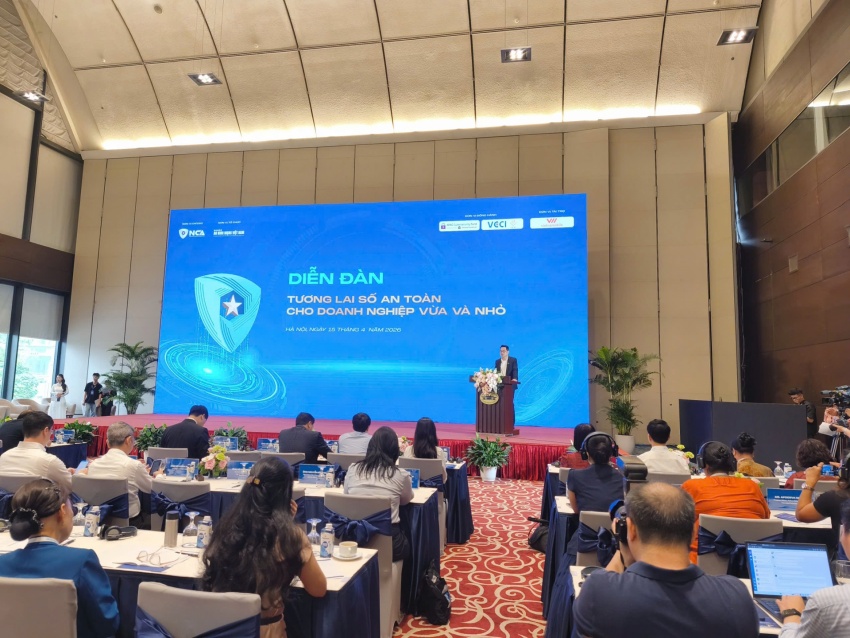 |
The Secure Digital Future for SMEs forum brought together around 200 representatives from government agencies, industry experts, business communities, professional associations and international partners to discuss practical solutions for strengthening digital security capacity among small- and medium-sized enterprises (SMEs).
Vu Duy Hien, deputy secretary general and chief of office at the National Cybersecurity Association, highlighted the challenges facing many SMEs as they enter the digital space with limited resources, insufficient tech talent, inadequate tools and little experience in risk response, while cyber threats continue to grow more sophisticated.
“For SMEs, incidents such as fraud, data breaches, malware or brand impersonation are not just technical issues, they can directly impact reputation, customer trust and even business survival,” he said. “Cybersecurity must be recognised as a foundational condition for effective digital transformation.”
Hien added that in an increasingly volatile digital landscape, the association aims to act as a strategic anchor for Vietnamese businesses through three key commitments: connecting resources to reduce isolation among SMEs, sharing practical knowledge and policies, and providing implementation support and rapid incident response.
Hoang Quang Phong, vice chairman of the Vietnam Chamber of Commerce and Industry, stressed that digital security is no longer optional but a prerequisite for long-term business sustainability. More importantly, he said, it should be treated not merely as a technical issue but as a matter of strategic governance, starting from leadership awareness, risk-focused corporate culture, and proactive investment in cybersecurity across the value chain.
“Businesses need to view data security management as a core capability,” Phong noted, adding that this would enable them to move forward with confidence in their digital transformation journey.
Nguyen Hong Quan, deputy director of the Department of Cybersecurity and High-Tech Crime Prevention under the Ministry of Public Security, pointed to the government’s digital transformation programme for SMEs for 2026-2030. The initiative aims to support at least 500,000 SMEs, including 300,000 adopting digital platforms and AI.
“This is a strategic step, affirming that digital transformation and cybersecurity are vital not only for businesses but for the national economy,” he said.
However, Quan warned that SMEs, despite making up the majority of enterprises, often lack resources, specialised personnel and incident response capabilities, leaving them vulnerable as the “weakest link” in the digital ecosystem. This exposes them to cyberattacks, fraud, data loss and operational disruption, with direct consequences for market credibility.
Nguyen Hoa Cuong, vice president of the Institute for Policy and Strategy Studies, noted that cybersecurity remains a major challenge due to low awareness, lack of dedicated personnel and the absence of long-term strategies. Many firms still rely heavily on third-party platforms and pursue only partial digitalisation rather than comprehensive transformation.
To address these gaps, Cuong proposed a range of solutions. At the ecosystem level, he called for the development of information portals and vendor directories, expanded skills training programmes, stronger public-private partnerships and early warning systems. At the enterprise level, he emphasised basic “cyber hygiene”, adoption of the 3-2-1 data backup rule, migration to cloud computing, use of licensed software, compliance with international standards and investment in specialised security tools.
Beyond technical discussions, the forum aimed to build a coordinated support network linking regulators, associations, experts, technology firms and international partners. This, organisers said, would help SMEs answer three fundamental questions: where they stand in terms of digital security, what assets need prioritised protection, and how to respond effectively when incidents occur.
 | Vietnam enhances SME ecosystem through digital and green transition training A two-day training programme aimed at strengthening support for small and medium-sized enterprises in digital and green transformation opened in Hanoi on April 9. |
 | Small business ESG strategies unlocked A true sustainability ecosystem requires global endorsement, genuine green financing, and technology solutions to lower the cost of implementation for businesses. |
 | JICA and BIDV launch $50m sustainable financing for rural MSMEs Japan International Cooperation Agency and BIDV have announced a sustainable financing facility to support rural micro, small and medium-sized enterprises in Vietnam. |
What the stars mean:
★ Poor ★ ★ Promising ★★★ Good ★★★★ Very good ★★★★★ Exceptional
 Tag:
Tag:Related Contents












Latest News




More News
- Sojitz in Vietnam: 40 years from individual projects to a business cluster 'KATAMARI' (October 08, 2026 | 09:00)
- Coteccons targets 'Quality Growth' with 25 per cent dividend plan (October 07, 2026 | 13:00)
- Vietnam Education Forum opens UK Education Mission's Hanoi visit (October 07, 2026 | 12:27)
- Tax authorities deactivate TINs of nearly 180,000 businesses (October 07, 2026 | 12:08)
- World Bank raises Vietnam's 2026 GDP growth forecast to 7.4 per cent (October 07, 2026 | 11:41)
- Vietstock 2026 to spotlight livestock innovation and green transition (October 07, 2026 | 09:00)
- Vietnam’s GDP grows over 9 per cent in first nine months (October 05, 2026 | 18:45)
- Vietnam earns $56.3 billion from agro-forestry-fishery exports (October 05, 2026 | 18:32)
- DSV balances resilience and decarbonisation in supply chains (October 05, 2026 | 18:20)
- Electronics exports reach $175.4 billion in the first nine months (October 05, 2026 | 18:12)



Latest News





 Mobile Version