
Circular solutions help Vietnamese farmers turn by-products into resources

Helvetas Vietnam has launched a biochar gasification kiln with an integrated heat transfer system for Nhat Tam Agricultural Service Cooperative in Ea Kar district, Daklak province.
In cocoa production, the husk accounts for up to 70 per cent of the fruit's weight, yet they are often discarded or openly burned. Such waste practices destroy valuable biomass resources and generate harmful emissions. The issue extends to other crops such as coffee, macadamia, and rice, where large volumes of post-harvest residues are difficult to manage.
Besides, traditional agricultural farmers face an additional challenge: prolonged rainy seasons. Sun-drying becomes nearly impossible, and high humidity easily causes cocoa and coffee beans to rot, reducing product quality and lowering market value. Traditional drying systems, meanwhile, rely heavily on fuel and produce significant emissions.
To address these issues, the project installed the KANAI-800 biochar gasification kiln at Nhat Tam Cooperative. The system operates semi-automatically using pneumatic valve control and runs on locally available residues such as cocoa husks, coffee husks, macadamia shells, and rice husks. During gasification, these materials are converted into syngas, a clean-burning synthetic gas. When fully combusted, syngas generates stable heat with minimal emissions, which is transferred through an integrated heat exchanger for precise temperature control.
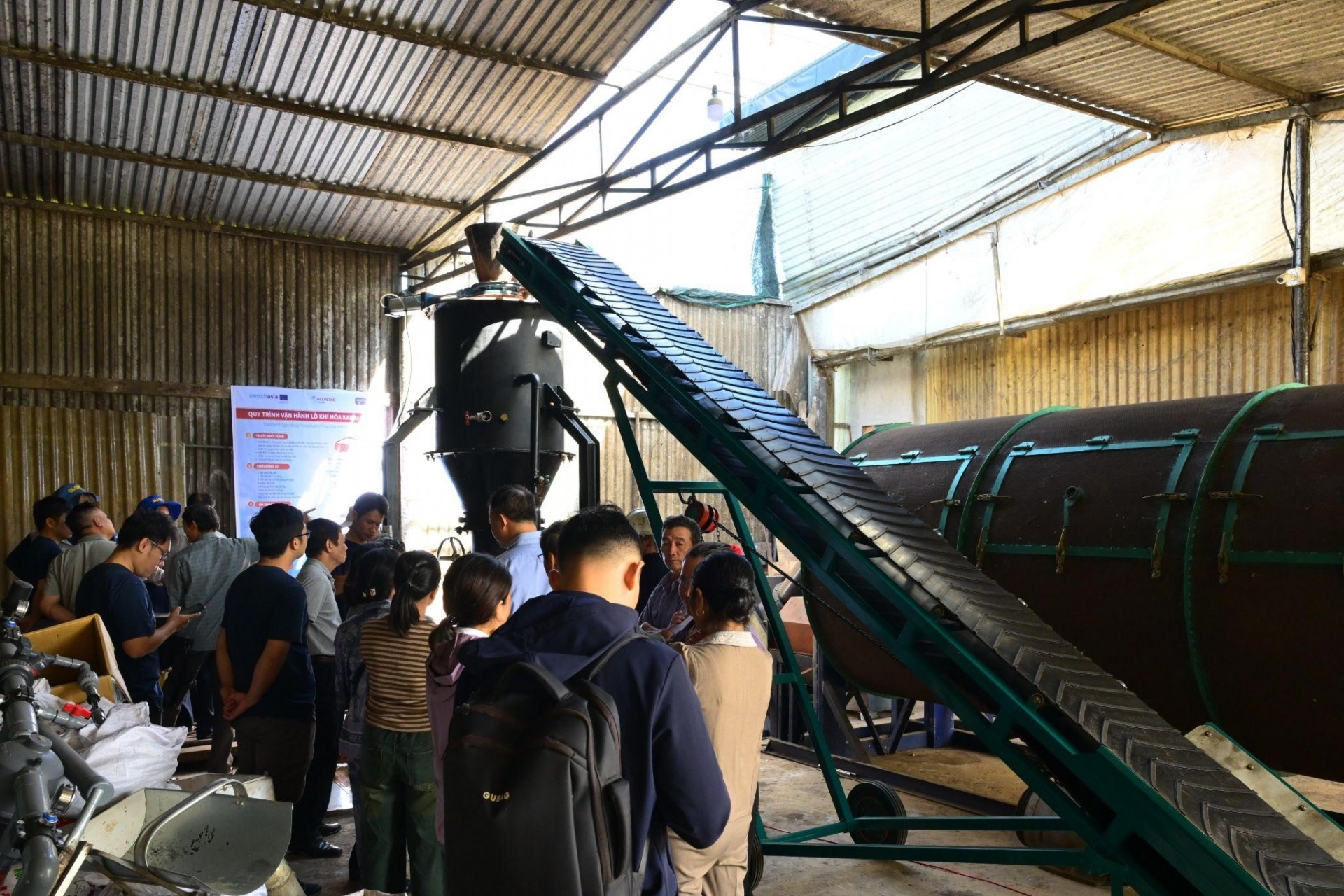 |
| The biochar gasification kiln model that utilises locally available agricultural waste has been warmly welcomed by local farmers |
This allows the cooperative to dry agricultural products continuously 24/7, with a capacity of 5-15 tonnes per batch, completely independent of weather conditions. The solution not only reduces energy costs but also helps maintain consistent crop quality, increasing value for farmers.
The “black gold” of sustainable agriculture
A key advantage of this technology is the production of biochar – a highly beneficial soil amendment. Biochar improves soil structure, enhances water retention, reduces nutrient loss, and lowers the need for chemical fertilisers. As a long-term carbon sink, biochar also contributes to climate mitigation by storing carbon in the soil for decades or even centuries.
The biochar gasification system showcases a practical model of circular agriculture, where by-products are converted into valuable inputs instead of being discarded. Drying operations are powered by clean energy generated onsite, helping cut both costs and emissions. The process also produces biochar – a high-value material used for soil regeneration or commercial purposes.
The system is simple to operate and can be seamlessly integrated into existing drying facilities, making it highly scalable across other commodity chains such as cashew, pepper, rice, and cassava. Altogether, this approach lowers farmers' expenses, enhances crop quality, and increases their overall income.
 |
| Biochar obtained from a gasifier is of high quality and useful for circular agriculture |
Pham Van Luong, country director of Helvetas Vietnam, emphasised, “This initiative reflects Helvetas' broader efforts to promote more sustainable and circular practices in Vietnam's agricultural sector. The model offers a practical way to make better use of local resources, improve production efficiency, and reduce environmental impacts.”
Nguyen Hong Thuong, director of Nhat Tam Cooperative, shared, "Each year, our cooperative dries hundreds of tonnes of agricultural products. In the past, we consumed a lot of fuel and wasted large amounts of post-harvest residues. With the new gasifier, we can now make use of cocoa husks, coffee husks, macadamia shells, and rice husks as clean fuel, while also producing biochar to enrich our soil. Farmers are excited because it helps us cut costs and creates additional value for production."
Duong Van Truc, director of Saigon Clean Water and Environment Co., Ltd. – the project's technical partner – added, “Compared with drying systems powered by electricity or gas, the biochar gasification can cut operational costs by up to 75 per cent, with a payback period of only about four months. Compared with firewood drying, it saves around 40 per cent in costs, with payback achieved in approximately nine months. This technology delivers tangible benefits both economically and environmentally.”
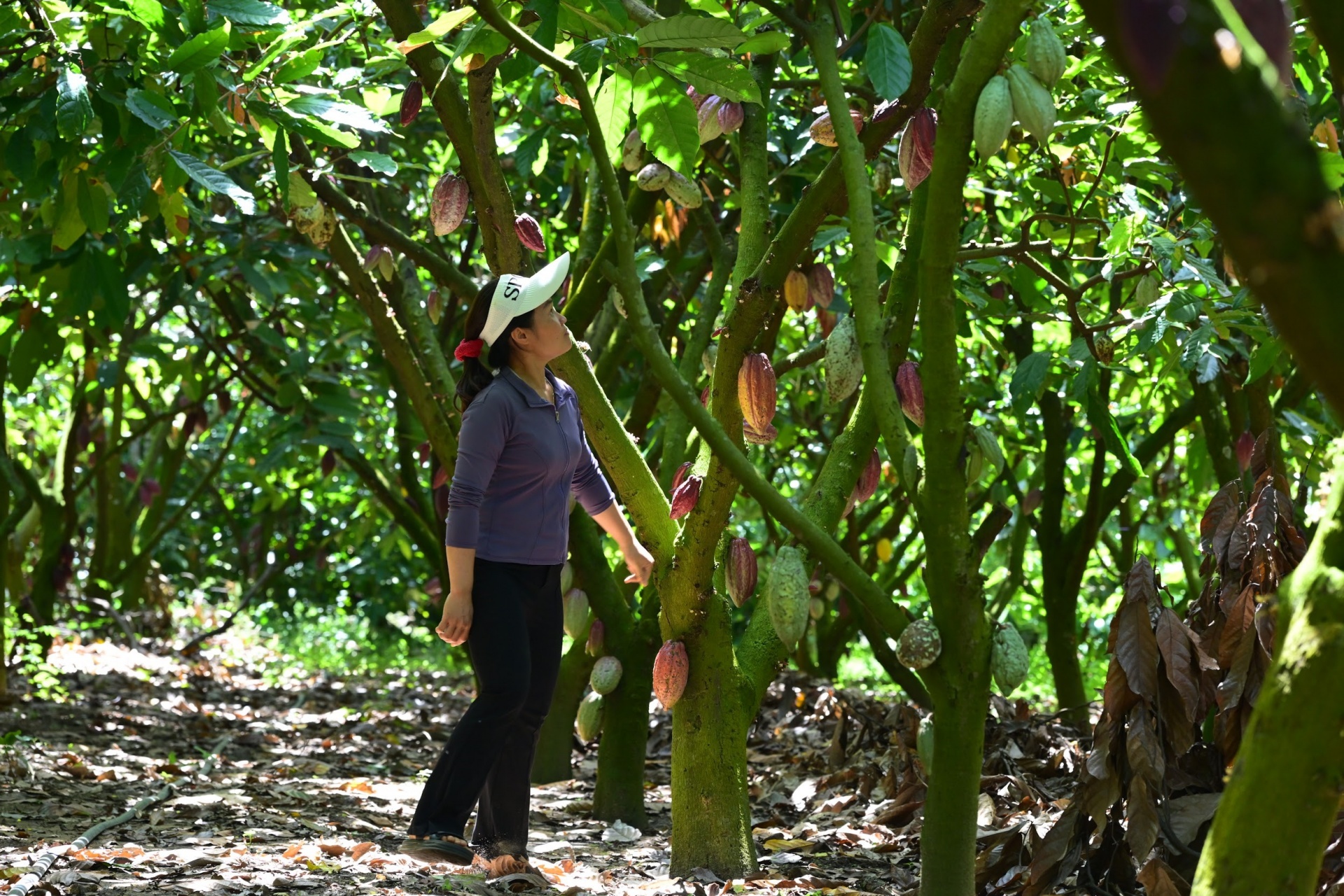 |
| Circular agriculture is opening up new opportunities for Vietnamese cocoa farmers |
The integrated biochar gasification kiln and heat transfer system at Nhat Tam Cooperative is one of the first circular economy demonstration models of its kind in Vietnam. By combining modern gasification technology with abundant local residues, the model proves that circular agriculture is entirely achievable at the cooperative level.
This is not simply a technological improvement – it is a pathway that empowers farmers to take control of their energy needs, enhance product quality, and shift towards more sustainable production practices.
 | South Korean enterprises show interest in developing green agriculture in Vietnam An increasing number of South Korean entrepreneurs are turning their attention to Vietnam, believing in the country's economic growth potential and its goals for green and low-emission agricultural development. |
 | Thai researchers turn food waste into biochar A team of researchers from the King Mongkut's University of Technology Thonburi (KMUTT) has devised a technique for turning two types of food waste into fuel comparable to low-grade coal, the Thai media has reported. |
 | DFCD backs HUSK to scale biochar-based fertiliser solutions in Vietnam and Cambodia The Dutch Fund for Climate and Development (DFCD) has approved origination support for HUSK, a pioneer in biochar-based fertilisers, to expand sustainable soil regeneration solutions for smallholder farmers across Vietnam and Canada. |
What the stars mean:
★ Poor ★ ★ Promising ★★★ Good ★★★★ Very good ★★★★★ Exceptional
 Tag:
Tag:
Related Contents


Latest News



More News
- AMATA congratulates Kao Vietnam on 30 years (October 21, 2026 | 14:17)
- Deputy Minister of Finance meets Gujarat delegation in Hanoi (October 21, 2026 | 12:11)
- Vietnam and US discuss financial cooperation and preparations for APEC 2027 (October 21, 2026 | 12:07)
- Vietnam and Denmark sign MoUs to strengthen bilateral ties (October 21, 2026 | 08:00)
- Vietnam and Liechtenstein sign double taxation avoidance agreement (October 19, 2026 | 18:08)
- Creative Young Entrepreneur 2026 showcases five young businesses (October 19, 2026 | 17:59)
- IEAE Hanoi 2026 to spotlight smart electronics trends (October 19, 2026 | 17:44)
- Vietnam and EFTA member states sign free trade agreement (October 19, 2026 | 13:10)
- TC-HICT handles over 8.2 million TEUs since 2018 launch (October 17, 2026 | 16:56)
- Vietnam transforming AI ambitions into business impact (October 16, 2026 | 18:01)



Latest News




 Mobile Version