
Brazil seen as alternative export market as global shipping in turmoil

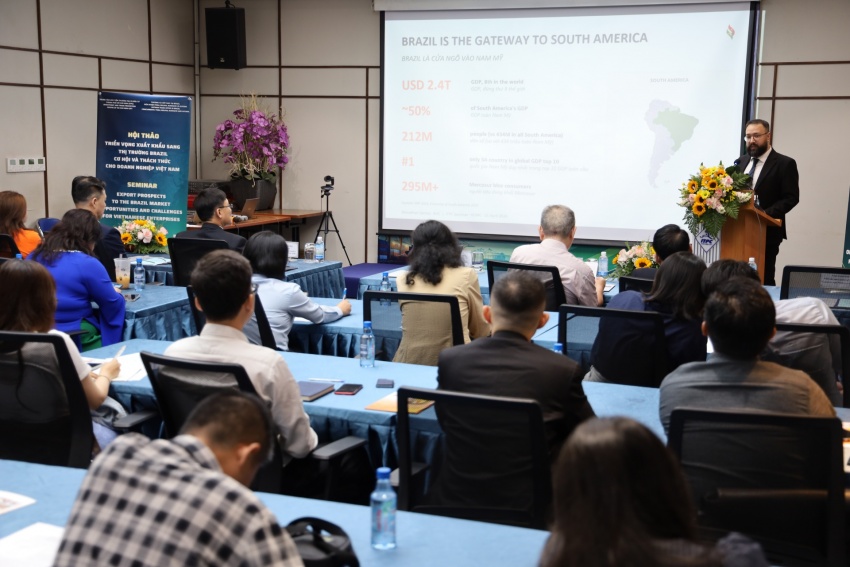
The call came at a seminar on opportunities and challenges in exporting to the Brazilian market, held in Ho Chi Minh City on April 21.
Le Anh Hoang, deputy director of the Ho Chi Minh City Investment and Trade Promotion Centre, explained that Latin America’s largest economy, with a population of over 200 million, represents a dynamic destination with strong purchasing power and relatively limited direct exposure to global hotspots.
“As the country’s leading economic engine, contributing 21 per cent of total national export turnover, Ho Chi Minh City is committed to supporting businesses in enhancing competitiveness and exploring new growth spaces,” Hoang said.
Pham Hong Trang, Vietnam’s Trade Counsellor in Brazil, noted that the country is not just a large consumer market, it is also a strategic gateway for Vietnamese goods to access the broader Southern Common Market (MERCOSUR).
She also highlighted strong growth potential in Vietnam’s key export categories, including seafood, processed foods, textiles and garments, and electronic components.
At the same time, she cautioned exporters about Brazil’s stringent technical barriers and trade defence measures.
“Imported goods face relatively high tariffs as they fall outside the MERCOSUR bloc, along with mandatory Portuguese labelling requirements and a range of complex sector-specific certifications such as MAPA for agricultural and aquatic products, ANVISA for medical and cosmetic products, and INMETRO for industrial goods,” Trang explained.
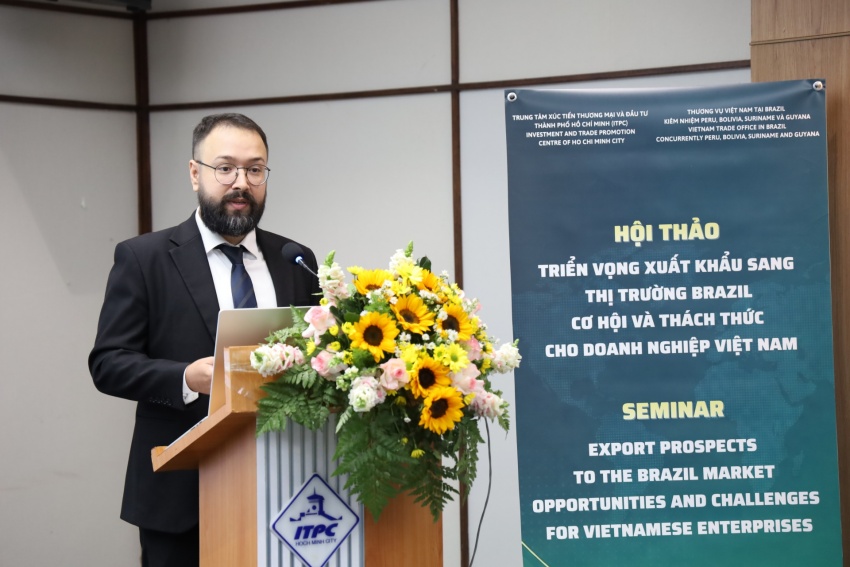 |
| Dionathan Santos, executive president of the Brazil-Vietnam Chamber of Commerce |
Providing more in-depth insights into local buyer behaviour, Dionathan Santos, executive president of the Brazil-Vietnam Chamber of Commerce, underscored the strong appeal of the world’s eighth-largest market, with a GDP of $2.4 trillion.
He pointed out that foreign companies are not permitted to handle customs clearance independently in Brazil.
"As a result, exports to Brazil can only be conducted on terms where the buyer takes responsibility for port procedures – such as Free On Board (FOB) – while Cost, Insurance and Freight, Cost and Freight, and Delivered Duty Paid terms are entirely inapplicable," Santos said.
Consequently, local importers must bear additional operating, tax, and warehousing costs that can increase by 60 to 100 per cent compared to the initial FOB price, creating pressure in price negotiations.
“We strongly recommend that exporters utilise Brazil’s public government databases to verify partner credentials and begin with small-scale orders to gradually test the market,” Santos advised.
Addressing the complexities of logistics and supply chain operations, Le Tran Nhat Phuong, deputy CEO of Bee Logistics Corporation, outlined cost optimisation scenarios for shipping routes between Vietnam and Brazil.
He also warned of risks associated with long transit times and significant fluctuations in destination port charges, such as demurrage fees.
To ensure trade security and maintain stability, Phuong noted that current maritime routes are increasingly structured to pass via the Cape of Good Hope instead of the Strait of Hormuz, thereby minimising geopolitical risks.
“The success of a shipment to Brazil depends on base freight rates and the high accuracy of documentation, particularly the consistency of product classification codes and the importer’s tax identification number,” he explained.
Brazil is currently Vietnam’s largest trading partner in Latin America, while Vietnam is one of Brazil’s leading partners in Southeast Asia.
Bilateral trade has maintained strong growth momentum, reaching approximately $8 billion in 2025, of which Vietnam’s exports to Brazil accounted for around $2.7 billion.
However, this performance is still not commensurate with Brazil’s substantial annual import demand, estimated at $250–$300 billion. The gap is largely attributed to geographical distance, high logistics costs, and complex domestic technical standards.
Looking ahead, both countries aim to elevate bilateral trade to $15 billion by 2030, paving the way for a promising new phase of economic cooperation.
 |
 | Vietnamese State President holds talks with visiting Brazilian counterpart Brazilian President Luiz Inácio Lula da Silva emphasised that his visit aims to reaffirm Brazil’s commitment to strengthening its strategic partnership with Vietnam as part of its broader policy to enhance relations with ASEAN and the Asia-Pacific region. |
 | Brazil’s JBS to inject $100 million to build two meat factories in Vietnam Brazilian meatpacker JBS on March 31 announced a $100 million investment plan for the construction of two factories in Vietnam, a move aimed at expanding its presence in the region and strengthening its position in the global market. |
 | US agriculture secures greater market access in Vietnam, Thailand, and Brazil US Secretary of Agriculture Brooke L. Rollins on June 6 announced American agricultural producers will have greater market access to Vietnam and Thailand and maintained access to Brazil. |
What the stars mean:
★ Poor ★ ★ Promising ★★★ Good ★★★★ Very good ★★★★★ Exceptional
 Tag:
Tag:Related Contents




Latest News




More News
- Expanding education partnerships to drive mutual growth (October 06, 2026 | 16:04)
- VTG 2026 to showcase textile and footwear innovation in Ho Chi Minh City (October 06, 2026 | 16:00)
- Infineon boosts Vietnam footprint with Ho Chi Minh City office (October 06, 2026 | 10:02)
- Vietnam Customs expands priority enterprise scheme to 74 firms (October 03, 2026 | 08:00)
- ASL Law opens Danang office (October 02, 2026 | 22:12)
- Project ACTIVE 2.0 launches in Vietnam to boost cervical cancer care (October 02, 2026 | 22:02)
- Vietnam launches first embodied AI conference to advance robotics ecosystem (October 02, 2026 | 17:00)
- DKSH Performance Materials – A trusted partner in Vietnam’s evolving personal care landscape (October 02, 2026 | 14:28)
- Ghanaian delegation reviews PSL Machinery’s cashew factory-management and implementation roadmap (October 02, 2026 | 10:18)
- People living with chronic kidney disease and diabetes should be aware of infectious disease risks (September 30, 2026 | 18:00)


Latest News




 Mobile Version