
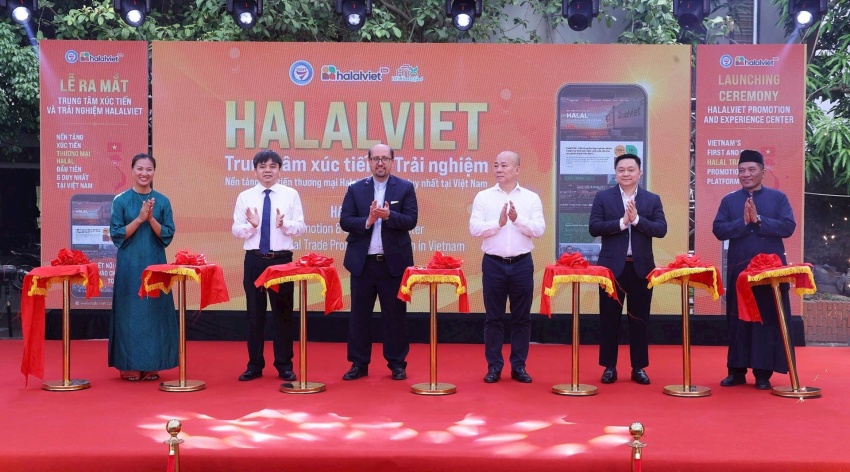
HalalViet centre launched to help Vietnamese firms tap global market

The establishment of the centre comes as the global Halal market enters a period of rapid expansion, driven by rising demand for certified products and increasingly stringent standards across sectors ranging from food and cosmetics to pharmaceuticals, tourism, logistics, and e-commerce.
According to Nguyen Van Hoi, director of the Institute for Strategic and Policy Studies on Industry and Trade, the centre is expected to serve not only as a trade promotion venue, but as a platform linking businesses, scientists, experts, international organisations, and consumers.
“The formation of the centre is an important step towards developing Vietnam’s Halal industry professionally and sustainably,” Hoi said. “We also plan to propose the inclusion of Halal promotion activities in the national trade promotion initiative, which would help mobilise more state resources to support enterprises and international market connectivity.”
The move reflects growing recognition that participation in the global Halal value chain requires more than competitive pricing or abundant supply. Businesses must also meet strict requirements related to certification, traceability, food safety, and compliance with sanitary and phytosanitary standards.
The global Halal market is estimated to have surpassed $8 trillion and is forecast to reach $10 trillion before 2028. Food products account for around 65 per cent of the market and continue to record annual growth rates of more than 10 per cent, supported by a global Muslim population of approximately two billion people.
Vietnam is considered well-positioned to participate more deeply in this ecosystem thanks to its strong agricultural production base, improving manufacturing capacity, and strategic location within ASEAN, which offers direct connectivity to major Halal markets in the Middle East and Asia.
 |
However, industry experts said the country’s biggest issue lies in its ability to satisfy market-specific standards and certification systems rather than in production capacity itself.
To address those challenges, the centre has been designed as a multi-functional platform providing consulting services on standards, certification, and competitiveness improvement for enterprises and cooperatives. It will also feature product showcases and cultural experience spaces aimed at introducing Vietnamese Halal products to international buyers and consumers.
One notable component is the planned development of the HalalViet.com e-commerce platform, which is expected to facilitate both business-to-business and business-to-consumer transactions in overseas markets.
Alongside the launch event, an international scientific seminar focused on key issues shaping the Halal industry, including changing consumer trends, technical barriers, traceability requirements, and solutions for building transparent supply chains through innovation and digital transformation.
Vu Ba Phu, director general of the Trade Promotion Agency under the Ministry of Industry and Trade, said many Vietnamese enterprises still view Halal simply as a certification label rather than a comprehensive production and management system.
“The Halal market extends far beyond food products into cosmetics, fashion, logistics, finance, and various services,” Phu said. “With the global Halal economy estimated at $2.5-3 trillion annually, the growth potential for Vietnamese businesses remains enormous.”
He noted that Halal standards involve the entire value chain, including sourcing, processing, logistics, and distribution, meaning companies need to adopt a more holistic approach if they want to compete effectively.
Meanwhile, Imam Abbas Mieu said that there was currently no universal Halal certification framework applicable to all countries. Each market has its own requirements regarding management systems, inspection procedures, and Fatwa regulations.
“Vietnamese businesses need to understand the specific standards of each target market to develop suitable market-entry strategies,” Mieu said, adding that Vietnam possesses several advantages thanks to its neutral position and lack of cultural conflicts with Muslim-majority countries.
He also noted that Vietnam could potentially become a strategic bridge connecting ASEAN’s manufacturing capabilities with major Halal consumption markets in the Middle East.
Experts attending the seminar shared the view that the Halal sector could emerge as a new growth driver for Vietnam’s exports in the coming years, particularly as global demand continues to diversify beyond traditional markets.
They stressed that building a comprehensive Halal ecosystem, improving certification capacity, and developing integrated supply chains would be essential for enhancing the international competitiveness of Vietnamese enterprises.
The launch of the HalalViet Promotion and Experience Centre is therefore being viewed not merely as a standalone trade promotion activity, but as part of a broader strategy to position Vietnam more firmly within one of the world’s fastest-growing consumer economies.
What the stars mean:
★ Poor ★ ★ Promising ★★★ Good ★★★★ Very good ★★★★★ Exceptional
 Tag:
Tag:Related Contents


Latest News



More News
- Viettel Global posted 30 per cent revenue growth in Q1 (May 04, 2026 | 18:58)
- Indonesia-Vietnam retail chain EraBlue targets $790 million by 2030 (April 14, 2026 | 16:57)
- Vingroup explores $6.5 billion investment in India (April 13, 2026 | 14:13)
- Government clarifies conditions for overseas investment (April 08, 2026 | 10:43)
- Vietnam launches strategic push to elevate businesses globally (April 08, 2026 | 10:26)
- Outbound investments accelerate in Q1 (April 06, 2026 | 15:11)
- HAGL unveils 20,000-hectare regional coffee expansion plan (March 23, 2026 | 12:31)
- Oman remains stable investment source amid Middle East turmoil (March 12, 2026 | 15:10)
- Vietnam steps up overseas investment (March 09, 2026 | 15:24)
- First Vietnamese law firm establishes office in the US (March 06, 2026 | 08:00)


Latest News



 Mobile Version