These issues were in focus at a workshop on January 8 in Ho Chi Minh City, where industry players discussed how combining Autodesk’s Building Information Modelling (BIM) tools with the ISO 19650 standard can help Vietnamese firms meet rising project requirements. The event brought together a broad range of companies from the architecture, engineering, and construction (AEC) sector to share practical approaches to improving efficiency and collaboration.
Discussions highlighted that Autodesk’s BIM solutions are no longer limited to design work, but function as a shared platform for managing and standardising project data across the entire lifecycle. From early planning and design through construction and operation, this approach enables clearer information flow, better coordination among stakeholders, and closer alignment with international standards increasingly required on large and cross-border projects.
Organised by Tech Data (Datech Solutions Vietnam) in collaboration with Autodesk and BSI Vietnam, the event provided a platform for industry professionals to exchange insights on BIM implementation, data standardisation, and best practices for managing information across the entire lifecycle.
The workshop addressed a key concern shared by many AEC businesses as projects become larger and more complex, involving multiple stakeholders and stricter requirements for timelines, transparency, and information control. In this context, data inconsistencies can quickly lead to delays, cost overruns, and higher risks from the design stage onward.
The discussions highlighted the evolving role of BIM, from a design support tool to a data-driven platform that manages and connects information. When implemented within the Autodesk ecosystem and aligned with the ISO 19650 standard, BIM enables the standardisation of data, roles, responsibilities, and information exchange processes, allowing BIM in Autodesk to deliver real project efficiency and meet the growing demands of both domestic and international projects.
Nguyen Ngoc Cuong, solutions consultant at Tech Data Vietnam, shared practical insights into how Autodesk’s BIM solutions integrate technology, processes, and data, positioning BIM as a platform that delivers clear, measurable value across construction projects.
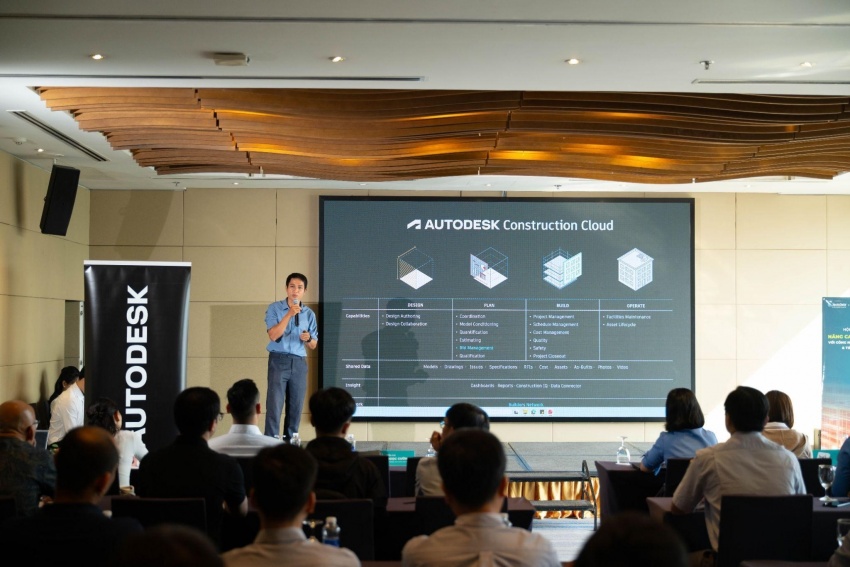 |
| Nguyen Ngoc Cuong, solutions consultant, Tech Data Vietnam |
Meanwhile, Vo Thi Thuy Huong, training director at BSI Vietnam, focused on standardising BIM capabilities under ISO 19650, outlining a roadmap from individual practitioners to organisation-wide adoption. She highlighted best practices in information management, training and certification, and the pathway to achieving BIM CoC and BIM Kitemark, offering businesses a clear framework for sustainable BIM implementation.
Through in-depth exchanges and discussions, the workshop provided AEC businesses with a comprehensive overview of BIM as a data management strategy, while clarifying the practical implementation roadmap by combining Autodesk technology with the ISO 19650 standard. Such an approach is increasingly seen as essential for Vietnamese enterprises to enhance competitiveness and meet the growing demands of both domestic and international projects amid the digital transformation of the construction industry.
 |
| Vo Thi Thuy Huong, training director, BSI Vietnam |
The event also featured interactive sessions that encouraged open discussion and closer engagement between speakers and participants.
The push for digital transformation in construction has accelerated since Deputy Prime Minister Tran Hong Ha signed Decision No. 2597/QD-TTg last November, approving a national scheme for digital transformation in construction activities.
The scheme targets completion of the legal framework for digital transformation in construction, infrastructure management, and operations by the end of 2026, alongside the issuance of standards and technical regulations covering data, digital platforms, BIM, the Internet of Things, and smart infrastructure management.
A national database on construction infrastructure is expected to be completed by the end of the year, enabling connectivity and data sharing with ministries, sectors, and local authorities. By 2030, the goal is to establish a smart digital infrastructure ecosystem linking management at central and local levels.
 | Why Vietnam must build a global strategy for its construction industry The prospect of Vietnamese enterprises becoming international general contractors has remained more an aspiration than a mainstream reality. Jerry Nguyen, board member and deputy general director of Investment and International Market Development at Hoa Binh Construction Group, looks at why, despite clear progress in domestic capabilities like strong engineering talent, competitive costs, and a growing building materials supply chain, the number of overseas projects led by Vietnamese groups as general contractors is still very limited. |
 | Major transport PPP projects open 2026 with strong investor interest A series of sizeable transport projects under the public private partnership (PPP) model across Ho Chi Minh City and southern region have been launched, drawing strong investor interest ahead of upcoming bidding rounds. |
 | Ho Chi Minh City starts construction of four key infrastructure projects Ho Chi Minh City commenced construction and held ground-breaking ceremonies for four key infrastructure and transport projects on January 15 with a combined investment of nearly VND240 trillion (more than $9.2 billion). |


 Tag:
Tag:
















 Mobile Version