
Aviation rethinks tactics after challenging period

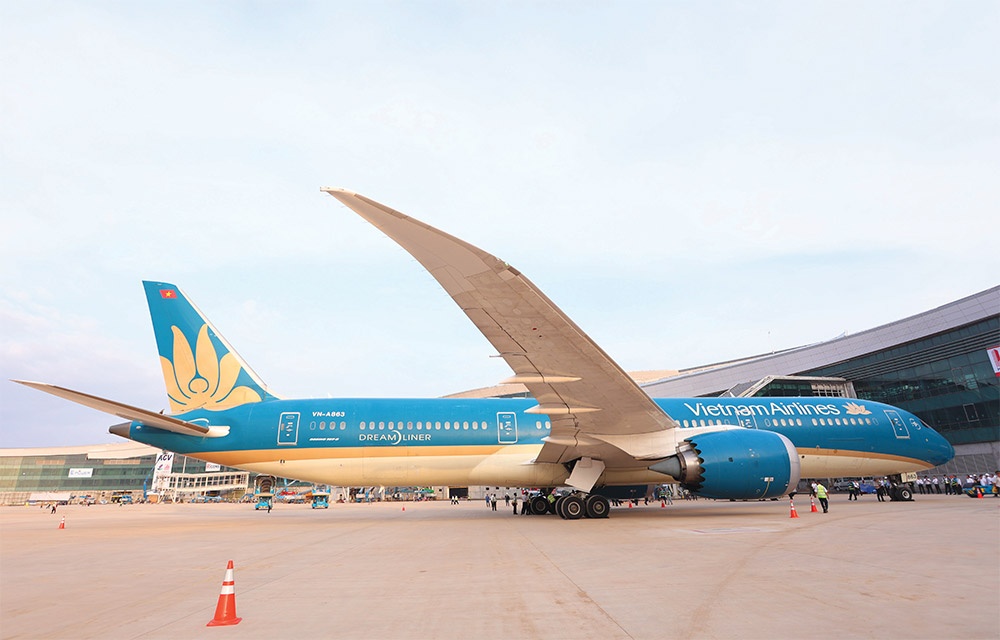 |
| More shifts to Southeast Asian supply chains can offer a business boost to aviation companies, Le Toan |
At last week’s Hanoi Aviation Forum, experts said that the global aviation industry is entering a cycle unlike any it has seen before. About 15,000-17,000 new aircraft are already on order from Airbus, Boeing and Comac, representing over a decade of guaranteed production and deliveries.
The surge in orders reflects a structural shift in global air travel, with Asia-Pacific expected to account for around 40 per cent of future aircraft demand.
New-generation aircraft such as the A320neo, 737 MAX, A350 and B787 are proliferating, alongside increasingly complex engines. At the same time, the global supply chain is under unprecedented strain. Tier 1 and Tier 2 suppliers are capacity-constrained, delivery delays stretch 12-18 months, and aircraft are grounded worldwide waiting for parts.
In this context, Vietnam is emerging as a potential solution to a global bottleneck. The question is whether Vietnamese businesses, especially in supporting industries, can move fast enough to seize them.
“If we look at the backlog of aircraft on order from Airbus, Boeing and Comac, there are more than 15,000 new aircraft on order. That is more than 10 years of deliveries for both Airbus and Boeing. There are not many industries where you have such stability and such long-term visibility,” said Michael Jones, managing director at Aerospace and MRO (maintenance repair and overhaul) at Progressional Aerospace in France.
This backlog is already reshaping supply chains. He said that original equipment manufacturers (OEMs) are missing delivery commitments. Engines have become a critical choke point. Aircraft-on-ground situations cost airlines thousands of US dollars per hour. Under these pressures, the traditional aerospace supply hubs in the US and Europe are no longer sufficient.
“Skilled labour shortages, geopolitical risks, and the lessons of the pandemic have pushed OEMs and Tier 1 suppliers to rethink single-source strategies,” he said.
The global aviation industry has an enormous economic value, with worldwide revenues reaching approximately $1 trillion in 2024 and 2025, generating an estimated $3.5 trillion contribution to global GDP. It supports millions of jobs, drives international trade and tourism, and is undergoing a profound transformation driven by AI and sustainability.
Beyond passenger transport, the industry also encompasses logistics and maintenance, with strong growth potential fuelled by the recovery in travel demand and broader socioeconomic factors.
Promising entry point
The global civil aircraft manufacturing industry is projected to be worth around $1 trillion, driven primarily by demand for new aircraft, the recovery of tourism, and the shift of manufacturing activities towards the Asia-Pacific region.
Supply chain resilience has become as important as cost. Dual- and multi-sourcing are strategic imperatives. Frédéric Lagarnier, vice president of Industrial Performance and Supply Chain at SNECI, a company specialising in consulting and services for industry, said, “Today, single sourcing cannot be a standard in the industry. Aerospace and aviation are increasing. They will need new suppliers, and Southeast Asia and Vietnam are very well placed for that.”
Vietnam’s relevance lies here, Lagarnier said, as it already hosts a strong manufacturing base in electronics, automotive, medical devices and precision engineering. Quality systems, process control and traceability, often seen as barriers to aerospace, are not foreign concepts. He added that what is missing is not capability, but certification, relationships, and scale.
From aluminium machining and high-tech extrusion to composite parts and electronics, Vietnam has pockets of competence that can be transferred into aerospace. “I visited some industrial plants in Vietnam. I know exactly the heritage, and it is strong. Vietnam already has good players. The question is how they leverage themselves to become regional and, why not, worldwide players,” Lagarnier said.
He added that MRO offers a particularly promising entry point. Unlike aircraft manufacturing, MRO is highly regionalised: fast turnaround time, proximity to airlines, and competitive pricing matter more than proximity to OEM headquarters.
“With Asia-Pacific forecast to account for 40 per cent of global air traffic by 2030, MRO capacity in the region is already lagging demand,” he said. “Vietnam’s location, modern airports and growing fleets position it well to capture this segment, while simultaneously building the quality culture and certifications needed for deeper manufacturing participation.”
The challenge Vietnam faces today is not unique. Two decades ago, Morocco stood at a similar crossroads. It had no aerospace industry to speak of, yet within 25 years it built a globally integrated aerospace hub. The turning point, according to Stéphane Castet, CEO of Advanced Business Events in France, was strategic coordination.
“Firstly, they decided to create a National Association,” Castet recalled. “A national association or national cluster is crucial because it is one voice and part of a network. When you have a national association, you can share solutions, competencies, services, and products.”
This collective approach allowed Morocco to move beyond isolated investments. Strategic partnerships followed to systematically upgrade local suppliers. “The Moroccan government signed partnerships with aerospace companies to develop the supply chain, not just technology transfers or building factories, but agreements to help companies increase their level of competency and quality to become aerospace suppliers,” Castet added.
Infrastructure, incentives, and human capital completed the picture. Dedicated aerospace industrial zones, tax and land incentives, and heavy investment in ports, airports and transport created the physical backbone. Training programmes and specialised schools, developed in partnership with OEMs and Tier 1 suppliers, ensured a steady pipeline of certified talent.
Castet stated that Vietnam already has many of these ingredients. Massive infrastructure investment is underway; the workforce is young, skilled, and cost-competitive; and the country sits within easy reach of the region’s established and fastest-growing aviation markets.
“Vietnam has all the assets to become a regional aerospace hub,” Castet said. “You have a skilled and competitive workforce, modern infrastructure, and a strategic geographical position serving the entire Asian market.”
Potential to participation
However, Nguyen Van, vice chairman of the Hanoi Supporting Industry Business Association, said that what remains missing is orchestration. Supporting industry enterprises, especially small- and medium-size enterprises, often operate in isolation, with limited visibility into aerospace requirements and no clear pathway to certification.
“Domestic enterprises currently meet only around 10 per cent of aviation-related demand, mostly in low-value components. Without stronger links, research and development investment, and also coordinated policy, this gap will persist,” Van explained.
Pierre-Yves Reville, CEO of PR Aero Consult, noted that equally important is focus. “Not every company can, or should, do everything,” Reville said. “Vietnam’s supporting industries should target niches aligned with existing strengths, precision machining, electronics, composites, tooling, software, and increasingly, digital solutions for forecasting and inventory optimisation.”
Better anticipation of demand through IT tools can directly address aircraft-on-ground situations and supply chain inefficiencies, he said.
“Partnerships are the multiplier and aerospace is a team sport,” Reville said. “OEMs, Tier 1s, airlines, MRO providers and regulators operate within tightly integrated value chains.”
Vietnamese firms must plug into these networks early, often through joint ventures, long-term supply agreements or co-development programmes. The government has a critical role in convening stakeholders, mapping capabilities and elevating industrial maturity across Tier 1, 2 and 3 suppliers, Reville added.
| Last week, Hanoi People’s Committee approved the Supporting Industry Development Programme for the 2026-2030 period, with a vision to 2035, aimed at enhancing the capabilities of domestic enterprises, expanding links with foreign-invested enterprises, and enabling deeper participation in global supply chains. Priority sectors include smart electronics, automobiles, mechanical engineering and automation, and high technology, alongside efforts to develop human resources and strengthen capacities in research, design, technology transfer, and digital transformation. By 2030, Hanoi targets around 1,200 supporting industry enterprises, with more than 40 per cent achieving international standards in production systems and products; by 2035, the number is expected to reach approximately 1,400 enterprises, of which about 45 per cent will meet international standards. Each year, an estimated 200-500 supporting industry enterprises and manufacturers of key industrial products are expected to receive support and benefit from policy incentives. |
What the stars mean:
★ Poor ★ ★ Promising ★★★ Good ★★★★ Very good ★★★★★ Exceptional
 Tag:
Tag:Related Contents



Latest News






More News
- Thanh Hoa urged to remove obstacles to Cong Thanh LNG project (October 23, 2026 | 10:14)
- Vietnam pledges transparent tax and customs policies for South Korean businesses (October 23, 2026 | 10:08)
- KUKA Vietnam inaugurates new Hanoi headquarters (October 22, 2026 | 09:00)
- OJI Group invests in $110 million aseptic carton packaging plant in Vietnam (October 22, 2026 | 08:23)
- EVN begins construction on the Quang Trach II LNG plant (October 22, 2026 | 07:00)
- Foreign investors pour billions into Vietnam's semiconductor sector (October 21, 2026 | 14:49)
- Hyosung TNC begins bio-BDO production in Vietnam (October 21, 2026 | 12:12)
- Ho Chi Minh City to unveil new projects worth $13.5 billion at AEF 2026 (October 21, 2026 | 11:51)
- Market upgrade is just the beginning: Vietnamese companies face tougher test to attract capital (October 20, 2026 | 16:04)
- EFTA–Vietnam Free Trade Agreement opens up opportunities to enhance supply chain (October 20, 2026 | 15:56)






 Mobile Version