
AI banking reshapes future of finance

On May 8, the Vietnam Blockchain and Digital Asset Association (VBA), the ABAII Institute, Nam A Commercial Joint Stock Bank, and Quang Trung University co-hosted the seminar “Fintech - Catching market trends, shaping careers.”
The event formed part of the ABAII Unitour programme, which promotes knowledge of blockchain and AI while supporting ABAII’s ambition of reaching one million learners.
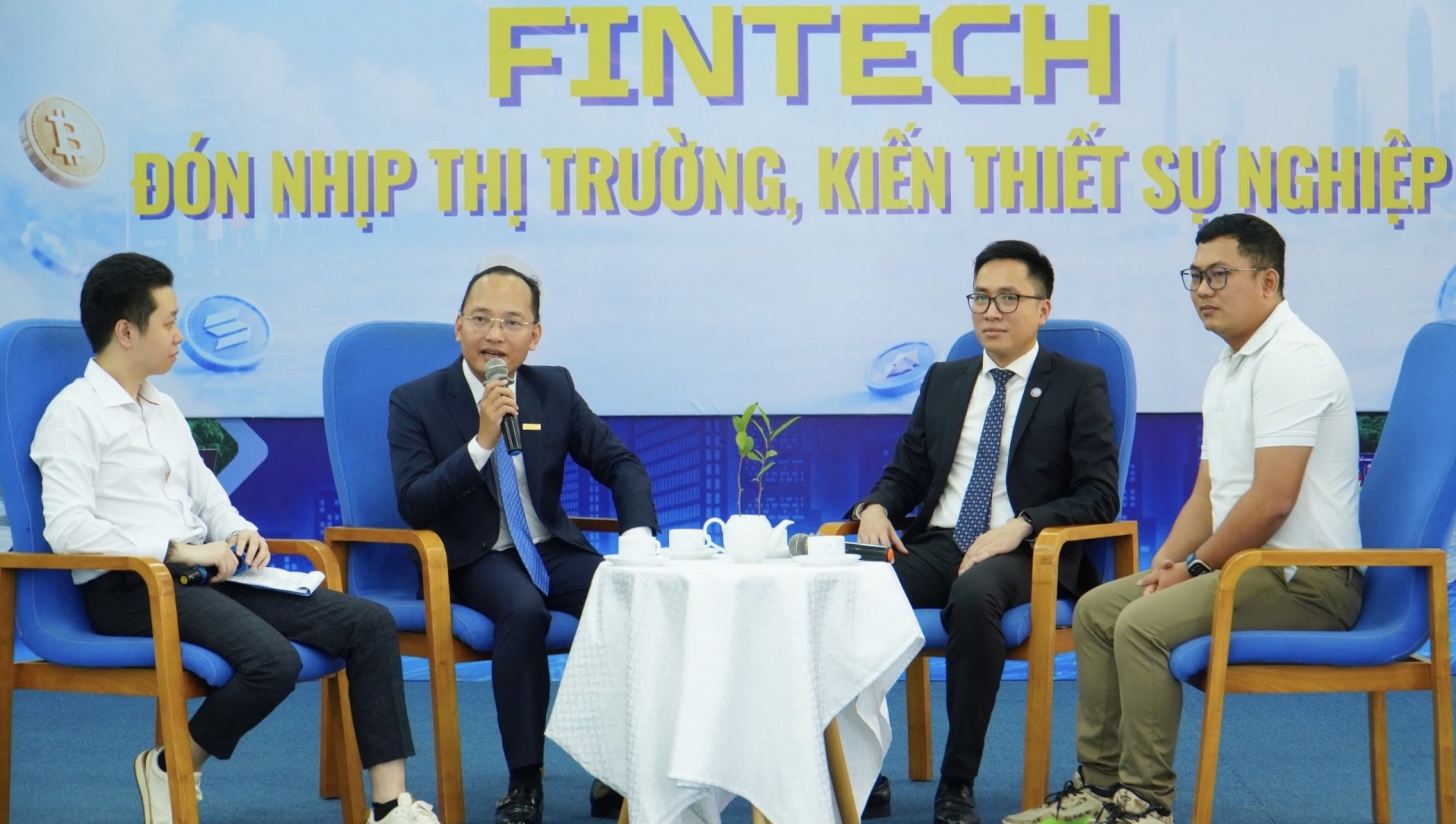 |
| The discussion session drew strong interest from attending students |
Opening the seminar, Dr To Ba Lam, rector of Quang Trung University, said fintech, AI, and blockchain were reshaping the way banks, businesses, and labour markets operate.
“In this context, education should not simply follow technological change, but develop alongside it, and in some cases move ahead of it,” he said.
The university is strengthening partnerships with businesses and the wider technology ecosystem while developing fintech-related training programmes aimed at equipping students with digital skills, adaptability, and career orientation aligned with market demand.
From a policy perspective, Tran Viet Hung, former deputy chief of the Party Central Office and senior adviser to the VBA, said Vietnam was entering a period of accelerated development in strategic technologies supporting the digital economy and national digital infrastructure.
According to Hung, blockchain development has been prioritised through a series of critical Politburo resolutions and government decisions.
“These policies demonstrate that fintech, AI, blockchain, and digital data will play an increasingly important role in the next phase of Vietnam’s financial market development,” Hung said.
Tran Huyen Dinh, head of the VBA’s Fintech Application Committee, noted that the financial sector was entering a new era of payment infrastructure restructuring driven by AI, blockchain, and stablecoins.
According to Dinh, banking is shifting from the mobile banking era towards AI banking, where AI agents may eventually conduct transactions on behalf of users through programmable financial systems.
Data from Artemis, Visa Onchain Analytics, CEX.IO, and Chainalysis shows that global on-chain stablecoin transaction volumes reached around $33 trillion in 2025, up from $27.6 trillion in 2024, surpassing the combined payment volumes of Visa and Mastercard for the first time.
Stablecoin transactions have risen from just $3.3 billion in 2018 to $33 trillion in 2025, signalling the emergence of a new global payment infrastructure.
“Bloomberg Intelligence forecasts that by 2030, stablecoins could account for around 25 per cent of global cross-border capital flows, equivalent to approximately $55 trillion annually,” Dinh said.
He added that these developments would significantly increase demand for talent capable of combining finance, data analysis, AI, and blockchain expertise.
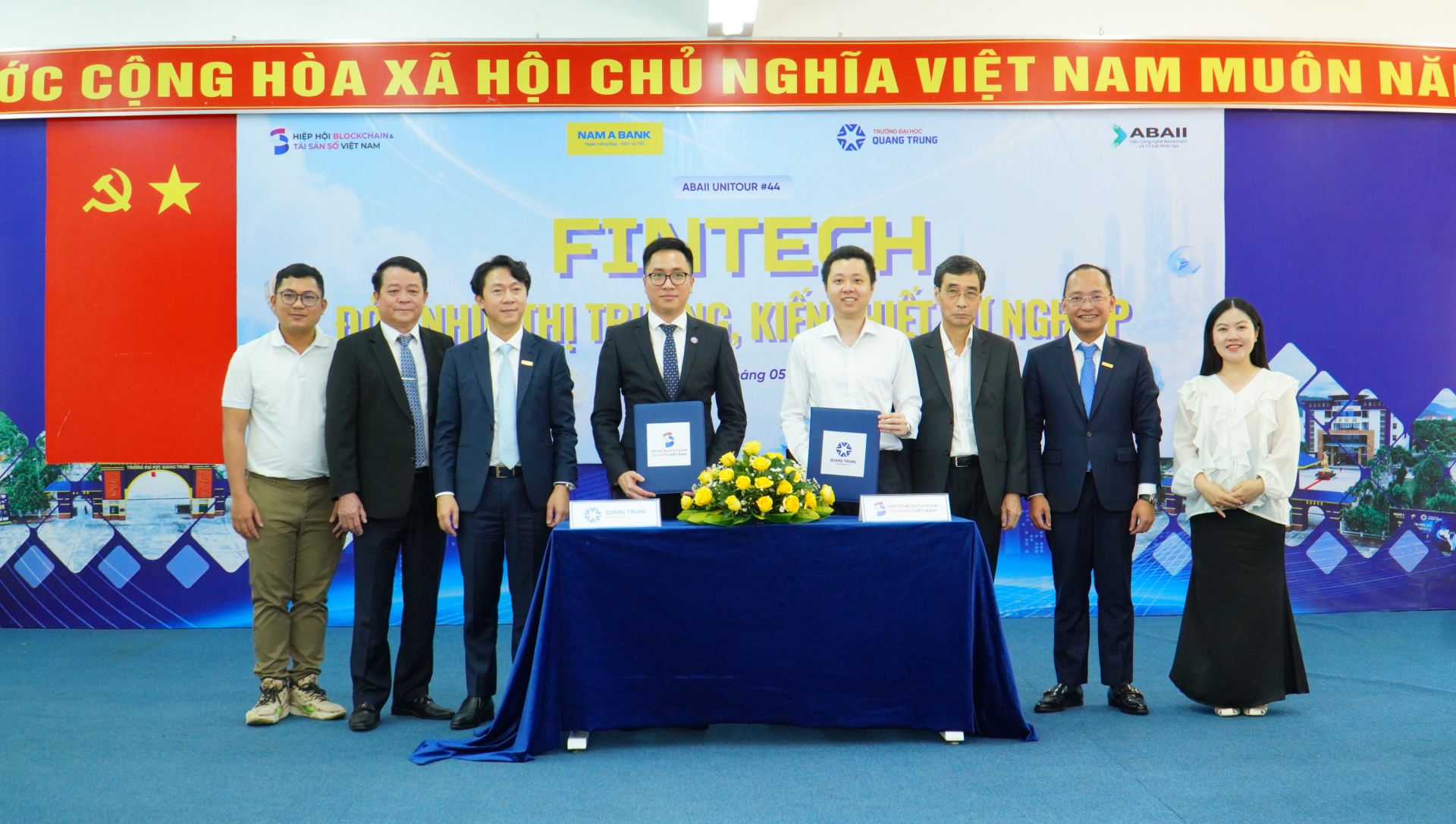 |
| Tran Huyen Dinh of the Vietnam Blockchain Association, and Dr. To Ba Lam, rector of Quang Trung University, signed an MoU to strengthen cooperation in blockchain and fintech training |
Representing Nam A Bank, deputy CEO Nguyen Vinh Tuyen said technologies such as mobile banking, open APIs, eKYC, e-wallets, and buy now, pay later services have fundamentally reshaped customer expectations.
As a result, banks are no longer focused solely on digitising services but are also restructuring operational models and technology architecture.
“We are moving from the mobile banking model of the past decade towards AI banking, where AI is becoming the brain of digital banking,” Tuyen said. “AI enables financial institutions to strengthen data analytics, understand customers more deeply, and make smarter decisions.”
However, he stressed that people would remain central to the process. “Human resources still play the decisive role in operating and taking responsibility for the entire system. Improving workforce capabilities and preparingfor the next financial race will be essential for survival,” he added.
Nam A Bank representatives also noted that the current fintech wave went beyond traditional digital transformation. Instead of simply putting services online, banks are increasingly adopting open operating models, in which open banking and APIs allow financial institutions to become service layers within a wider digital financial ecosystem.
Human resources became a major focus during the discussion session on “Fintech, AI, and career mapping in the digital finance era”.
Vo Thanh Thien Toan, chief technology officer of DecomStars, said the key difference between understanding technology and building practical products lies in the ability to address operational problems, analyse data, and understand business needs.
He argued that students should develop systems thinking, data-processing skills, and practical product deployment capabilities from an early stage.
During the event, the VBA and Quang Trung University signed an MoU to encourage research into blockchain, digital assets, and fintech, while expanding specialised training and strengthening links between universities and the digital technology business ecosystem.





What the stars mean:
★ Poor ★ ★ Promising ★★★ Good ★★★★ Very good ★★★★★ Exceptional
 Tag:
Tag:Related Contents




Latest News


More News
- SSI chairman shifts stance on digital assets, eyes market entry (April 24, 2026 | 12:29)
- CAEX partners with HashKey to build an international-standard digital asset exchange in Vietnam (April 22, 2026 | 19:21)
- OKX Ventures and HashKey invest in Vietnam crypto exchange CAEX (April 10, 2026 | 16:07)
- Digital asset boom drives need for tech talent (April 01, 2026 | 18:14)
- Sun Group takes controlling stake in Vietnam Digital Asset JSC (March 17, 2026 | 11:54)
- 0.1 per cent tax proposed on each transfer of digital assets (February 05, 2026 | 17:27)
- Pilot digital asset exchanges to be licensed by mid-January (January 08, 2026 | 10:38)
- Promoting digital assets initiative in Vietnam (December 13, 2025 | 09:30)
- Vietnam establishes management board for crypto asset trading market (December 11, 2025 | 18:11)
- Tether explores investment prospects in Vietnam’s digital asset sector (October 10, 2025 | 18:09)








 Mobile Version